Gardens don’t stand still. As our gardens change and evolve with time, the maturing of permanent trees means shrub borders benefit from a review and revamp every few years, to keep them looking at their best.
My current makeover project is a long border that runs alongside a boundary hedge of leylandii ‘Leyland cypress’. The hedge was planted over 40 years ago and is maintained at about 2.5 metres height. The border is south facing but is shaded in parts by nearby specimen trees and shrubs.
Growing conditions along the bottom of any hedge tend to be notoriously dry and often shady, but the worst is a leylandii hedge, which creates dusty, dry soil that is often depleted of nutrients and congested with the competing roots of the hedge. Because of this increasingly challenging growing environment, several extensive gaps have emerged in this border where plants have failed and now is an ideal time for us to tackle replanting these areas.
Spring and autumn were once considered equally good times for planting perennials, shrubs and trees. However, recent years have yielded some prolonged periods of very dry spring weather, making it difficult for new plants to establish. This means that autumn, which generally has more reliable rainfall, is becoming a better time for planting.
Our first step was to assess the existing plants that are doing well in the border while ruthlessly digging out any plants that are not thriving, either potting them up for later planting elsewhere or immediately moving them to more suitable locations.
Existing plants which have stayed the course in the dry and shady areas of the border include pulmonaria (lungwort), comfrey, spreading colonies of sweet woodruff and convallaria (lily of the valley), lamium orvala (deadnettle) and brunnera macrophylla ‘Betty Bowring’ with dainty sprays of bright white flowers, borne in spring, above heart-shaped, green leaves. Some hardy geraniums are also thriving, particularly varieties of Geranium nodosum and G. macrorrhizumwhile a patch of native woodrush, Luzula sylvatica, has evolved into an attractive ground cover, forming dense tufts of glossy, dark green linear leaves.
After weeding the border and pruning some of the shrubs that had become a bit overgrown, we prepared the soil in areas to be replanted by incorporating plenty of our own well-rotted garden compost to improve quality and moisture retention. If you don’t have access to garden compost or your soil is very poor, consider raking in a potassium-rich general fertiliser at 70g per square metre.
Planting options
While planting options are more limited for conditions along the base of a hedge, there is still a good range of plants that will thrive in this tricky situation, provided they are kept well-watered and mulched in their first year of settling in.
To replant some of the gaps where the soil is particularly parched and congested with roots, epimediums are my go-to plant, especially old stalwart varieties such as Epimedium x rubrum and E. x perralchicum ‘Fröhnleiten’, which are more drought tolerant and resilient than newer introductions. Epimediums are great low-maintenance perennials and they associate well in dry shade with evergreen perennials like hellebores, bergenias, Iris foetidissima and the vigorous-growing, evergreen wood spurge, Euphorbia amygdaloides var. robbiae reveals vivid lime flowers in late spring. Lily turf, Liriope muscari, is another tough perennial that copes even in the darkest and driest of conditions. Its purple blooms are an asset in autumn, rising above the evergreen, strap-like leaves.
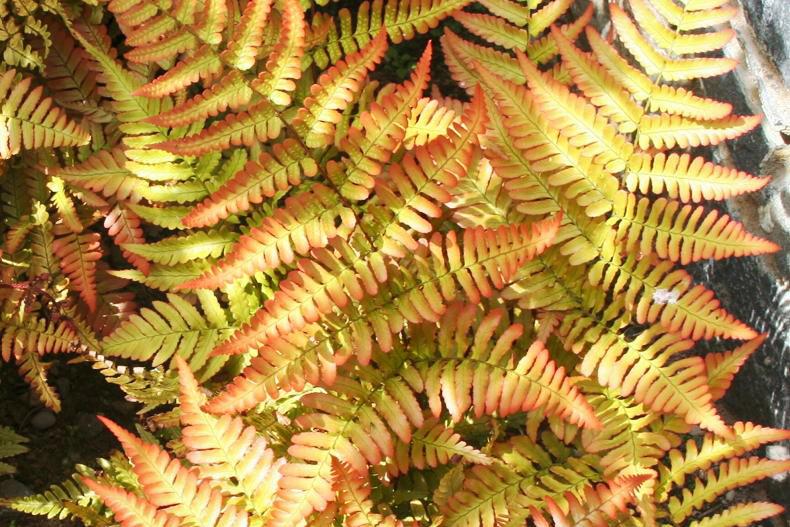
Several ferns will also make useful additions to this border. Amongst the toughest are hart’s tongue fern, Asplenium scolopendrium, and forms of the soft shield fern, Polystichum. Many species of Dryopteris are tolerant of dry shade, including Dryopteris erythrosora ‘Brilliance’ which provides a striking pop of colour with its unique, reddish-copper emerging fronds that mature to bright, yellow-green.
To aid moisture retention and fertility, when the new planting is done, we mulch the entire border with an 8-10cm layer of farmyard manure. It’s probably sinful to write in this publication that we buy bagged farmyard manure, but it is well-composted to high temperatures. For the first year or two, we will keep new plants well-watered to help get their roots down.
Q&A: Why is my beech hedge straggly?
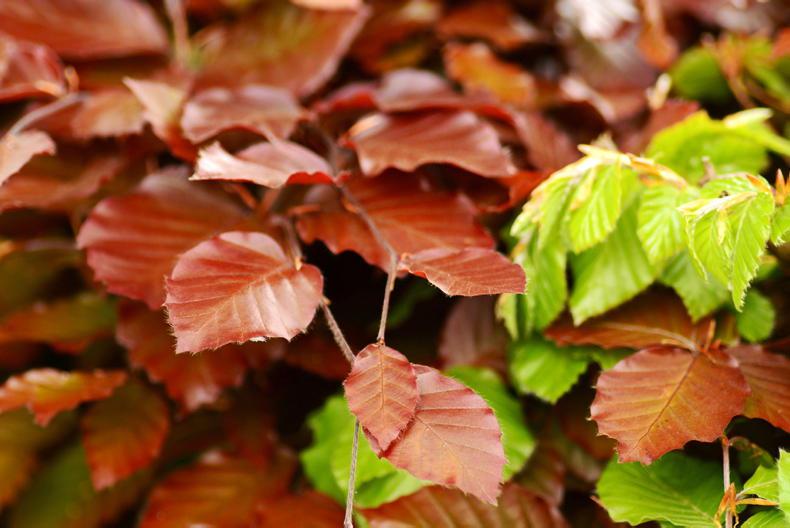
Beech is a popular hedging plant that changes with the seasons.
Last March, I planted a new beech hedge using young, bare-root plants and kept them well-watered. Some have died and look straggly. What should I do? – Yvonne, Co Clare
It is common to have to re-plant some misses in a newly planted, bare-root beech hedge, but about 10% would be the most that it should be.
Lack of water, poor soil drainage, planting too deeply and weed competition are common reasons for beech hedge failure. Beech requires good soil drainage and does not tolerate wet conditions. If their vulnerable, bare roots dry out before planting, this will diminish their survival.
The plant is also susceptible to drought when leafing out in spring and may have needed more water than was applied. Often young beech makes roots the first year and the top does not grow until the second.
Clear: As leaves continue to fall, remove them off low-growing plants to prevent them being smothered and compost them to make soil-conditioning leaf mould.
Cover: Be prepared for frost and ensure all exotic and tender plants are under cover.
Replace: It’s time to remove faded plants in summer container displays with colourful young phormiums or skimmia as focal points, surrounded by winter-flowering heathers, trailing ivy, evergreen grasses, pansies and spring-flowering bulbs.
Mary Keenan and Ross Doyle run Gash Gardens, Co Laois. See gashgardens.ie
Gardens don’t stand still. As our gardens change and evolve with time, the maturing of permanent trees means shrub borders benefit from a review and revamp every few years, to keep them looking at their best.
My current makeover project is a long border that runs alongside a boundary hedge of leylandii ‘Leyland cypress’. The hedge was planted over 40 years ago and is maintained at about 2.5 metres height. The border is south facing but is shaded in parts by nearby specimen trees and shrubs.
Growing conditions along the bottom of any hedge tend to be notoriously dry and often shady, but the worst is a leylandii hedge, which creates dusty, dry soil that is often depleted of nutrients and congested with the competing roots of the hedge. Because of this increasingly challenging growing environment, several extensive gaps have emerged in this border where plants have failed and now is an ideal time for us to tackle replanting these areas.
Spring and autumn were once considered equally good times for planting perennials, shrubs and trees. However, recent years have yielded some prolonged periods of very dry spring weather, making it difficult for new plants to establish. This means that autumn, which generally has more reliable rainfall, is becoming a better time for planting.
Our first step was to assess the existing plants that are doing well in the border while ruthlessly digging out any plants that are not thriving, either potting them up for later planting elsewhere or immediately moving them to more suitable locations.
Existing plants which have stayed the course in the dry and shady areas of the border include pulmonaria (lungwort), comfrey, spreading colonies of sweet woodruff and convallaria (lily of the valley), lamium orvala (deadnettle) and brunnera macrophylla ‘Betty Bowring’ with dainty sprays of bright white flowers, borne in spring, above heart-shaped, green leaves. Some hardy geraniums are also thriving, particularly varieties of Geranium nodosum and G. macrorrhizumwhile a patch of native woodrush, Luzula sylvatica, has evolved into an attractive ground cover, forming dense tufts of glossy, dark green linear leaves.
After weeding the border and pruning some of the shrubs that had become a bit overgrown, we prepared the soil in areas to be replanted by incorporating plenty of our own well-rotted garden compost to improve quality and moisture retention. If you don’t have access to garden compost or your soil is very poor, consider raking in a potassium-rich general fertiliser at 70g per square metre.
Planting options
While planting options are more limited for conditions along the base of a hedge, there is still a good range of plants that will thrive in this tricky situation, provided they are kept well-watered and mulched in their first year of settling in.
To replant some of the gaps where the soil is particularly parched and congested with roots, epimediums are my go-to plant, especially old stalwart varieties such as Epimedium x rubrum and E. x perralchicum ‘Fröhnleiten’, which are more drought tolerant and resilient than newer introductions. Epimediums are great low-maintenance perennials and they associate well in dry shade with evergreen perennials like hellebores, bergenias, Iris foetidissima and the vigorous-growing, evergreen wood spurge, Euphorbia amygdaloides var. robbiae reveals vivid lime flowers in late spring. Lily turf, Liriope muscari, is another tough perennial that copes even in the darkest and driest of conditions. Its purple blooms are an asset in autumn, rising above the evergreen, strap-like leaves.
Several ferns will also make useful additions to this border. Amongst the toughest are hart’s tongue fern, Asplenium scolopendrium, and forms of the soft shield fern, Polystichum. Many species of Dryopteris are tolerant of dry shade, including Dryopteris erythrosora ‘Brilliance’ which provides a striking pop of colour with its unique, reddish-copper emerging fronds that mature to bright, yellow-green.
To aid moisture retention and fertility, when the new planting is done, we mulch the entire border with an 8-10cm layer of farmyard manure. It’s probably sinful to write in this publication that we buy bagged farmyard manure, but it is well-composted to high temperatures. For the first year or two, we will keep new plants well-watered to help get their roots down.
Q&A: Why is my beech hedge straggly?
Beech is a popular hedging plant that changes with the seasons.
Last March, I planted a new beech hedge using young, bare-root plants and kept them well-watered. Some have died and look straggly. What should I do? – Yvonne, Co Clare
It is common to have to re-plant some misses in a newly planted, bare-root beech hedge, but about 10% would be the most that it should be.
Lack of water, poor soil drainage, planting too deeply and weed competition are common reasons for beech hedge failure. Beech requires good soil drainage and does not tolerate wet conditions. If their vulnerable, bare roots dry out before planting, this will diminish their survival.
The plant is also susceptible to drought when leafing out in spring and may have needed more water than was applied. Often young beech makes roots the first year and the top does not grow until the second.
Clear: As leaves continue to fall, remove them off low-growing plants to prevent them being smothered and compost them to make soil-conditioning leaf mould.
Cover: Be prepared for frost and ensure all exotic and tender plants are under cover.
Replace: It’s time to remove faded plants in summer container displays with colourful young phormiums or skimmia as focal points, surrounded by winter-flowering heathers, trailing ivy, evergreen grasses, pansies and spring-flowering bulbs.
Mary Keenan and Ross Doyle run Gash Gardens, Co Laois. See gashgardens.ie





SHARING OPTIONS