‘The brown oak-bough vies with the red-gemmed holly now, and here and there, like pearls, there show the berries of the mistletoe.”
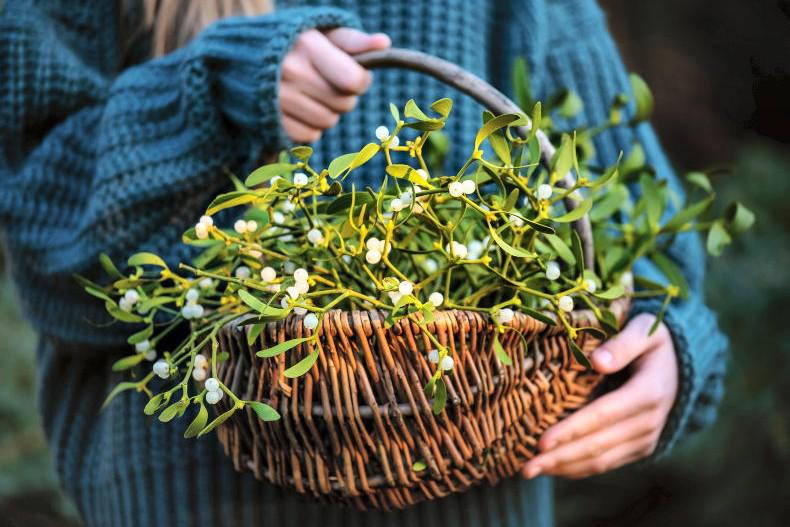
The poem by the American poet Paul Laurence Dunbar (1872-1906) tells of the beauty of mistletoe at a time when holly is in full flush with red berries in our winter landscape, in contrast to the white of mistletoe.
Viscum album is the botanical name of mistletoe, drualus in Irish. Even though Laurence refers to oak as the host, which is true, I have only ever seen it growing on apple or lime in Ireland.
Mistletoe is native to central and southern Europe, including Britain. It was introduced into The National Botanic Gardens, Glasnevin by Dr David Moore in the 1840s and he placed seed there on several trees – it still grows there today.
Accounts of mistletoe go back as far as the Roman author and naturalist Pliny The Elder 23–79 CE. He mentions it as a cure for barrenness in animals and tells of the reverence Druids had for mistletoe, provided it is grown on oak trees. They cut it down with a golden sickle and caught on a white cloth for the purpose of venerating it.
Kissing under the mistletoe
The act of kissing under the mistletoe is steeped in tradition, although its origin is somewhat unknown. It is more of a custom rather than an initiation of romance. Mistletoe was seen as a symbol of fertility, largely I suspect because of its ability to sprout into life on the bare branches of its host. From there, it developed into well established shrubby plants firmly held on the branches.
Mistletoe flowers are insignificant insofar as they are difficult to see even at close range. They are dioecious which means you need male and female flowers. However, trees tend to have multiple clumps so male and female may likely be present. This is not a certainty though.
They open in February and March and if pollination is successful, berries are formed. White in colour, they are viscous and sticky inside. They contain one or more green seeds, so even within, the berry photosynthesis is taking place ready for germination.
The berries fall from the clump and settle on lower branches of the host and begin germination thus spreading the mistletoe through its host. In order for mistletoe to spread to other trees it needs a carrier, and the mistle thrush is the bird we credit with this ability. They gorge on the berries and on other trees, they defecate the berries or they often clean their beaks of berries on its branches.
After seed is deposited it germinates on the branches and develops from there.
It is here that the intrigue develops, and to the onlooker it truly looks to be part of the tree, especially in winter as it stands out clearly as a distinct entity and it is. In fact, it is parasitic in so far as it partly lives on the resources of the tree itself.
The stems are green in colour and have the ability to photosynthesise which classifies it as a hemiparasite.
However, it does draw heavily on the tree as it develops a root structure called a haustorium, and this taps in to the trees’ water system, depriving the branch beyond it of nutrients. In order to secure itself to the tree, the mistletoe releases hormones which induces the tree to develop a knuckle. This is partly the response of the tree to try and get more sustenance and give the mistletoe a better foothold.
As it becomes stronger, it can start to cause harm to the life of its host. It has even caused the death of trees especially on lime, Tilia europaea.
After years of mistletoe growth, the crown reduces and a slow death ensues. So be aware, that even though mistletoe is a wonderful thing, it can cause destruction. It needs the attention of tree specialists to remove some infected branches.
On apple trees where it also occurs, it is an easier issue to resolve by simply pruning out little mistletoe seedlings and perhaps retaining one clump.
Q&A: How do I keep my hedge healthy?

Ireland’s native hawthorn, Crataegus monogyna, is an ideal tree for a small garden with attractive flowers and fruit that support a wide variety of wildlife. \ Mary Keenan
I would love your suggestion for a roadside hedge, it is 40m in length.
We live in the countryside. – Eugene, Roscrea, Co Tipperary.
My advice is to keep it native Irish and plant hawthorn, Crataegus monogyna. You can easily source these now as bare root plants and they are reasonably priced too. For best results, plant a double row and alternate the planting, leaving no visual gap. This will give you a thicker hedge. Plant 50cm apart and 50cm back for the row behind. Now is the best time to do the work, but avoid waterlogged or frozen ground. Keep all shoots tipped back to bring the hedge on evenly, then decide your desired height and maintain it at that.
To-to-list
Lawns: all ground is wet now so stay off lawns as much as possible.
Clear all fallen leaves or debris
after recent storms.
Trees and shrubs: now is the best time to plant or prune trees and shrubs. Examine where overgrowth is
problematic and prune back.
Pots and planters: raise all pots and planters off the ground. Pot risers are available from garden centres.
Planted beds: when days are dry, remove any weeds, dig out perennial ones and mulch with well-rotted compost or
composted pine bark.
‘The brown oak-bough vies with the red-gemmed holly now, and here and there, like pearls, there show the berries of the mistletoe.”
The poem by the American poet Paul Laurence Dunbar (1872-1906) tells of the beauty of mistletoe at a time when holly is in full flush with red berries in our winter landscape, in contrast to the white of mistletoe.
Viscum album is the botanical name of mistletoe, drualus in Irish. Even though Laurence refers to oak as the host, which is true, I have only ever seen it growing on apple or lime in Ireland.
Mistletoe is native to central and southern Europe, including Britain. It was introduced into The National Botanic Gardens, Glasnevin by Dr David Moore in the 1840s and he placed seed there on several trees – it still grows there today.
Accounts of mistletoe go back as far as the Roman author and naturalist Pliny The Elder 23–79 CE. He mentions it as a cure for barrenness in animals and tells of the reverence Druids had for mistletoe, provided it is grown on oak trees. They cut it down with a golden sickle and caught on a white cloth for the purpose of venerating it.
Kissing under the mistletoe
The act of kissing under the mistletoe is steeped in tradition, although its origin is somewhat unknown. It is more of a custom rather than an initiation of romance. Mistletoe was seen as a symbol of fertility, largely I suspect because of its ability to sprout into life on the bare branches of its host. From there, it developed into well established shrubby plants firmly held on the branches.
Mistletoe flowers are insignificant insofar as they are difficult to see even at close range. They are dioecious which means you need male and female flowers. However, trees tend to have multiple clumps so male and female may likely be present. This is not a certainty though.
They open in February and March and if pollination is successful, berries are formed. White in colour, they are viscous and sticky inside. They contain one or more green seeds, so even within, the berry photosynthesis is taking place ready for germination.
The berries fall from the clump and settle on lower branches of the host and begin germination thus spreading the mistletoe through its host. In order for mistletoe to spread to other trees it needs a carrier, and the mistle thrush is the bird we credit with this ability. They gorge on the berries and on other trees, they defecate the berries or they often clean their beaks of berries on its branches.
After seed is deposited it germinates on the branches and develops from there.
It is here that the intrigue develops, and to the onlooker it truly looks to be part of the tree, especially in winter as it stands out clearly as a distinct entity and it is. In fact, it is parasitic in so far as it partly lives on the resources of the tree itself.
The stems are green in colour and have the ability to photosynthesise which classifies it as a hemiparasite.
However, it does draw heavily on the tree as it develops a root structure called a haustorium, and this taps in to the trees’ water system, depriving the branch beyond it of nutrients. In order to secure itself to the tree, the mistletoe releases hormones which induces the tree to develop a knuckle. This is partly the response of the tree to try and get more sustenance and give the mistletoe a better foothold.
As it becomes stronger, it can start to cause harm to the life of its host. It has even caused the death of trees especially on lime, Tilia europaea.
After years of mistletoe growth, the crown reduces and a slow death ensues. So be aware, that even though mistletoe is a wonderful thing, it can cause destruction. It needs the attention of tree specialists to remove some infected branches.
On apple trees where it also occurs, it is an easier issue to resolve by simply pruning out little mistletoe seedlings and perhaps retaining one clump.
Q&A: How do I keep my hedge healthy?
Ireland’s native hawthorn, Crataegus monogyna, is an ideal tree for a small garden with attractive flowers and fruit that support a wide variety of wildlife. \ Mary Keenan
I would love your suggestion for a roadside hedge, it is 40m in length.
We live in the countryside. – Eugene, Roscrea, Co Tipperary.
My advice is to keep it native Irish and plant hawthorn, Crataegus monogyna. You can easily source these now as bare root plants and they are reasonably priced too. For best results, plant a double row and alternate the planting, leaving no visual gap. This will give you a thicker hedge. Plant 50cm apart and 50cm back for the row behind. Now is the best time to do the work, but avoid waterlogged or frozen ground. Keep all shoots tipped back to bring the hedge on evenly, then decide your desired height and maintain it at that.
To-to-list
Lawns: all ground is wet now so stay off lawns as much as possible.
Clear all fallen leaves or debris
after recent storms.
Trees and shrubs: now is the best time to plant or prune trees and shrubs. Examine where overgrowth is
problematic and prune back.
Pots and planters: raise all pots and planters off the ground. Pot risers are available from garden centres.
Planted beds: when days are dry, remove any weeds, dig out perennial ones and mulch with well-rotted compost or
composted pine bark.







SHARING OPTIONS