Spreading fertiliser evenly, at bout widths from 15m to 36m (and more) can be a challenge with different fertiliser types, even in an indoor test hall. But in the field, wind, uneven ground and some machine wear, makes the challenge of wider bouts enormous.
For decades, spreader manufacturers have been striving to spread evenly at wider bout widths.
Initially, very different spreading mechanisms were used by different manufacturers: single-disc, oscillating spout (wagtail), twin-disc and pneumatic techniques have all been deployed, but over the last 30 years, the twin-disc mechanism has become almost universal.
Different manufacturers took different approaches to the development of the twin-disc spreader.
For example, Amazone and Rauch, focused on different discs for different bout widths, with multiple vane positions (and lengths) possible to adjust the spread pattern for different fertilisers at different bouts.
Sky (formerly Sulky) used different discs, but also a variable drop point on the disc to tune the spread pattern.
Lely, Bogballe and Bredal used inward turning discs to give a wider spreading arc from each disc with more overlapping, which gave a more forgiving pattern, less dependent on the need for fine tuning of the spreader settings.
Today, wider bouts (24m upwards) have almost become the norm, while at the same time fertiliser quality for spreading has become more challenging, with less-dense urea and various components mixed into blends, causing particular problems.
Spreader manufacturers are now offering more features and more adjustment in an attempt to cope with these fertilisers and bout widths.
This approach of offering a multiplicity of adjustments carries with it some risks and downsides – it makes the spreader more complicated and expensive and requires extensive continuous test-hall work by the spreader manufacturer to get the right setting for all fertiliser types and bout widths. It also needs clear setting protocols that the user can follow; an area where many manufacturers have not succeeded in the past.
Latest tech
Recent developments in spreaders have included:
Further developments in matching the fertiliser you are going to spread to a product in the manufacturer’s database to get the correct settings.A focus on getting fertiliser spread more accurately on the headland – an area identified in Oak Park research as being quite poor in practice. With wider bouts, the areas involved in headlands are huge and many of the headland mechanisms are not achieving even spreading.Manufacturers are adopting a number of different spreading adjustment technologies to fine-tune spreading in the field and on the headland. Apps, databases, information transfer protocols and artificial intelligence are being used to get the correct machine adjustment and good spreading.While there were a huge number of fertiliser spreaders and developments at Agritechnica, here, Irish Farmers Journal discusses some of the items that stood out.
Amazone AutoSpread: self-adjusting spreader technology
Broadcast spreaders rely on having a fertiliser spread pattern of the right shape overlapping correctly with its adjacent runs. While this is normally achieved by matching the fertiliser being spread to fertiliser tested in a test hall, variations in field conditions (wind etc) and fertiliser quality, may result in an incorrectly set machine.
The concept of using sensors at the back of the spreader to assess the spread and to adjust the pattern is not new – Sulky introduced its ‘Justax’ system in 1995 and Amazone has had the Argus twin system since 2015.
These have not revolutionised spreading until now, because they were limited in their capability, expensive, and probably hadn’t all of the information and data communication capacity necessary.
But sensors, data processing and electronic control systems continue to develop and Amazone is having another go, particularly as its newer TS spreading mechanism (now varying drop point) is adjustable on the move.
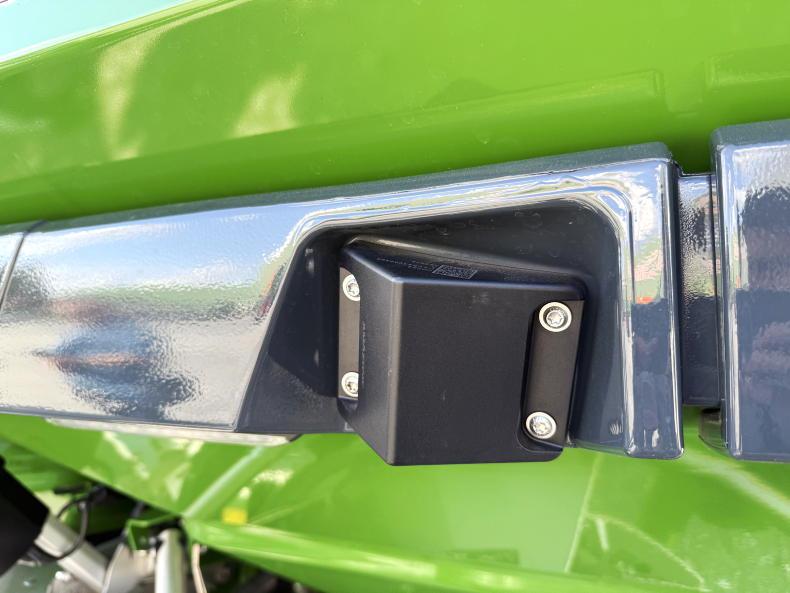
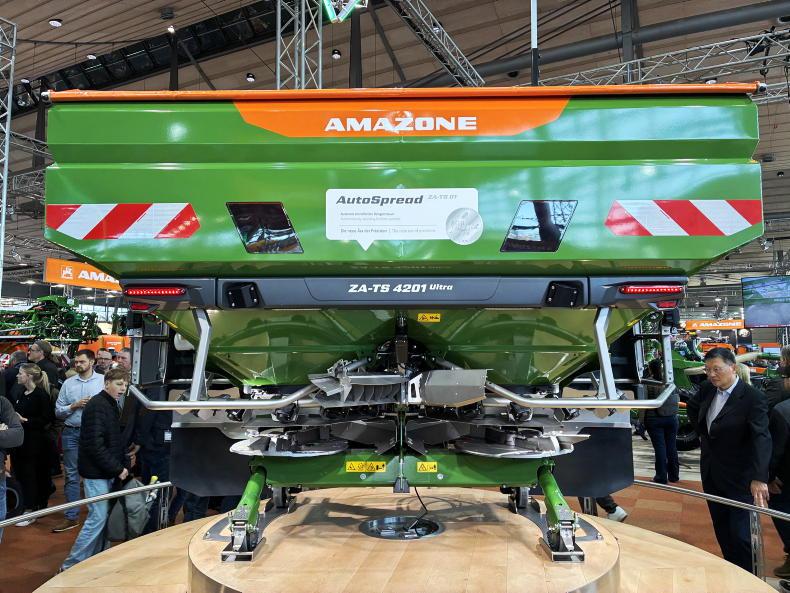
Two new rear-facing radar sensors monitor fertiliser throw distance behind the spreader.
The new ‘auto-spread’ sensors add an estimate of spreading distance to the limited spread pattern shape information provided by the Argus twin system.
With this information, a more accurate estimate of the shape of the spread pattern is known and this can be compared with what it should be, from the manufacturer’s test hall data. The pattern can then be automatically adjusted (primarily by varying fertiliser drop point) on the go to improve the spread pattern.
This technology can help set the correct turn-on/off points for the spreader as it meets the headland.
It can also be helpful in getting the correct response to wind speed and direction information provided by a wind sensor (wind control) mounted on the spreader.
Bogballe: hydraulic disc drive, headland spreading and weather sensor
The basic spread pattern of the inward turning discs of the Bogballe spreader made it easy to get a good spread pattern in the field, for bouts up to 24m with most fertilisers, but like all spreading systems, it is not perfect.
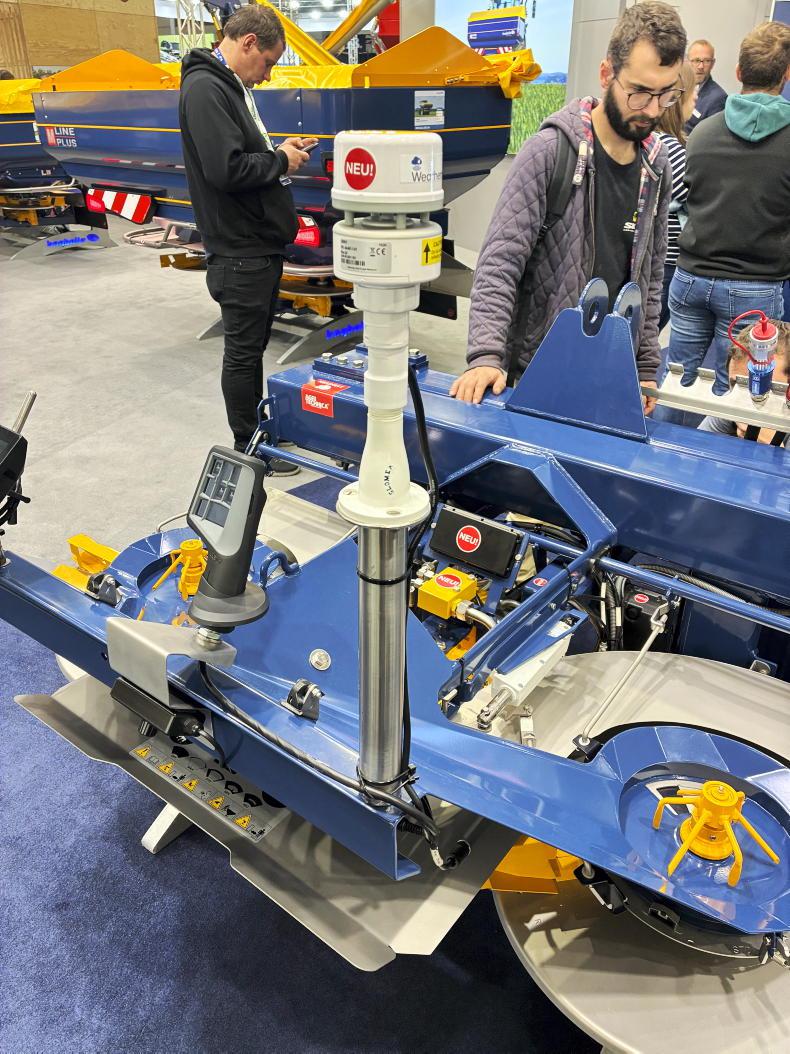
Bogballe displayed its new integrated hydraulic drive system, wind/humidity sensor as well as a new Isobus system.
Some years back, when on-the-move width adjustment for narrow bouts or short runs (so-called section control – a misnomer for spreaders) was introduced, the inward turning discs had more limited capacity to change width.
For that, Bogballe adopted a variable drop point for its wider spreading spreaders, to give improved spreading of narrow bouts. It has recently developed this technology further on these wider spreaders to become a full-headland-spreading system with inward turning discs. This is quite a change from the traditional Bogballe ‘Trend’ system which changed the direction of the disc rotation on the headland to give different spreading characteristics.
This older ‘Trend’ system required the operator to drive in one direction around the field headland and was difficult to optimise with different fertilisers at different bout widths.
At Agritechnica, Bogballe added a further option to improve headland spreading with a hydraulic disc drive option on wider spreading machines offering the option of different disc speeds, again improving headland spreading accuracy.
Bogballe also showed a machine-mounted weather sensor (‘weatherman’) that, in addition to measuring wind speed and direction, also measures humidity.
While the wind sensor at this point is mainly used to warn the operator about excess wind, perhaps surprisingly, the humidity sensor is used to adjust the spreader settings. Bogballe has found that the distance back from the spreader where the spread pattern is centred, changes with humidity. The spreader can compensate for this by changing the on/off or rate change (short ground) reaction times to give more even spreading.
This is interesting as it would not necessarily need a tractor-mounted unit to measure humidity – Met Éireann forecast data could possibly be used.
Rauch: variable disc speed via PTO and new tray testing kit
Rauch was not left behind in the spreader development area at Agritechnica either. It too is now offering the option of reducing or changing the headland disc speed – but not by using a hydraulic drive.
The XCheck tray testing system uses fabric mats.
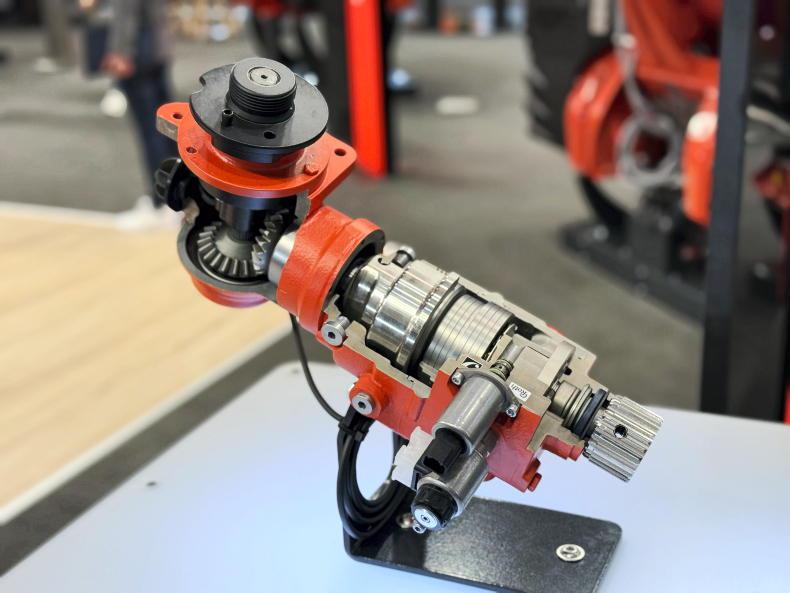
Its new VarioSmart system uses a variable clutch drive between the two disc drives, which allows a speed sensor to control the hydraulic pressure on the clutch unit which allows the speed of one disc to be varied from 1100rpm down to 300rpm.
This VarioSmart system allows individual disc speed to be controlled independently of a tractor hydraulic service, which can sometimes be impacted by other hydraulic demands form the tractor.
Aside from showing the new Axis 25 spreader (below), Rauch showed its new XCheck field tray testing system which uses foldable fabric trays and a simple fertiliser collection unit and app-based analysis.
This very portable solution, like the Amazone mat-based system, could make field testing easier and much more likely to be carried out.
Fertiliser image analysis from Amazone and Sky
Both Amazone and Sky won Agritechnica awards for their photo-based fertiliser identification systems, which should help operators set their spreader optimally. There are distinct differences in the offerings however.
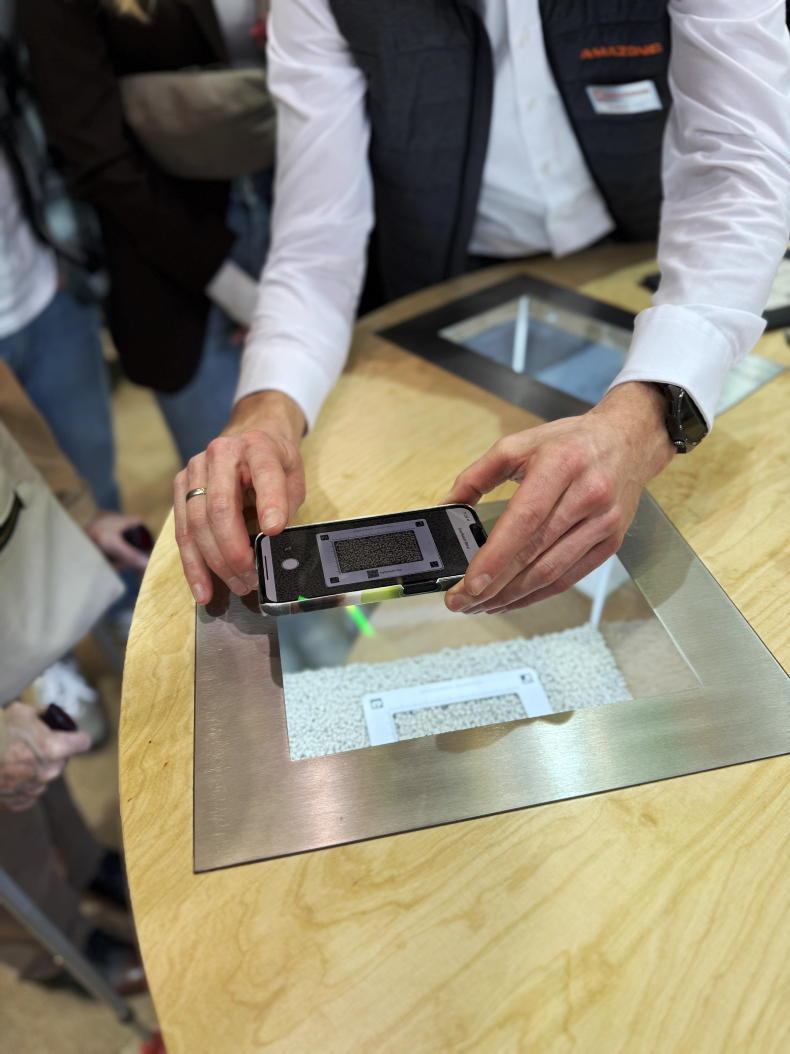
Amazone and Sky showcased photo-based fertiliser identification apps.
The Sky FertiEye consists of a unique sample collector which separates the fertiliser grains on a sampling tray to allow the photo image to capture the size, shape and colour of the individual particles.
The key feature of FertiEye is that the associated app then determines the setting for the spreader based on the predicted ballistic characteristics of the particles in the sample. This is a really powerful use of image analysis, as it must determine the size, shape, density and probably strength and flow characteristics of the individual particles in the sample to be effective. Progress will be interesting.
Amazone’s image analysis system, on the other hand, seeks to match the fertiliser being spread with one from of its large database of tested products.
It is simply achieved by placing a physical photo frame with an in-built measurement scale onto the fertiliser and uploading an image of the fertiliser in the frame to the ‘Easymatch’ app. The image is analysed (granule size, shape etc) and then the database is searched for the nearest match to determine the settings to be used.
Agrispread: wide-disc spacing
The Irish built Agrispread AS 3000 trailed spreader features a unique positioning of the two spreading discs at each side of the spreader with 6m between them.
While the concept has been tried with disc – and spout – designs before, the level of development in the Agrispread suggests that it will be a feature it markets strongly.
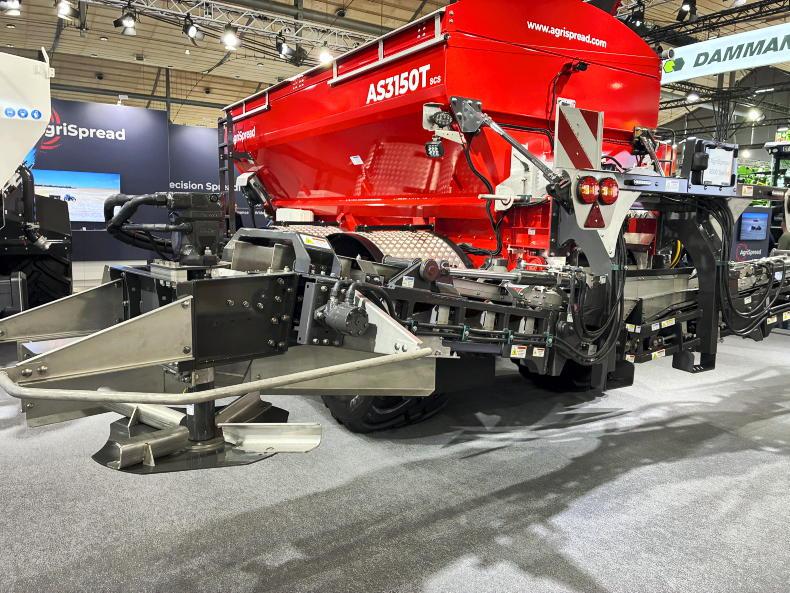
The rear conveyor system can spread urea up to 48m.
Fertiliser is delivered by belt conveyors to the individual discs. The spread pattern will benefit from the disc spacing potentially with all materials but particularly with difficult to spread products like lime.
The challenges of spreading fertiliser evenly with a broadcast spreader in the field and on the headland are immense and manufacturers are adding more and more features to try and improve precision.
But they must ensure that these techniques actually work well in the field and are easy to set up. Most of all, the basic spread pattern of the spreader should be good as it is easier to start from a good base than adding bells and whistles to try to improve a poor basic pattern.
Spreading fertiliser evenly, at bout widths from 15m to 36m (and more) can be a challenge with different fertiliser types, even in an indoor test hall. But in the field, wind, uneven ground and some machine wear, makes the challenge of wider bouts enormous.
For decades, spreader manufacturers have been striving to spread evenly at wider bout widths.
Initially, very different spreading mechanisms were used by different manufacturers: single-disc, oscillating spout (wagtail), twin-disc and pneumatic techniques have all been deployed, but over the last 30 years, the twin-disc mechanism has become almost universal.
Different manufacturers took different approaches to the development of the twin-disc spreader.
For example, Amazone and Rauch, focused on different discs for different bout widths, with multiple vane positions (and lengths) possible to adjust the spread pattern for different fertilisers at different bouts.
Sky (formerly Sulky) used different discs, but also a variable drop point on the disc to tune the spread pattern.
Lely, Bogballe and Bredal used inward turning discs to give a wider spreading arc from each disc with more overlapping, which gave a more forgiving pattern, less dependent on the need for fine tuning of the spreader settings.
Today, wider bouts (24m upwards) have almost become the norm, while at the same time fertiliser quality for spreading has become more challenging, with less-dense urea and various components mixed into blends, causing particular problems.
Spreader manufacturers are now offering more features and more adjustment in an attempt to cope with these fertilisers and bout widths.
This approach of offering a multiplicity of adjustments carries with it some risks and downsides – it makes the spreader more complicated and expensive and requires extensive continuous test-hall work by the spreader manufacturer to get the right setting for all fertiliser types and bout widths. It also needs clear setting protocols that the user can follow; an area where many manufacturers have not succeeded in the past.
Latest tech
Recent developments in spreaders have included:
Further developments in matching the fertiliser you are going to spread to a product in the manufacturer’s database to get the correct settings.A focus on getting fertiliser spread more accurately on the headland – an area identified in Oak Park research as being quite poor in practice. With wider bouts, the areas involved in headlands are huge and many of the headland mechanisms are not achieving even spreading.Manufacturers are adopting a number of different spreading adjustment technologies to fine-tune spreading in the field and on the headland. Apps, databases, information transfer protocols and artificial intelligence are being used to get the correct machine adjustment and good spreading.While there were a huge number of fertiliser spreaders and developments at Agritechnica, here, Irish Farmers Journal discusses some of the items that stood out.
Amazone AutoSpread: self-adjusting spreader technology
Broadcast spreaders rely on having a fertiliser spread pattern of the right shape overlapping correctly with its adjacent runs. While this is normally achieved by matching the fertiliser being spread to fertiliser tested in a test hall, variations in field conditions (wind etc) and fertiliser quality, may result in an incorrectly set machine.
The concept of using sensors at the back of the spreader to assess the spread and to adjust the pattern is not new – Sulky introduced its ‘Justax’ system in 1995 and Amazone has had the Argus twin system since 2015.
These have not revolutionised spreading until now, because they were limited in their capability, expensive, and probably hadn’t all of the information and data communication capacity necessary.
But sensors, data processing and electronic control systems continue to develop and Amazone is having another go, particularly as its newer TS spreading mechanism (now varying drop point) is adjustable on the move.
Two new rear-facing radar sensors monitor fertiliser throw distance behind the spreader.
The new ‘auto-spread’ sensors add an estimate of spreading distance to the limited spread pattern shape information provided by the Argus twin system.
With this information, a more accurate estimate of the shape of the spread pattern is known and this can be compared with what it should be, from the manufacturer’s test hall data. The pattern can then be automatically adjusted (primarily by varying fertiliser drop point) on the go to improve the spread pattern.
This technology can help set the correct turn-on/off points for the spreader as it meets the headland.
It can also be helpful in getting the correct response to wind speed and direction information provided by a wind sensor (wind control) mounted on the spreader.
Bogballe: hydraulic disc drive, headland spreading and weather sensor
The basic spread pattern of the inward turning discs of the Bogballe spreader made it easy to get a good spread pattern in the field, for bouts up to 24m with most fertilisers, but like all spreading systems, it is not perfect.
Bogballe displayed its new integrated hydraulic drive system, wind/humidity sensor as well as a new Isobus system.
Some years back, when on-the-move width adjustment for narrow bouts or short runs (so-called section control – a misnomer for spreaders) was introduced, the inward turning discs had more limited capacity to change width.
For that, Bogballe adopted a variable drop point for its wider spreading spreaders, to give improved spreading of narrow bouts. It has recently developed this technology further on these wider spreaders to become a full-headland-spreading system with inward turning discs. This is quite a change from the traditional Bogballe ‘Trend’ system which changed the direction of the disc rotation on the headland to give different spreading characteristics.
This older ‘Trend’ system required the operator to drive in one direction around the field headland and was difficult to optimise with different fertilisers at different bout widths.
At Agritechnica, Bogballe added a further option to improve headland spreading with a hydraulic disc drive option on wider spreading machines offering the option of different disc speeds, again improving headland spreading accuracy.
Bogballe also showed a machine-mounted weather sensor (‘weatherman’) that, in addition to measuring wind speed and direction, also measures humidity.
While the wind sensor at this point is mainly used to warn the operator about excess wind, perhaps surprisingly, the humidity sensor is used to adjust the spreader settings. Bogballe has found that the distance back from the spreader where the spread pattern is centred, changes with humidity. The spreader can compensate for this by changing the on/off or rate change (short ground) reaction times to give more even spreading.
This is interesting as it would not necessarily need a tractor-mounted unit to measure humidity – Met Éireann forecast data could possibly be used.
Rauch: variable disc speed via PTO and new tray testing kit
Rauch was not left behind in the spreader development area at Agritechnica either. It too is now offering the option of reducing or changing the headland disc speed – but not by using a hydraulic drive.
The XCheck tray testing system uses fabric mats.
Its new VarioSmart system uses a variable clutch drive between the two disc drives, which allows a speed sensor to control the hydraulic pressure on the clutch unit which allows the speed of one disc to be varied from 1100rpm down to 300rpm.
This VarioSmart system allows individual disc speed to be controlled independently of a tractor hydraulic service, which can sometimes be impacted by other hydraulic demands form the tractor.
Aside from showing the new Axis 25 spreader (below), Rauch showed its new XCheck field tray testing system which uses foldable fabric trays and a simple fertiliser collection unit and app-based analysis.
This very portable solution, like the Amazone mat-based system, could make field testing easier and much more likely to be carried out.
Fertiliser image analysis from Amazone and Sky
Both Amazone and Sky won Agritechnica awards for their photo-based fertiliser identification systems, which should help operators set their spreader optimally. There are distinct differences in the offerings however.
Amazone and Sky showcased photo-based fertiliser identification apps.
The Sky FertiEye consists of a unique sample collector which separates the fertiliser grains on a sampling tray to allow the photo image to capture the size, shape and colour of the individual particles.
The key feature of FertiEye is that the associated app then determines the setting for the spreader based on the predicted ballistic characteristics of the particles in the sample. This is a really powerful use of image analysis, as it must determine the size, shape, density and probably strength and flow characteristics of the individual particles in the sample to be effective. Progress will be interesting.
Amazone’s image analysis system, on the other hand, seeks to match the fertiliser being spread with one from of its large database of tested products.
It is simply achieved by placing a physical photo frame with an in-built measurement scale onto the fertiliser and uploading an image of the fertiliser in the frame to the ‘Easymatch’ app. The image is analysed (granule size, shape etc) and then the database is searched for the nearest match to determine the settings to be used.
Agrispread: wide-disc spacing
The Irish built Agrispread AS 3000 trailed spreader features a unique positioning of the two spreading discs at each side of the spreader with 6m between them.
While the concept has been tried with disc – and spout – designs before, the level of development in the Agrispread suggests that it will be a feature it markets strongly.
The rear conveyor system can spread urea up to 48m.
Fertiliser is delivered by belt conveyors to the individual discs. The spread pattern will benefit from the disc spacing potentially with all materials but particularly with difficult to spread products like lime.
The challenges of spreading fertiliser evenly with a broadcast spreader in the field and on the headland are immense and manufacturers are adding more and more features to try and improve precision.
But they must ensure that these techniques actually work well in the field and are easy to set up. Most of all, the basic spread pattern of the spreader should be good as it is easier to start from a good base than adding bells and whistles to try to improve a poor basic pattern.






SHARING OPTIONS