With farmers facing increasing pressure from unpredictable weather, nitrates legislation, and narrowing profit margins, many are turning to alternative forage options like red clover, multispecies swards, and wholecrop silage.
However, Agrotopia believes there’s a more consistent solution: a high-quality, homegrown protein source that can thrive regardless of the weather.
Based at Finnegan’s Farm in Co Meath, Agrotopia has introduced a fully automated hydroponic vertical growing tower, developed in partnership with US-based company Hydrogreen.
Shipping containers
Fiore Macari, director of commercial development at Agrotopia, told the attendees at the ITLUS summer field day that many people have tried to grow sprouts from cereal grain in shipping containers, but this is not viable at a large scale and there can be issues with mould and consistency.
In contrast, the Agrotopia system is designed for scalability, reliability, and cleanliness.
The hydroponic system is modular, allowing farmers to scale it to suit their needs. Most systems will have a number of towers, with each tower typically featuring six to eight levels, with a standard level capable of holding 400kg of cereal grain.
This produces about 2,000kg of fresh sprouts, equivalent to 480kg of dry matter at a 24% dry matter content. A complete unit can produce anywhere from 16t/day all the way up to 130t/day.
Any cereal grains can be used, but there is a preference for wheat for ruminant animals, while barley is preferred in the equine sector.
The grain used needs to be of a high quality, with a high germination rate of over 90%.
Farmers can tailor the harvest window – usually between five and seven days growth –depending on the nutritional needs of their livestock.
Macari noted that during the summer, the fresh sprouts should be fed to animals the same day they are harvested, while in winter they can last for two to three days. Most farmers operate the system on a daily harvest cycle to ensure continuous feed availability.
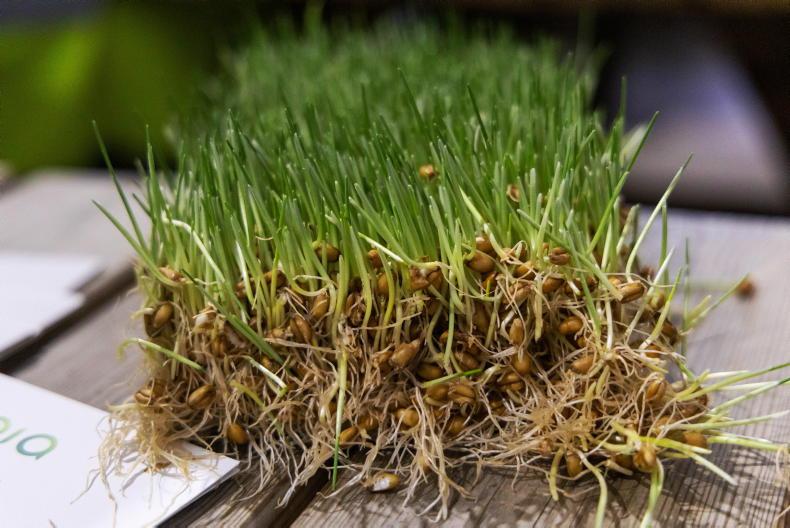
A sample of sprouted grain. \Justin Lynch
Feed trials
Animal feed trials have been carried out with the sprouts by animal nutritionist Gerry Giggins. He described the sprouts as “maize and beet combined”. The sprouts deliver a protein content of 18-19%, nearly double the 10-11% found in the original wheat grain that the sprouts grew from.
Giggins explained that trials with winter finishing beef cattle showed an 18% increase in performance from a slightly lower feed cost. “You could nearly smell how good they were doing,” Giggins commented.
The sprouts have been included in animal diets at inclusion rates of up to 48% with no adverse effects. According to Giggins, it’s a full feed, there’s no need for soya hulls, soyabeans, or molasses.
In addition to reductions in imported feeds, there are some additional environmental benefits to the system.
The sprouts require up to 90% less water to produce livestock feed than other methods, and all unused water is recycled through the system.
There is no waste with the system too, the animal consumes the sprout, the grain, and the mat of roots.
Macari also explained that the system also makes for an efficient use of land, with a standard facility that may only take up 1,000m2, but produce 6,000t of fresh wheat sprouts each year. Research by Deloitte in the USA shows a 21.5% reduction in the carbon footprint of milk when these sprouts are fed, with a 25% reduction for beef.
Macari noted that this research will have to be replicated in Ireland to account for our grass-based system.
Interest in the system is growing steadily. Macari confirmed that Agrotopia is currently engaging with the Department of Agriculture to explore its eligibility under the Targeted Agricultural Modernisation Scheme (TAMS).
With an exclusive partnership for this system in Ireland, the UK, parts of Europe, and the Middle East, Macari is very confident that this will soon be a system that will be seen on many farms across the continent.
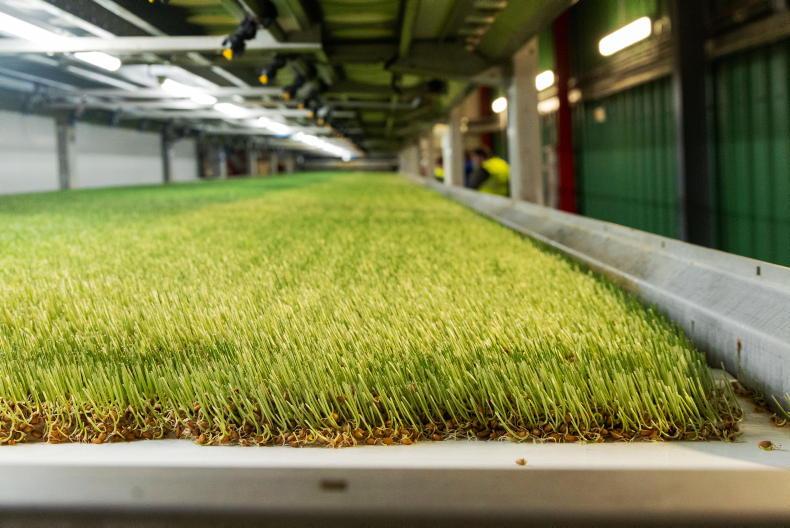
Sprouting grain is seen during the production process at the ITLUS Summer Field Day at Agrotopia. \Justin Lynch
How it works
The Agrotopia hydroponic tower is fully automated and cycles through the following steps:
Seeding: 400kg of high-quality grain is spread evenly onto a conveyor belt.
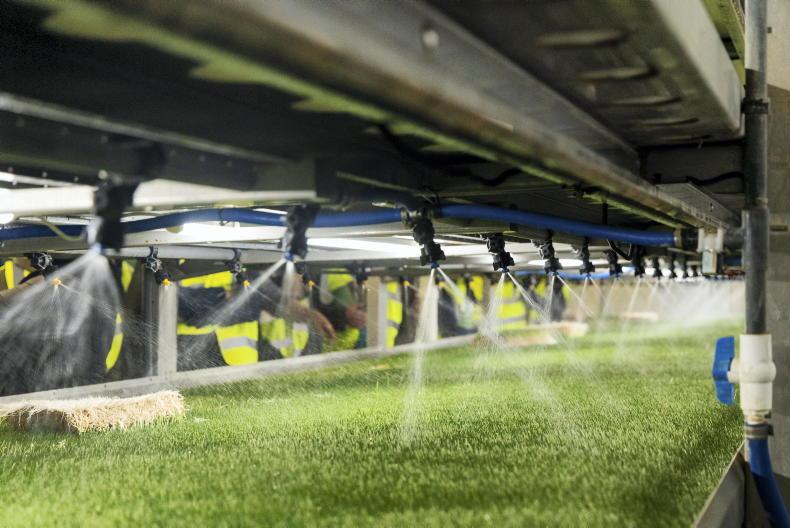
Watering: The grain is watered at hourly intervals. It is possible to add minerals to the water for enhanced animal nutrition.
Climate control: The tower maintains a stable temperature between 18 and 22°C.
Harvesting: After five to seven days, the mature sprouts drop from the belt into a shredder that breaks up the mat before the feed is transferred by conveyor belts, ready to be loaded into a diet feeder.
Cycle reset: The belt is cleaned, and the next batch of grain begins the cycle.
With farmers facing increasing pressure from unpredictable weather, nitrates legislation, and narrowing profit margins, many are turning to alternative forage options like red clover, multispecies swards, and wholecrop silage.
However, Agrotopia believes there’s a more consistent solution: a high-quality, homegrown protein source that can thrive regardless of the weather.
Based at Finnegan’s Farm in Co Meath, Agrotopia has introduced a fully automated hydroponic vertical growing tower, developed in partnership with US-based company Hydrogreen.
Shipping containers
Fiore Macari, director of commercial development at Agrotopia, told the attendees at the ITLUS summer field day that many people have tried to grow sprouts from cereal grain in shipping containers, but this is not viable at a large scale and there can be issues with mould and consistency.
In contrast, the Agrotopia system is designed for scalability, reliability, and cleanliness.
The hydroponic system is modular, allowing farmers to scale it to suit their needs. Most systems will have a number of towers, with each tower typically featuring six to eight levels, with a standard level capable of holding 400kg of cereal grain.
This produces about 2,000kg of fresh sprouts, equivalent to 480kg of dry matter at a 24% dry matter content. A complete unit can produce anywhere from 16t/day all the way up to 130t/day.
Any cereal grains can be used, but there is a preference for wheat for ruminant animals, while barley is preferred in the equine sector.
The grain used needs to be of a high quality, with a high germination rate of over 90%.
Farmers can tailor the harvest window – usually between five and seven days growth –depending on the nutritional needs of their livestock.
Macari noted that during the summer, the fresh sprouts should be fed to animals the same day they are harvested, while in winter they can last for two to three days. Most farmers operate the system on a daily harvest cycle to ensure continuous feed availability.
A sample of sprouted grain. \Justin Lynch
Feed trials
Animal feed trials have been carried out with the sprouts by animal nutritionist Gerry Giggins. He described the sprouts as “maize and beet combined”. The sprouts deliver a protein content of 18-19%, nearly double the 10-11% found in the original wheat grain that the sprouts grew from.
Giggins explained that trials with winter finishing beef cattle showed an 18% increase in performance from a slightly lower feed cost. “You could nearly smell how good they were doing,” Giggins commented.
The sprouts have been included in animal diets at inclusion rates of up to 48% with no adverse effects. According to Giggins, it’s a full feed, there’s no need for soya hulls, soyabeans, or molasses.
In addition to reductions in imported feeds, there are some additional environmental benefits to the system.
The sprouts require up to 90% less water to produce livestock feed than other methods, and all unused water is recycled through the system.
There is no waste with the system too, the animal consumes the sprout, the grain, and the mat of roots.
Macari also explained that the system also makes for an efficient use of land, with a standard facility that may only take up 1,000m2, but produce 6,000t of fresh wheat sprouts each year. Research by Deloitte in the USA shows a 21.5% reduction in the carbon footprint of milk when these sprouts are fed, with a 25% reduction for beef.
Macari noted that this research will have to be replicated in Ireland to account for our grass-based system.
Interest in the system is growing steadily. Macari confirmed that Agrotopia is currently engaging with the Department of Agriculture to explore its eligibility under the Targeted Agricultural Modernisation Scheme (TAMS).
With an exclusive partnership for this system in Ireland, the UK, parts of Europe, and the Middle East, Macari is very confident that this will soon be a system that will be seen on many farms across the continent.
Sprouting grain is seen during the production process at the ITLUS Summer Field Day at Agrotopia. \Justin Lynch
How it works
The Agrotopia hydroponic tower is fully automated and cycles through the following steps:
Seeding: 400kg of high-quality grain is spread evenly onto a conveyor belt.
Watering: The grain is watered at hourly intervals. It is possible to add minerals to the water for enhanced animal nutrition.
Climate control: The tower maintains a stable temperature between 18 and 22°C.
Harvesting: After five to seven days, the mature sprouts drop from the belt into a shredder that breaks up the mat before the feed is transferred by conveyor belts, ready to be loaded into a diet feeder.
Cycle reset: The belt is cleaned, and the next batch of grain begins the cycle.







SHARING OPTIONS