


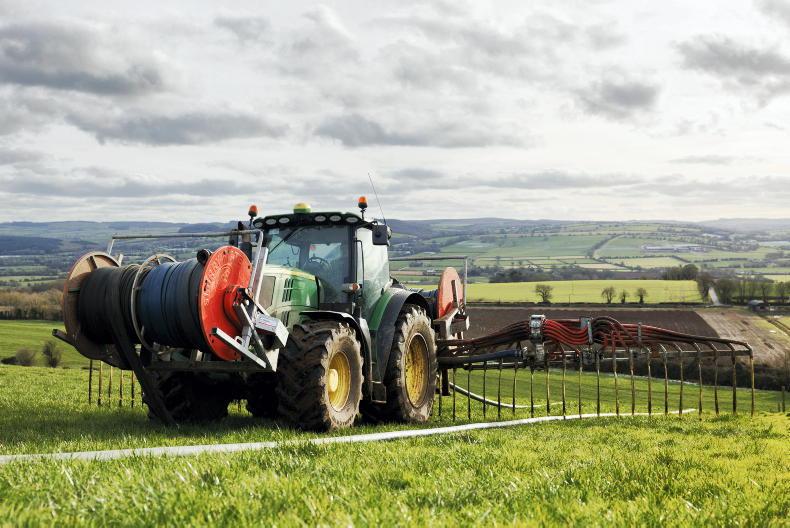
The current closed period for slurry spreading is the most effective policy for protecting waterways from farm nutrient losses, Agriculture Minister Andrew Muir has said.
Calls for slurry spreading rules to be reviewed have reemerged this year following a dry spell of weather during last winter’s closed period which runs from 15 October to 31 January.
Minister Muir said DAERA has given “careful consideration” to suggestions that slurry spreading should be regulated on a weather-led approach, rather than fixed dates.
However, he said there is “no scientific, agronomic or economic evidence” to support a change to the closed period for slurry applications. “This policy position is consistent with other comparable countries in northwest Europe where similar or longer closed periods are implemented,” he said.
The Alliance MLA also pointed to two recent reviews into slurry spreading rules which the Agri Food and Biosciences Institute carried out in 2020 and 2024.
Both reviews found that the current arrangement was “the most effective strategy” for minimising environmental risks with slurry spreading.
In response to a question from North Antrim MLA Timothy Gaston, Minister Muir said grass growth is limited by lower temperatures and short day-length during the closed period.
“While there may be dry spells in some winters and soils may be trafficable on occasions, there is minimal nutrient uptake. Any nutrients in slurry applied during this period remain in the soil and are highly vulnerable to run off to waterways during any subsequent wet weather until grass and crop growth picks up in the spring,” he said.





SHARING OPTIONS