With the straw market depressed, imports of UK and Spanish straw on the rise, and the tillage sector facing one of its most difficult challenges to its very survival, many growers are asking where new opportunities might lie.
This stands in sharp contrast to the construction sector, which is booming across Ireland.
But could this construction boom present new opportunities for the tillage sector?
That question sits at the heart of a new project.
Circular Reno is an EU Interreg North-West Europe project working to create supply chains for bio-based construction materials made from agricultural crops, for use in modular building and renovation.
Led in Ireland by Kore Retrofit, in partnership with Tuath Housing Association, a seminar and demonstration event was held last week to explore these opportunities. The Irish Farmers Journal went along.
Focus on Irish crops
The seminar focused on three crops identified as most suitable for Irish conditions: cereal straw, miscanthus and hemp.
While both miscanthus and hemp may have a role to play, this article focuses on cereal straw, given the quantity and quality of material already produced in Ireland.
What can straw be used for?
Patrick Daly, consultant for Kore Retrofit, outlined that straw can be used as an insulation and is already being integrated into buildings across Europe.

Patrick Daly.
Straw is particularly suitable as infill insulation in timber-frame houses. In this process, straw is shredded, de-dusted, and blown into the cavities of timber-frame walls. However, it can also be further processed into batt insulation (pre-cut rectangular insulation sections) and insulation boards, with several companies across Europe already producing these materials at scale.
Why straw?
Straw is a natural insulator with excellent thermal and sound-absorbing properties.
It also acts as a carbon sink and is significantly more environmentally friendly than many conventional insulation materials.
Patrick also explained that this presents a real opportunity to develop a new rural economy, with potential for job creation across processing, manufacturing and construction.
As a fast-growing and highly sustainable material, straw is already produced at scale in Ireland, with approximately one million tonnes produced annually, a proportion of which could be diverted to construction.
Is this practical?
When asked if this was practical, Patrick said that it was. There is already a well-established market for straw-based construction materials across Europe he explained.
Currently, 11 companies are manufacturing straw-based products for the construction sector, with a further nine companies using straw as a core material in modular construction systems.
Patrick highlighted examples from Austria, Poland, and Slovakia. One Austrian company shreds straw and blows it into pre-made timber-frame walls.
In Slovakia, another company uses straw to manufacture modular construction panels and has grown to such a scale that it has built a fully automated production facility.
As Patrick emphasised, this is not a concept or a theory. It is a proven industrial solution already in widespread use across Europe, and he firmly believes it can work in Ireland.
Developing a straw-based construction industry requires the alignment of four key stages within the supply chain: the production of straw on farms, the processing of straw into a suitable raw material, the manufacturing of straw-based construction products and the integration of those products into the construction sector.
Already in use in Ireland
Niall Crosson, group technical director with Ecological Building Systems, also spoke at the conference and explained that straw and other bio-based construction materials are already being imported and used in Ireland.

Niall Crosson.
His company currently imports a range of bio-based materials, including wool insulation, grass fibre insulation, wood fibre insulation, and straw wall panels.
Both Niall and Patrick emphasised the opportunity to replace imports with a domestic industry, particularly given that there is already an established and growing market for these products.
Demonstration at Straw Chip
Following the seminar, the group visited Straw Chip, based in Athy, Kildare, to see a live working demonstration. Straw Chip has built a business around straw, having first started processing the material in the mid-1990s.
Today, the company produces a range of processed bedding materials, pellets, and other products for both domestic and export markets.
Straw Chip grows straw on its own tillage farm, purchases locally, and also imports straw.
Gavin Owens addressed the seminar and guided attendees around the facility, joined by his brothers Francis and Diarmuid, all of whom are involved in the business.
Gavin explained that he views the construction industry as a different market to food and believes tillage farmers need to diversify some of their crops to improve business security.
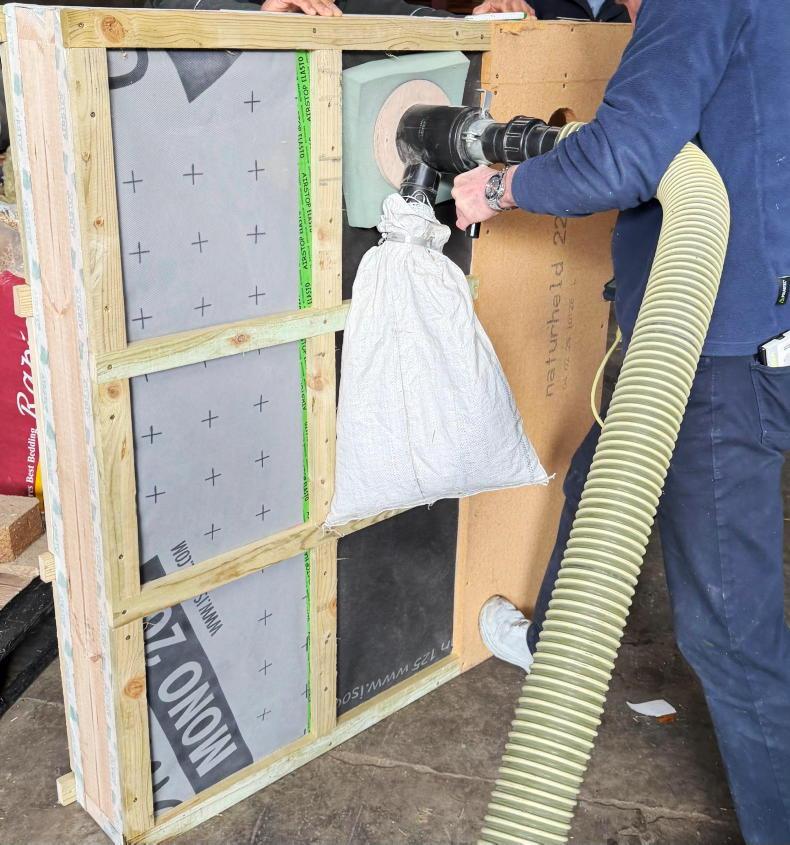
A specialist machine is then used to blow the chopped straw into the cavities.
A live demonstration was held at the Straw Chip facility, where the Owens family has been working closely with the Circular Reno project team to determine whether a product suitable for the Irish market could be developed. In Gavin’s words, they are “nearly there”.
Wheaten straw was used for the demonstration.
The straw must be dry and in excellent condition before processing. It is first shredded, then passed through a tumbler where dust is extracted.
A specialist machine is then used to blow the chopped straw into pre-made cavities within a timber frame. Within seconds, the cavity was fully filled. Patrick explained that the straw is blown into the cavity at a density of 100kg per cubic metre. At this density, only a small amount of air remains within the cavity, which helps reduce fire risk. Following settlement testing, the material showed only a 1% reduction, indicating that the structure will remain stable over the foreseeable future.
The downside
One challenge associated with bio-based construction products is cost competitiveness. At present, they are not always competitive on a price basis compared to conventional materials. For example, straw insulation products can be up to twice the cost of standard Rockwool insulation.
However, Patrick explained that bio-based products often offer superior performance and environmental benefits.
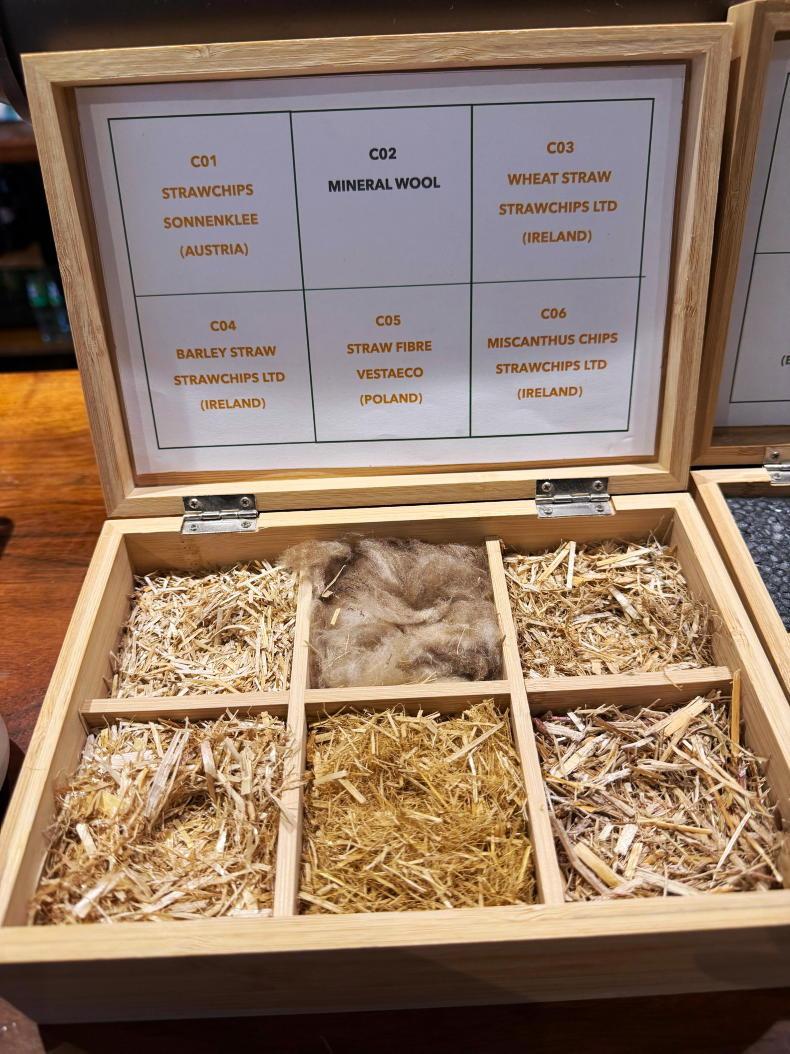
A selection of straw materials used in construction.
But if straw-based insulation products can be produced domestically, the cost could be significantly reduced. Pauric Kavanagh of Kore Retrofit stated that producing a straw product in Ireland could make it approximately 50% cheaper than current imported options, which are sourced from Poland.
Any new market with the potential to support the struggling tillage sector deserves serious consideration. With straw sitting in sheds and demand weak, it makes sense to pivot towards a market that wants it.
While building a new industry would not be easy, real demand only needs one committed buyer to get a supply chain moving.
However, for this to work, farmers must receive a fair, and ideally higher, price than current market levels. Without that incentive, there is little reason to engage.
With the straw market depressed, imports of UK and Spanish straw on the rise, and the tillage sector facing one of its most difficult challenges to its very survival, many growers are asking where new opportunities might lie.
This stands in sharp contrast to the construction sector, which is booming across Ireland.
But could this construction boom present new opportunities for the tillage sector?
That question sits at the heart of a new project.
Circular Reno is an EU Interreg North-West Europe project working to create supply chains for bio-based construction materials made from agricultural crops, for use in modular building and renovation.
Led in Ireland by Kore Retrofit, in partnership with Tuath Housing Association, a seminar and demonstration event was held last week to explore these opportunities. The Irish Farmers Journal went along.
Focus on Irish crops
The seminar focused on three crops identified as most suitable for Irish conditions: cereal straw, miscanthus and hemp.
While both miscanthus and hemp may have a role to play, this article focuses on cereal straw, given the quantity and quality of material already produced in Ireland.
What can straw be used for?
Patrick Daly, consultant for Kore Retrofit, outlined that straw can be used as an insulation and is already being integrated into buildings across Europe.
Patrick Daly.
Straw is particularly suitable as infill insulation in timber-frame houses. In this process, straw is shredded, de-dusted, and blown into the cavities of timber-frame walls. However, it can also be further processed into batt insulation (pre-cut rectangular insulation sections) and insulation boards, with several companies across Europe already producing these materials at scale.
Why straw?
Straw is a natural insulator with excellent thermal and sound-absorbing properties.
It also acts as a carbon sink and is significantly more environmentally friendly than many conventional insulation materials.
Patrick also explained that this presents a real opportunity to develop a new rural economy, with potential for job creation across processing, manufacturing and construction.
As a fast-growing and highly sustainable material, straw is already produced at scale in Ireland, with approximately one million tonnes produced annually, a proportion of which could be diverted to construction.
Is this practical?
When asked if this was practical, Patrick said that it was. There is already a well-established market for straw-based construction materials across Europe he explained.
Currently, 11 companies are manufacturing straw-based products for the construction sector, with a further nine companies using straw as a core material in modular construction systems.
Patrick highlighted examples from Austria, Poland, and Slovakia. One Austrian company shreds straw and blows it into pre-made timber-frame walls.
In Slovakia, another company uses straw to manufacture modular construction panels and has grown to such a scale that it has built a fully automated production facility.
As Patrick emphasised, this is not a concept or a theory. It is a proven industrial solution already in widespread use across Europe, and he firmly believes it can work in Ireland.
Developing a straw-based construction industry requires the alignment of four key stages within the supply chain: the production of straw on farms, the processing of straw into a suitable raw material, the manufacturing of straw-based construction products and the integration of those products into the construction sector.
Already in use in Ireland
Niall Crosson, group technical director with Ecological Building Systems, also spoke at the conference and explained that straw and other bio-based construction materials are already being imported and used in Ireland.
Niall Crosson.
His company currently imports a range of bio-based materials, including wool insulation, grass fibre insulation, wood fibre insulation, and straw wall panels.
Both Niall and Patrick emphasised the opportunity to replace imports with a domestic industry, particularly given that there is already an established and growing market for these products.
Demonstration at Straw Chip
Following the seminar, the group visited Straw Chip, based in Athy, Kildare, to see a live working demonstration. Straw Chip has built a business around straw, having first started processing the material in the mid-1990s.
Today, the company produces a range of processed bedding materials, pellets, and other products for both domestic and export markets.
Straw Chip grows straw on its own tillage farm, purchases locally, and also imports straw.
Gavin Owens addressed the seminar and guided attendees around the facility, joined by his brothers Francis and Diarmuid, all of whom are involved in the business.
Gavin explained that he views the construction industry as a different market to food and believes tillage farmers need to diversify some of their crops to improve business security.
A specialist machine is then used to blow the chopped straw into the cavities.
A live demonstration was held at the Straw Chip facility, where the Owens family has been working closely with the Circular Reno project team to determine whether a product suitable for the Irish market could be developed. In Gavin’s words, they are “nearly there”.
Wheaten straw was used for the demonstration.
The straw must be dry and in excellent condition before processing. It is first shredded, then passed through a tumbler where dust is extracted.
A specialist machine is then used to blow the chopped straw into pre-made cavities within a timber frame. Within seconds, the cavity was fully filled. Patrick explained that the straw is blown into the cavity at a density of 100kg per cubic metre. At this density, only a small amount of air remains within the cavity, which helps reduce fire risk. Following settlement testing, the material showed only a 1% reduction, indicating that the structure will remain stable over the foreseeable future.
The downside
One challenge associated with bio-based construction products is cost competitiveness. At present, they are not always competitive on a price basis compared to conventional materials. For example, straw insulation products can be up to twice the cost of standard Rockwool insulation.
However, Patrick explained that bio-based products often offer superior performance and environmental benefits.
A selection of straw materials used in construction.
But if straw-based insulation products can be produced domestically, the cost could be significantly reduced. Pauric Kavanagh of Kore Retrofit stated that producing a straw product in Ireland could make it approximately 50% cheaper than current imported options, which are sourced from Poland.
Any new market with the potential to support the struggling tillage sector deserves serious consideration. With straw sitting in sheds and demand weak, it makes sense to pivot towards a market that wants it.
While building a new industry would not be easy, real demand only needs one committed buyer to get a supply chain moving.
However, for this to work, farmers must receive a fair, and ideally higher, price than current market levels. Without that incentive, there is little reason to engage.






SHARING OPTIONS