


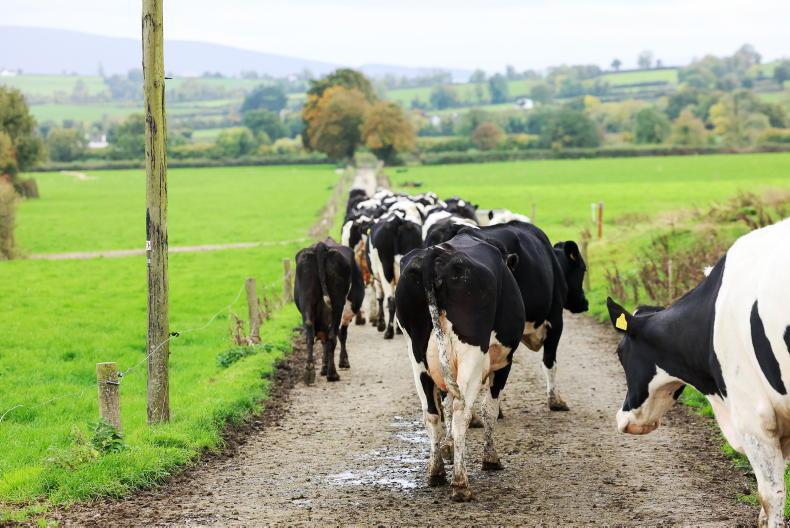
The speed and scale of this week’s milk price drops have come as a shock to the system. Dairygold farmers were literally out on the street a month ago following the price drop announced for August.
On Monday, we heard that another 3.57c/l (excluding VAT) was slashed off the Dairygold September milk price. Within hours of the Dairygold cut, Tirlán announced a 3.81c/l (excluding VAT) cut in the September price. Both Dairygold and Tirlán are now paying less than 40c/l of a base price when VAT is excluded.
Two of the largest processors in Ireland are unable to keep price above a threshold that many farmers feel represents the new “magic line” above which decent money is made. Below that line, farmers wonder if all the effort and stress of dairy farming is worth it. If fat cow prices remain buoyant, some farmers may cull hard, others may get out altogether.
Bad prices reveal all kinds of stress points and fault lines. Tirlán suppliers might have hoped that the Royal A-ware joint venture would deliver soft cheese sales that would underpin price when butter and cheddar markets slid.
So far, that has not proved to be the case and the only thing soft is the price of the cheese made in the new factory.
The Dealer hears that there is already some hard-talking going on between the two parties over the future ownership structure.
Dairygold suppliers seem to be similarly disappointed with how the €60m investment in Vita Actives is performing, with speculation circulating that the minority shareholder Deepak Sharma wants to exercise his option to trigger the sale of his remaining shares, which would cost in the region of a further €40m.
Dairygold stated the direct opposite publicly a few months ago, stating that Sharma was “deeply committed” to the project.
Timing
The upside for farmers is that if milk price has to fall, now is the time for it to do so, with the hope being that markets bottom out over the low output months ahead.
If prices were to rally in March and April, farmers could look forward to another decent year in 2026.
The downside is that markets, particularly butter markets, have collapsed. It’s a slump, and slumps can be slow to resolve themselves.
There has been one winner among the co-ops in terms of the timing of the downturn and its fallout. Kerry was bracing itself earlier this year for a winter of discontent in advance of the April 2026 “transfer window” for suppliers, when the current milk supply agreement expires.
Now, Kerry suppliers might be grumbling about their own house, but there is no appetite for a mass exodus to Dairygold, which is paying less for milk. Especially when so many Dairygold suppliers are in disagreement with their own co-op over strategy and representation.



SHARING OPTIONS