



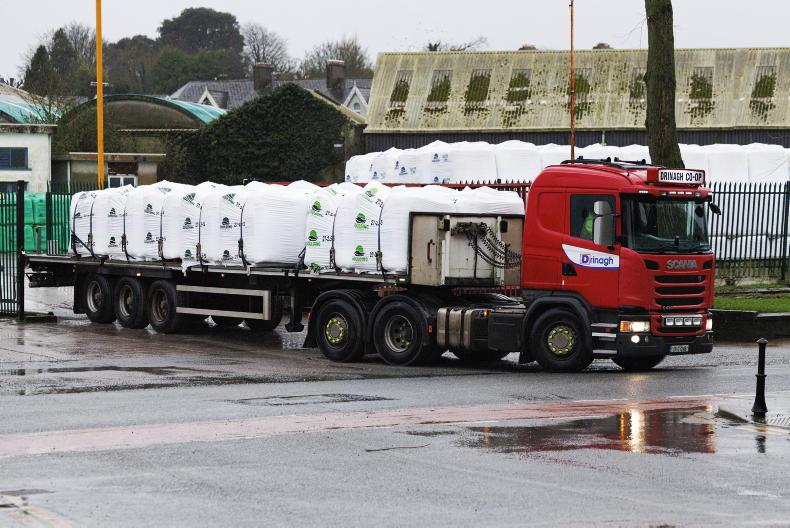
Just over 912,000 tonnes of fertiliser were sold to farmers by 11 March or were held in the yards of fertiliser importers, wholesalers and merchants.
This represents around 64% of the country’s likely fertiliser usage for the full fertiliser season, which runs from October to September.
The figures were provided to the Irish Farmers Journal by the Department of Agriculture from its national fertiliser database.
Fertiliser sales up to 11 March totalled 216,083 tonnes.
This included 89,285 tonnes of blended product, 42,250 tonnes of CAN, 59,640 tonnes of urea, and 23,935 tonnes of what the Department classed as “other fertiliser products”.
Meanwhile, the Department figures calculated that there were 696,201 tonnes of product available for sale on 11 March.
Blended product
This volume of product included 118,827 tonnes of blended product, 249,049 tonnes of CAN, 63,151 tonnes of urea, and 265,174 tonnes of other fertiliser products.
A Department spokesperson pointed out that the fertiliser sales figures may be higher than recorded as merchants have up to 15 April 2026 to submit sales returns to the database for March.
Given that Ireland used 1.4m tonnes of fertiliser in the 2024-25 season, the fertiliser sales and in-stock figures for the season to date suggest that Ireland has yet to source around 500,000 tonnes.
This could prove challenging and expensive given the worsening situation in the Middle East.
“Urea is in short supply as the Strait of Hormuz is effectively closed leading to delays in the transportation of fertiliser,” the Department spokesperson said.
“Iran is one of the largest producers of urea in the world and whilst Iranian urea is not imported into Ireland, the loss of its production has ramifications for global urea supply,” the spokesperson explained.
“In addition, gas supplies to Egypt have seen interruptions which has had an effect on fertiliser production; Egypt is a significant source of urea for Ireland,” the spokesperson added.
Middle East conflict
The Middle East conflict is causing major fertiliser supply disruption globally and has prompted a serious spike in prices.
Urea costs have increased 60% in Australia to reach around A$1,350/tonne or €800/tonne since the start of the war.
India has launched a major drive to secure fertiliser supplies outside the Gulf region, where it traditionally sourced 40% of its imports.
India uses 39 million tonnes of fertiliser each year, but has just 18 million tonnes in stock.
In further blow to global fertiliser supplies, China has imposed export restrictions as it seeks to protect its domestic users. Some nitrogen-potassium products and phosphates are included in the ban.




SHARING OPTIONS