


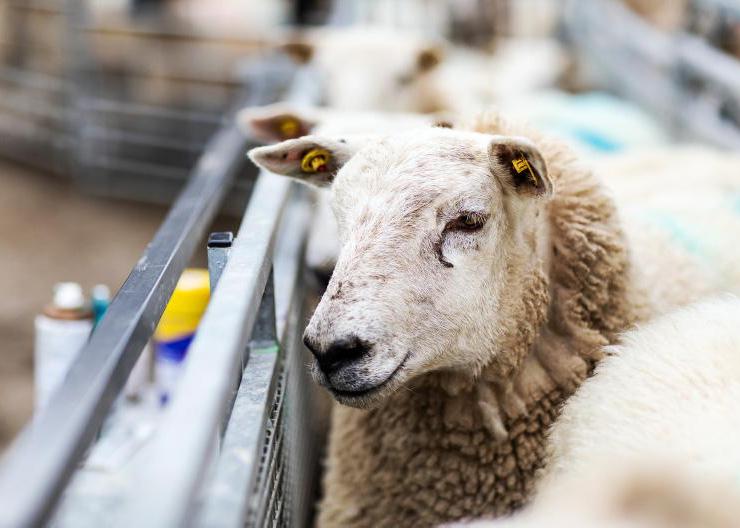
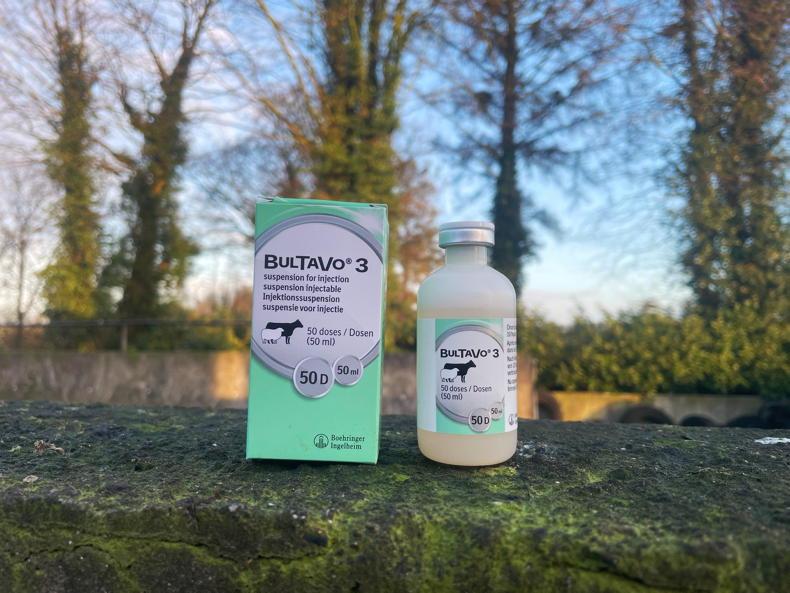
Vaccination against the bluetongue virus (BTV) will now be included as an optional action in the 2026 National Sheep Welfare Scheme (NSWS) and the 2026 National Beef Welfare Scheme (NBWS). The announcement was made this week by Minister for Agriculture Martin Heydon.
He said that vaccination can reduce the impact and severity of BTV on livestock and in turn mitigate both animal health and welfare issues and production losses which an infection may cause.
Minister Heydon also outlined that actions included in the 2026 sheep and beef schemes will “replicate the practical measures contained in the schemes implemented in 2025”.
NSWS actions
The announcement stated that NSWS will include an option to vaccinate, and that participants may choose to vaccinate against either BTV or clostridial diseases. This suggests that the suite of measures detailed in Table 1 will remain unchanged with regards participants having to select two mandatory actions to receive their core payment, with the option to select a third action likely to remain voluntary.
The minister stated that further details would be released closer to the opening date and commented that the NSWS is expected to open for applications in the first half of April.
As the scheme payment is based on a number of ewes over a given period, it is likely that the requirement to vaccinate will extend to ewes.
For example, if the payable number is 60 ewes then in the case of an inspection, the Department will seek proof that 60 vaccines have been purchased.
Payable number
While on the subject, the scheme payable number in 2025 was based on the average of the number of breeding ewes declared for the last three sheep census returns from 2022 to 2024.
Where ewe numbers declared in the 2024 census was higher, then an applicant could opt to claim the higher figure.
There is no reason to suggest that the 2026 scheme payable number will not be based on the average of sheep census returns from 2023 to 2025, or the 2025 scheme year, if higher. A farmer can opt to select a lower payable number if they wish.
The minister noted that he secured €50m in funding for 2026 with €22m allocated to sheep and €28m to beef.
If we assume that a similar number of flocks and ewes are entered in to the scheme in 2026 and that farmers opt to complete the same number of actions then it is probable that the payment will remain similar in 2026 – that is €8 for the completion of two mandatory category A actions (€4 for each action) and €3.50 for an optional category B action.
The payment rate will be confirmed in the coming weeks when the full details of the scheme are announced.
NBWS actions
The minister said that farmers completing the optional vaccination action in the NBWS will now have a third action to choose from with BTV vaccination joining the existing options of clostridial vaccination and pneumonia vaccination.
In contrast to the NSWS where the number of animals eligible is based on ewes, the payment in the NBWS is based on the number of calves born from 1 July 2025 to 30 June 2026.
The actions in the beef scheme need to be completed on calves as opposed to cows.
However the Irish Farmers Journal understands that the Department is open to the vaccine being administered to cows as the first line of defence in the herd. If a farmer opts to do both cows and calves then they can do so, but payment will be based on the eligible calf number. This will be confirmed in due course.
A funding allocation of €28m for 2026 means that if a similar number of farmers and calves are entered in to the scheme the payment will remain in the region of €67 per calf up to 45 calves. Farm organisations are calling for higher funding to be allocated to bring the payment rate back to the original figure of €75 per eligible calf.
For now, however, table 2 details the rate of payment per action and overall payment offered in 2026. It is important to highlight that BTV is not an added action and is an extra option within the vaccination action.
As can be seen there is likely to be a support payment of €12 available for BTV vaccination if that is the vaccination measure chosen. The actual payment rate will depend on number of calves entered in the scheme. The scheme is expected to open in August similar to previous years.
Timing of vaccination
The minister outlined: “I am publicising this new option now so that farmers thinking of vaccinating animals in advance of the 2026 schemes being rolled out can do so confident that vaccinating for bluetongue will be subsidised at existing payment rates. Spring is the optimum time for vaccinating for bluetongue, which should take place before the higher risk period during the warmer summer months.”
Farmers planning to vaccinate for BTV may obtain BTV vaccines from their veterinary practitioner, under licence from the Department.



SHARING OPTIONS