


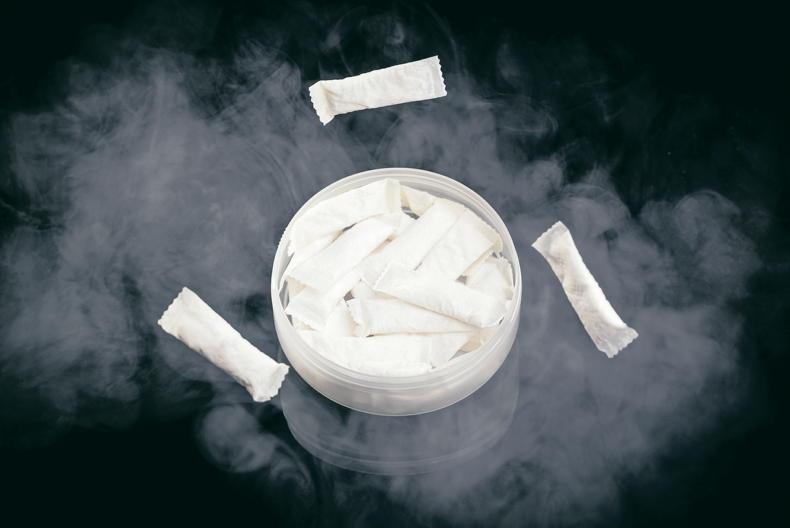
First it was smoking. Then it was vaping. And now? Nicotine pouches are the new kids on the block and they are rapidly gaining popularity. These products are primarily marketed towards young people – putting a whole new generation at risk.
If you aren’t familiar with them, a nicotine pouch could almost be mistaken for a teabag. A small white rectangle filled with powdered nicotine, flavourings and plant fibres, the user discreetly places the pouch under their upper lip for a hit of nicotine.
This ‘hit’ is initially a tingly sensation, as nicotine is absorbed through the gums and enters the bloodstream. Typically, within 10 minutes, the nicotine reaches the brain and triggers a release of adrenaline and an energy boost.
Nicotine pouches are often confused with ‘snus’, a name for pouches which contain tobacco leaves and are illegal to sell in Ireland. Unlike snus, nicotine products don’t contain tobacco and therefore they currently don’t fall under any legislation to ban or regulate them.
The irony is both deliver nicotine, both carry health risks, yet only one is currently regulated. Nicotine pouches typically cost €5.50-€7 for 10-15 pouches.
The concern is that nicotine pouches are being used in schools, and they make vaping look almost retrograde. The pouches are discreet and placed on the gum, so are easy to hide.
They are smokeless, odourless and in most cases, the only way that teachers find out about them is if a student is seen dropping one on the floor.
According to Paul Crone, director of the National Association of Principals and Deputy Principals (NAPD), nicotine pouches are: “touching every school in the country”. That includes primary schools, he adds. “I’m talking about sixth class children or even fifth class children. They would be aware of it, and some of them might be using it.”

Common sight in schools
Joe* (16) is in a secondary school in the west of Ireland. He tells Irish Country Living that nicotine pouches “are pretty common among my peers.”
“I don’t use it myself but I know lads who do and they say they take it for the nicotine hit. My school doesn’t allow us to vape on school property, even though plenty of students do get caught in the toilets vaping, but the teachers wouldn’t know if a lad had a nicotine pouch in his gums during class, which plenty do.”
Sarah*, a 19-year-old college student from Co Carlow echoes Joe’s points. She says that nicotine pouches are “becoming a lot more popular than the actual vaping, because it’s so much easier to get away with. It’s just gotten so popular, you can see them being sold in the petrol stations and shops don’t ID for anything like that.
“Not a lot of young people would really smoke. That’s not a thing. But I remember in school, when we were in sixth year two years ago, the boys used to just use nicotine pouches in class, but they were never caught because they’re shoving it up into their gums. The teachers are oblivious to it.
“A lot of people that I went to school with did vape. They said that they went on to the pouches to get away from the vapes. But you just find that they actually got more addicted to the pouches than the actual vapes because they are shoving them up their gums every 20 minutes, which obviously isn’t good for them.”
Although Sarah does not vape herself, many of her friends do. “They use them at home and their parents don’t notice because it’s so discreet.” And on nights out, nicotine pouches are “everywhere”.
“You see it on the bathroom floors and everything, it’s everywhere. In bars, you see them on the ground, in toilets. In college, we had pre-drinks in our apartment. The next morning, there was just pouches everywhere.
“I think some people look at it like ‘I don’t vape because vaping is not cool but I use nicotine pouches.’”
Paul Crone says that some students are directly influenced by sports players and celebrities who use them. Nicotine pouches are also sold in different flavours, like strawberry and bubblegum, and directly marketed at young people.
In terms of the impact in the classroom, Paul claims that the nicotine pouches could be affecting students’ mood and ability to concentrate. “There’s an increase in irritability at certain times,” he reflects. “We have so many of our students that are addicted that we’re going to see the withdrawal symptoms and all that goes with that, like the increase in student anxiety.”
At the end of last year, the HSE issued a health advisory notice for schools to open a conversation around nicotine pouches with parents in a non-judgemental way.
“I would put this challenge to any parent,” Paul continues.
“Ask your teenager, do they know about nicotine pouches? They know about them, and they know where to get them, and they know who has them, and they know who’s using them. There is a whole world our teenage children are living that we don’t know anything about.”
Cause for concern
The highly addictive nature of the pouches is also a cause for concern for Professor Patrick Mitchell, respiratory consultant at Blackrock Health, who describes them as “gateway drugs” that can lead to vaping or smoking.
“These are nefarious efforts by companies to try and get young, unsuspecting, innocent teenagers and young adults addicted to what is one of the most addictive substances known to mankind, and that is nicotine,” he says, plainly.
“Once you become addicted to nicotine, it is very difficult to stop and to get over that addiction. Just look at the number of people who genuinely want to stop smoking and cannot. It is not because of the cigarette, it is not because of the tobacco, it is because of the nicotine.
“Nicotine pouches are marketed as these clean modern products. This is highly misleading. The nicotine content can be extremely high, leading to addiction.”
“The dosage of nicotine can be equivalent to several cigarettes. The nicotine passes through the lining of the mouth and enters the bloodstream, quickly reaches the brain, very quickly breaching the blood brain barrier and attaches onto receptors called nicotinic acetylcholine receptors. These are like docking stations, and they get this trigger effect.”
This causes the buzz and increased alertness that keeps people hooked, the ‘reward hit’.
“That why some people say: ‘oh, it helps me focus. It helps with my anxiety.’ However, you need to take it all the time so there is a cumulative dose dependent effect that is required,” Professor Mitchell explains.

“Afterwards, when coming down, people can get jittery, irritable, and there’s restlessness, anxiety, agitation, racing thoughts.”
There are also significant physical effects, including increased heart rate, increased blood pressure, and palpitations, as well as problems in the mouth and gums, like blisters, soreness, and tooth sensitivity.
“Nicotine is a vasoconstrictor. It causes blood vessels to constrict, and therefore, it compromises long-term health of the gums, risking gum irritation and bad breath.”
Dr Caroline Robins of Kiwi Dental in Co Carlow reinforces this. “If the pouch is held inside the mouth beside the gum, it could cause localised irritation,” she says. “Nicotine contributes to decreased saliva flow which could dry the mouth and lead to decay or gum disease issues in a mouth that has poorer oral hygiene and irregular cleaning habits.”
Policy interventions
A major issue with nicotine pouches is their accessibility. They fall outside the scope of existing tobacco control legislation, and are not subject to Tobacco Products Tax or any other specific form of taxation. This means not only are they currently legal to sell in Ireland but details of their sale in Ireland are not returned to Revenue.
The Government therefore has no handle on the extent of sales.
Last July, the EU Commission officially adopted a proposal for a recast of the Tobacco Tax Directive. The revision proposes to expand the Directive to include new products like nicotine pouches. The Department of Finance says this is “a welcome proposal”.
“Ireland is largely supportive of the measures included in the revised directive and looks forward to constructive engagement on the directive over the coming months,” a spokesperson from the Department of Finance told Irish Country Living.
*Names have been changed to protect the anonymity of individuals.
- A spokesperson from the HSE said that: “Nicotine pouches contain nicotine powder mixed with flavourings, sweeteners, fillers and other chemicals.”
- The nicotine pouch is placed between your lip and gum, and nicotine is absorbed through the lining of the mouth and enters the bloodstream.
- Nicotine pouches have the same addictive effects as smoking or vaping, despite being marketed as ‘tobacco-free’. People who use them are at a very high risk of developing nicotine dependence.
The long-term effects of nicotine pouches are still not fully understood, but they carry significant risks, including oral inflammation and dental health problems.
- Nicotine pouches are not covered by the same laws as tobacco products. “New legislation will need to be considered by Government to regulate the sale, supply and marketing of these products,” according to the HSE.






SHARING OPTIONS