


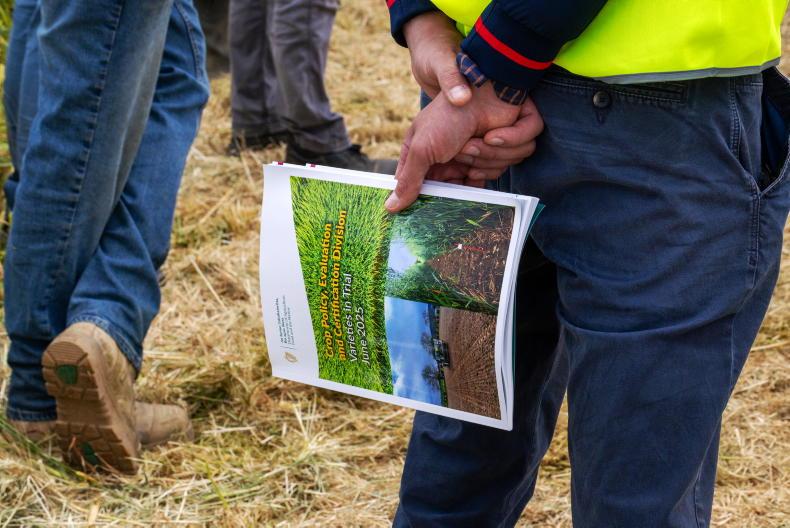
Winter planting: The winter wheat and winter oats lists from the Department of Agriculture are on this week’s tillage pages. Barley was in last week’s paper and all are available online.
Look through and choose varieties suited to your farm and order seed as soon as possible. Before this you should do up your books with estimated prices and decide how much of each crop should be grown. What is going to make you the most money? What crops can you grow best and are suited to your land? Having your costs estimated is essential before you order any seed for the coming season.
Urea: Some farmers received notice last week to remind them that unprotected urea can no longer be used. Many tillage farmers did not receive this notice. However, they should note that it applies to everyone.
The Department of Agriculture, Food and the Marine has reminded farmers that unprotected urea (ie urea that has not been coated with a urease inhibitor) in solid form will no longer be permitted to be spread on land after 14 September 2025.
“This restriction applies to all urea nitrogen (N) products with ureic N content of 1% or above, including those products blended with secondary macronutrients (eg sulphur) and/or micronutrients (eg selenium). However, the restriction does not apply to blends or compounds containing unprotected urea and phosphorus. Furthermore, unprotected urea can still be used in liquid form as a fertiliser.”
The move aims to reduce Ireland’s ammonia emissions, but research into the use of protected urea on tillage crops is not abundant.
Machinery: With the early harvest it’s now an ideal time to service tractors and machinery. Make sure vehicles are serviced. Clean out drills and ensure any parts that are worn or under pressure are replaced or fixed. Check PTO covers are safe and replace if needed. Doing some small jobs now could save you a lot of time at planting. We don’t know what weather will come for winter planting so it’s best to be prepared and ready to go when allowed.
Glyphosate: Many farmers will be ordering glyphosate or spraying off weeds and volunteers in fields in the coming weeks. As cases of glyphosate resistance have been found in Ireland and as it gets harder to control weeds on farms, it is essential that you use trusted products and high rates. Teagasc has found that some generic glyphosate does not perform as well as Roundup, so a higher rate is needed where generics are used.
To control bromes and canary grass, you need 540g of Roundup per hectare (1.5l/ha of 360g/l glyphosate), but you need 720g/ha (2l/ha of 360g/l glyphosate) of generic products. To control blackgrass or Italian ryegrass, you need 720g/ha of Roundup, but you need 1,080g/ha of generic glyphosate (3l/ha of 360g/l glyphosate).
Mizr is a generic glyphosate made by Bayer and should generally be treated as a Roundup product and not a generic.




SHARING OPTIONS