


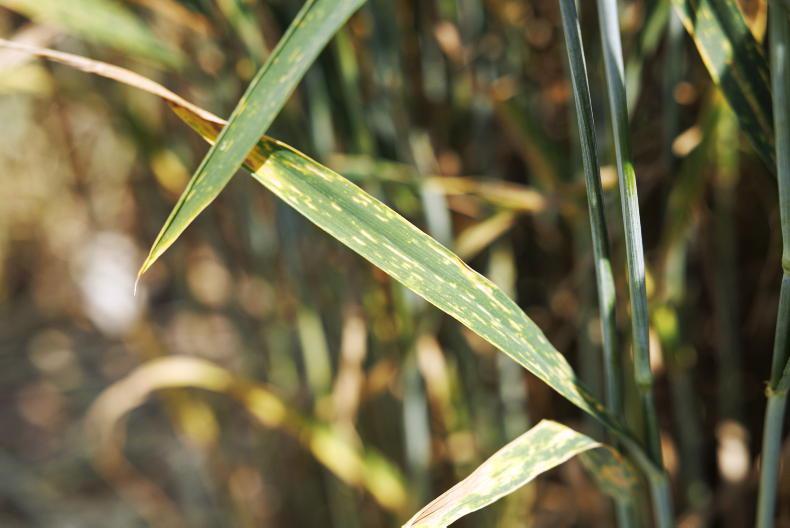
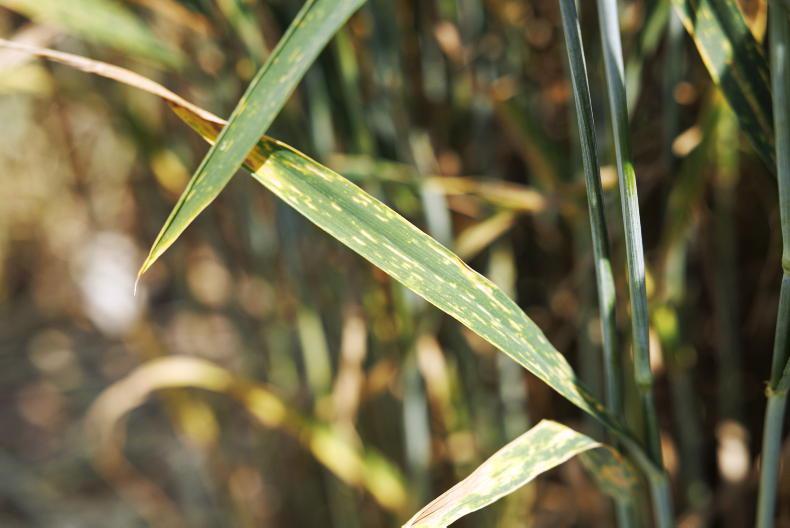
The majority of winter wheat varieties are now susceptible to yellow rust after the breakdown of the YR15 resistance gene last year.
This is according to Teagasc’s Steven Kildea, who was speaking at a workshop session on diseases at the National Tillage Conference.
Yellow rust must now be considered during the T0, T1, and T2 spray timings and it is important to keep a close eye on wheat crops to prevent the disease from becoming established.
However, Kildea noted there are a range of chemistries available that are quite effective against yellow rust once they are used in a protective manner before yellow rust enters a crop.
Early applications are essential, especially on susceptible varieties.
There are two exceptions to this; the multi-site fungicides folpet and sulphur will not provide the same level of control as the other fungicides.
This is important as they are often used at the T0 timing by themselves to control septoria.
Kildea says that an azole or strobilurin should be used alongside the multi-site at the T0 timing on a susceptible variety or a moderately resistant variety that has yellow rust present.
An azole/strobilurin mix should be used if a susceptible variety has yellow rust present.
The T1 leaf three spray should focus on septoria, but also contain some activity against yellow rust.
Septoria
Kildea also discussed the Teagasc wheat fungicide star ratings for 2026. These star ratings give an indication of the expected control of septoria, with five stars indicating excellent control and one star indicating little to no control.
There are only some small changes from the 2025 ratings and these changes are provisional because 2025 was a low septoria pressure year.
Elatus Era and prothioconazole were noted to have weaker control than expected in 2025, while folpet and sulphur (Thiopron) have gained an additional star when they are used in a protective situation. These provisional changes will be further studied this year.
Kildea highlighted that no resistance to Inatreq has been detected so far and Univoq was shown to give very good protective control at a trial in Oak Park. Revystar XL and sulphur (Thiopron) also gave good control.
The control given by benzovindiflupyr + prothioconazole (Elatus Era), prothioconazole (Proline), pyraclostrobin (Comet), tebuconazole (Folicur) and prothioconazole + tebuconazole (Prosaro) was poor, with tebuconazole being the only one of these five to reach over 40% control of septoria.
It was noted that the buildup of resistance to azoles and SDHIs is stable and has not got any worse. Kildea added that getting the fungicide application timings right still remains critical for septoria control.



SHARING OPTIONS