A new pea plant has been developed which is flavourless, has a better nutrition profile than a standard pea and has fewer allergens. The development could provide another crop for Irish tillage farmers to grow and provide an alternative to soybean production and possibly help in the production of pea flour.
The research work is being carried out by Germinal, the John Innes Centre, the Institute of Biological, Environmental and Rural Sciences (IBERS) at Aberystwyth University, and the Processors and Growers Research Organisation (PGRO).
Paul Billings, chief executive of Germinal Ireland and the UK, said: “Pea crops provide a rich source of protein and boost soil health through fixing free atmospheric nitrogen, leaving behind a supply of nutrients for following crops in crop rotations.
Their potential to help reduce reliance on imports of soya, which in Ireland can amount to three-quarters of a million tonnes per year, is enormous. But this also depends on our ability to broaden out their use as a sustainably produced, locally grown source of protein in food manufacturing.
“We have now cleared a further hurdle by improving the protein quality of peas while removing the flavour that holds back their wider use and demand in food manufacturing. This has been achieved through traditional plant breeding methodologies.”
The project was awarded a €1.15 million research grant in 2023 by the UK Department of the Environment, Food and Rural Affairs and the Farming Innovation Pathways via Innovate UK. It had three main objectives:
To produce a viable alternative to imported soya with home-grown protein crops.To meet market demand for taste and functionality in food manufacturing.To produce a protein alternative to soya that can be grown sustainablyResearch by the John Innes Centre previously found characteristics on the flavour of peas and traits that enhance their protein quality.
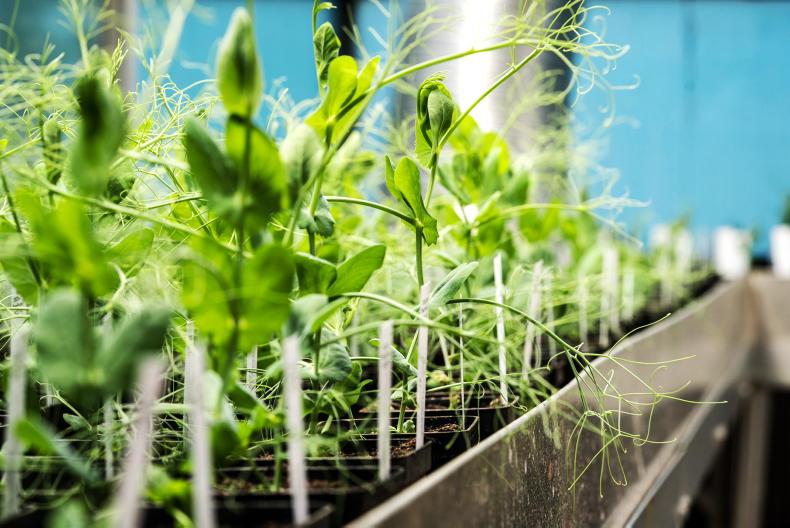
Samples of a new pea plants growing at Germinal Horizon at Aberystwyth University, Wales.
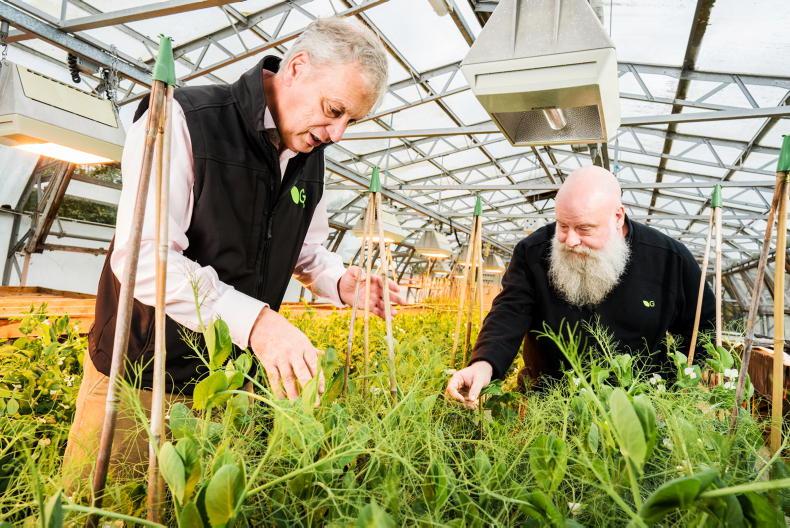
The first phase of this project was to incorporate these innovations into commercially viable pea plants. This was done using traditional breeding methods and was carried out as part of Germinal Ireland’s research portfolio in Germinal’s research division (Germinal Horizon embedded at Aberystwyth University in Wales).
At present those varieties are being developed and will be tested on farms to examine their agronomic performance and their food processing attributes.
Roger Vickers, chief executive of the Processors and Growers Research Organisation, said:
“We are now about to embark on the next phase of the project which is to multiply the seed stock to permit testing of their agronomic performance under practical farm growing conditions.
“This project has the potential to introduce a protein crop with a wide range of applications in food manufacturing that will be both commercially attractive to farmers and a significant contributor in terms of nutrients, soil health and disease control in arable rotations.”
A new pea plant has been developed which is flavourless, has a better nutrition profile than a standard pea and has fewer allergens. The development could provide another crop for Irish tillage farmers to grow and provide an alternative to soybean production and possibly help in the production of pea flour.
The research work is being carried out by Germinal, the John Innes Centre, the Institute of Biological, Environmental and Rural Sciences (IBERS) at Aberystwyth University, and the Processors and Growers Research Organisation (PGRO).
Paul Billings, chief executive of Germinal Ireland and the UK, said: “Pea crops provide a rich source of protein and boost soil health through fixing free atmospheric nitrogen, leaving behind a supply of nutrients for following crops in crop rotations.
Their potential to help reduce reliance on imports of soya, which in Ireland can amount to three-quarters of a million tonnes per year, is enormous. But this also depends on our ability to broaden out their use as a sustainably produced, locally grown source of protein in food manufacturing.
“We have now cleared a further hurdle by improving the protein quality of peas while removing the flavour that holds back their wider use and demand in food manufacturing. This has been achieved through traditional plant breeding methodologies.”
The project was awarded a €1.15 million research grant in 2023 by the UK Department of the Environment, Food and Rural Affairs and the Farming Innovation Pathways via Innovate UK. It had three main objectives:
To produce a viable alternative to imported soya with home-grown protein crops.To meet market demand for taste and functionality in food manufacturing.To produce a protein alternative to soya that can be grown sustainablyResearch by the John Innes Centre previously found characteristics on the flavour of peas and traits that enhance their protein quality.
Samples of a new pea plants growing at Germinal Horizon at Aberystwyth University, Wales.
The first phase of this project was to incorporate these innovations into commercially viable pea plants. This was done using traditional breeding methods and was carried out as part of Germinal Ireland’s research portfolio in Germinal’s research division (Germinal Horizon embedded at Aberystwyth University in Wales).
At present those varieties are being developed and will be tested on farms to examine their agronomic performance and their food processing attributes.
Roger Vickers, chief executive of the Processors and Growers Research Organisation, said:
“We are now about to embark on the next phase of the project which is to multiply the seed stock to permit testing of their agronomic performance under practical farm growing conditions.
“This project has the potential to introduce a protein crop with a wide range of applications in food manufacturing that will be both commercially attractive to farmers and a significant contributor in terms of nutrients, soil health and disease control in arable rotations.”





SHARING OPTIONS