Flahavan’s is a household name. In fact, it is the oldest family food business in Ireland and at present is being run by the seventh generation of the family.
The mill has been based in Kilmacthomas since 1785. However, back then the product was mainly sold at home.
Now, Flahavan’s sells three times more products internationally than it does domestically.
Flahavan’s promoted organic oats long before it became the thing to do at Government and EU level, and could be credited with the build up of the organic tillage area in Ireland, because, without a premium product in the market, tillage farmers would struggle to make the conversion.
The company saw a record intake of organic oats in 2025, with 10,000t crossing the weighbridge and another 2,000t needed to keep up with demand in the coming years.
Speaking at the Flahavan’s Organic Oat Growers’ Conference in Co Laois last week, James Flahavan said that in 2025 supply came very close to demand.
“We have a lot more upside in terms of demand and where we want to go,” he said, and added that there is more appetite for organic oats.
James commented that many organic tillage farmers are “quite heavily reliant” on Flahavan’s organic oats to make their farm sustainable. He said this is good for Flahavan’s, but did note it has to be managed sustainably.

The farmer panel of Matt Hennessy, Pat O'Connor, James O'Connell and Joe Nolan at the Flahavan's Organic Oat Growers Conference.
He would like to see farmers growing more crops on their farms, to improve rotations and make their farms sustainable in the long-term.
He added that nights like the growers’ conference bring farmers together to learn from each other.
However, more research is needed to help growers and it should be noted that organic growers don’t have much choice on the crops they grow, as other markets are limited.
Carbon footprint
The possibilities for Irish oats remain positive. A presentation on AgNav and the carbon footprint of Irish grain showed a crop of organic spring oats yielding 4t/ha had a carbon footprint of 196.42kg CO2eq/t and just 37.04kg CO2eq/t, when straw chopping and other offsets were taken into account.
A 5t/ha crop only produced 152.56kg CO2eq/t and had a net carbon footprint of -6.82kg CO2eq/t, when straw chopping and other offsets were accounted for. This means the oats are actually taking carbon from other sectors and sequestering it as well as the carbon oats produce.
Speaking on AgNav James said: “There would be huge opportunities for it. I think particularly on the international side.
“We know the yields are amongst the highest in the world coming out of Irish-grown oat crops. Therefore, the carbon footprint would automatically be lower. So potentially, yes, Irish oats relative to other oats in other countries, have a fantastic story to tell but it’s still a work in progress. We’d love to see how we can do more with it.”

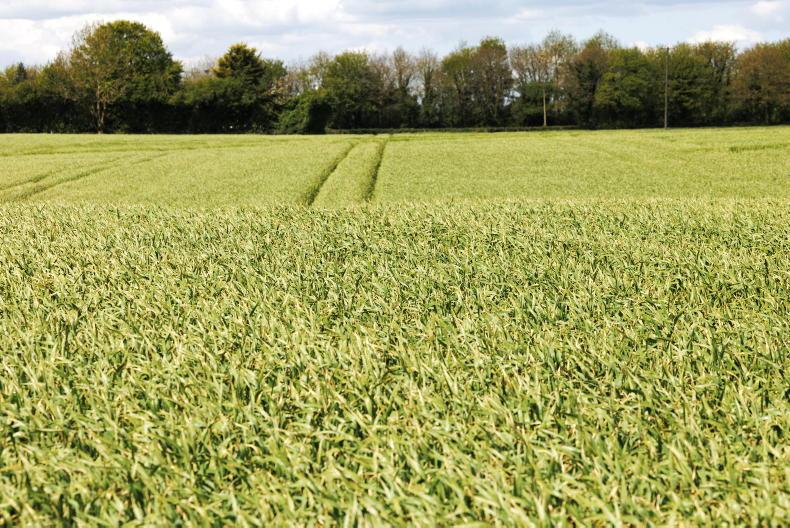
Oats being grown for Flahavan's.
Margaret Farrell of Teagasc encouraged the growers in attendance to use AgNav and to contact their adviser for support in filling out the details to improve the data that is currently there.
What organic farmers had to say
A panel discussion made for interesting listening at the conference. Matt Hennessy from south Tipperary joined the Organic Farming Scheme five years ago. He has just over 100ac of oats and 20ac of barley. Matt and his son had livestock on the farm up to two years ago and had been milking cows, but bought a combine and are now stockless, although sheep will come in to graze a catch crop on 1 January.
Joe Nolan from Fenagh in Co Carlow has 60ac of oats for Flahavan’s, 17ac of seed oats and 40ac of combi crop. Joe only had sheep on the farm up to five years ago, but is now working hard on a rotation and planting catch crops to get high yields.
He commented that the cover crops grew so well this year he doesn’t know if he has enough sheep to graze them. The sheep are really important for soil fertility and while he said there will always be weeds in organics, he does think the sheep grazing helps to reduce weed levels.
James O’Connell farms in Loughmore, Thurles and has tillage and grassland. He rents most of the land and has drystock, along with winter and spring oats, winter barley and some winter wheat. He joined organics in 2015 and began supplying Flahavan’s in 2017. James said he predominantly grows winter oats. His land is suitable for the crop and he finds the weed burden is lower. He does have to hand pick some charlock, but has it down to a limited number of fields now.
He emphasised that good ploughing is the most important thing for weed control.
He then goes in with a one-pass and closes the gate until harvest. He targets spring crops to his more marginal land. James brings in dairy sludge and has his own farmyard manure.
James noted that frosty weather this year helped winter crops to tiller and this helped with yields.
Pat O’Connor does not have any stock on his farm. He has 90ac of oats, 7-8ac of wheat and 12ac of grass.
Next year he will increase his area of grass to get a rotation on track and boost yields in the future.
He takes in sheep and cattle to graze off cover crops and grass. Pat said his farm has very dry land and this year the later crops were sown, the worse yield they had.
He under-sows some fields to have a living mulch in the ground after harvest. Sheep graze those fields then and provide a cleaner field when ploughing. Clearing the volunteer cereals also helps to reduce the disease and mosaic virus risk.
Organic markets
In November, the Department of Agriculture will reopen the Organic Farming Scheme and Niall Ryan of the Department of Agriculture told the Flahavan’s Organic Oat Growers’ Conference that tillage farmers will be prioritised under the scheme for 2026.
Niall said that the organic market globally is worth about €130bn. Of this, €63bn is in North America and Europe has the next biggest demand for the produce. He noted that 10.9%, or 17.7m hectares, of land in the EU is in organic production – 42% grassland, 43% arable, 13% permanent crops and 2% others.
There are 434,577 producers and 89,379 processors. The Department inspector explained that the area under organics is doubling every 10 years or so. Based on current figures, he says 18% of the EU farming area will be in organics by 2030. It will hit around 25% by 2033 or 2035.
In Ireland we’re at about 5.5% of farmland in organics. Austria has 27% of its land in organics, while Italy is at 18%.
Ireland’s organics
About 248,000ha are farmed organically in Ireland by 5,500 farmers. Niall noted that organic farmers tend to be younger than conventional farmers. In fact, 38% of Organic Farming Scheme participants are under 49 years old. Out of all applicants to the BISS 21% are under 49.
Niall outlined figures for the organic cereal area. In 2025, there were approximately 2,703ha of spring oats and a further 230ha in conversion.
There were 738ha of winter oats and another 40ha in conversion, while there were 245ha of spring barley and another 92ha in conversion. The protein-cereal mix crop takes up 1,249ha and there are another 181ha in conversion.
What sort of profits are there
from organic oats?
At the conference, Teagasc’s organic tillage adviser Martin Bourke outlined some of the cost and returns figures for organic spring oats at varying yields. These figures are displayed in Table 1.
It is important to note that these figures are based on owned land and do not include other fixed costs like hedge-cutting, consulting, etc.
The figures show that in all cases farmers made a profit, although at the lower yields the straw payment played an important role.
For example, at a yield of 2t/ha the Straw Incorporation Measure (SIM) payment accounted for €250/ha of the €315/ha profit. Meaning straw accounted for 80% of the profit per hectare.
However, if you can reach the higher end of the yields at 5t/ha (2t/ac) then straw only contributes to 16% of the profit.
Yields can be hugely variable in all farming systems, but probably more so in organics. Farmers will know what yields they reach on average on their farm, but it is important for farmers to consider factors that hit their yields.
For example, if you are not long out of conversion your soil indices may still be high enough, but if you don’t do anything to maintain those indices then yields will fall back.
Those in conversion also need to remember they will take a hit in yields during conversion, but will not receive the organic premium. However, the figures outlined in Table 1 do not include the organic payments or the BISS payment or any other schemes apart from the SIM. Farmers also have the opportunity to take part in ACRES and Farming for Water and avail of Protein Aid.
Organic manures
Martin also detailed some trial work on organic manures over a three-year period. As you would expect there was a significant yield increase in crops that received organic manures. In the trial, the untreated yield over three years was 3.66t/ha. Martin said an application of 3,000 gallons per acre of cattle slurry increased yield by 0.55t/ha. He placed the benefit of the cattle slurry a0t €103/ha and noted it will help to build up K in the soil.
An application of 0.5t/ha of poultry pellets increased yield by 0.59t/ha. He said this places the payback on the pellets at about breakeven at a cost of €210/t for pellets.
How are Flahavan’s products performing?
As of December 2024, Flahavan’s Organic Porridge Oats was the number two brand in hot cereals and in the top 20 brands of cereals in the UK.

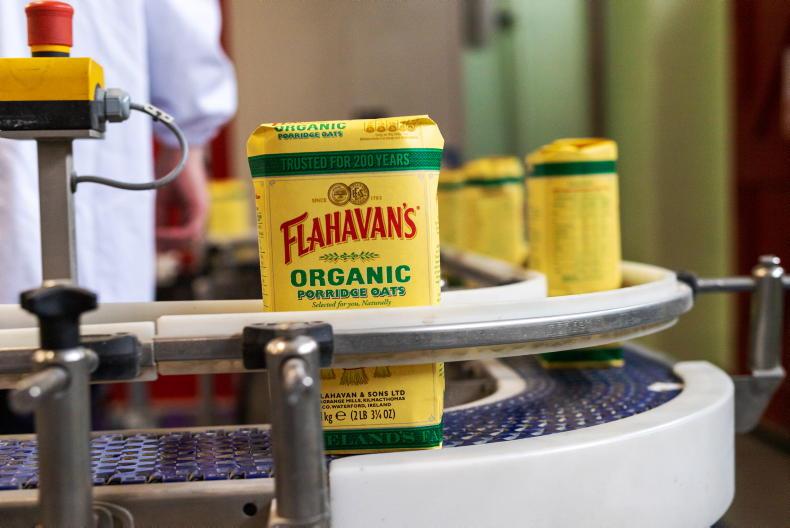
Flahavan's now sell three times more produccts internationally as it does domestically. \ Claire Nash
It is the only brand with double digit growth year-on-year and is the fastest growing brand in the category. It was the only family-owned business on the list. Flahavan’s Organic Oats was also the only product to get two gold stars in its category in the great taste awards, which is blind tasted.
The main retailers for the product in the UK are Tesco, Waitrose and Sainsbury’s.
Flahavan’s is a household name. In fact, it is the oldest family food business in Ireland and at present is being run by the seventh generation of the family.
The mill has been based in Kilmacthomas since 1785. However, back then the product was mainly sold at home.
Now, Flahavan’s sells three times more products internationally than it does domestically.
Flahavan’s promoted organic oats long before it became the thing to do at Government and EU level, and could be credited with the build up of the organic tillage area in Ireland, because, without a premium product in the market, tillage farmers would struggle to make the conversion.
The company saw a record intake of organic oats in 2025, with 10,000t crossing the weighbridge and another 2,000t needed to keep up with demand in the coming years.
Speaking at the Flahavan’s Organic Oat Growers’ Conference in Co Laois last week, James Flahavan said that in 2025 supply came very close to demand.
“We have a lot more upside in terms of demand and where we want to go,” he said, and added that there is more appetite for organic oats.
James commented that many organic tillage farmers are “quite heavily reliant” on Flahavan’s organic oats to make their farm sustainable. He said this is good for Flahavan’s, but did note it has to be managed sustainably.
The farmer panel of Matt Hennessy, Pat O'Connor, James O'Connell and Joe Nolan at the Flahavan's Organic Oat Growers Conference.
He would like to see farmers growing more crops on their farms, to improve rotations and make their farms sustainable in the long-term.
He added that nights like the growers’ conference bring farmers together to learn from each other.
However, more research is needed to help growers and it should be noted that organic growers don’t have much choice on the crops they grow, as other markets are limited.
Carbon footprint
The possibilities for Irish oats remain positive. A presentation on AgNav and the carbon footprint of Irish grain showed a crop of organic spring oats yielding 4t/ha had a carbon footprint of 196.42kg CO2eq/t and just 37.04kg CO2eq/t, when straw chopping and other offsets were taken into account.
A 5t/ha crop only produced 152.56kg CO2eq/t and had a net carbon footprint of -6.82kg CO2eq/t, when straw chopping and other offsets were accounted for. This means the oats are actually taking carbon from other sectors and sequestering it as well as the carbon oats produce.
Speaking on AgNav James said: “There would be huge opportunities for it. I think particularly on the international side.
“We know the yields are amongst the highest in the world coming out of Irish-grown oat crops. Therefore, the carbon footprint would automatically be lower. So potentially, yes, Irish oats relative to other oats in other countries, have a fantastic story to tell but it’s still a work in progress. We’d love to see how we can do more with it.”
Oats being grown for Flahavan's.
Margaret Farrell of Teagasc encouraged the growers in attendance to use AgNav and to contact their adviser for support in filling out the details to improve the data that is currently there.
What organic farmers had to say
A panel discussion made for interesting listening at the conference. Matt Hennessy from south Tipperary joined the Organic Farming Scheme five years ago. He has just over 100ac of oats and 20ac of barley. Matt and his son had livestock on the farm up to two years ago and had been milking cows, but bought a combine and are now stockless, although sheep will come in to graze a catch crop on 1 January.
Joe Nolan from Fenagh in Co Carlow has 60ac of oats for Flahavan’s, 17ac of seed oats and 40ac of combi crop. Joe only had sheep on the farm up to five years ago, but is now working hard on a rotation and planting catch crops to get high yields.
He commented that the cover crops grew so well this year he doesn’t know if he has enough sheep to graze them. The sheep are really important for soil fertility and while he said there will always be weeds in organics, he does think the sheep grazing helps to reduce weed levels.
James O’Connell farms in Loughmore, Thurles and has tillage and grassland. He rents most of the land and has drystock, along with winter and spring oats, winter barley and some winter wheat. He joined organics in 2015 and began supplying Flahavan’s in 2017. James said he predominantly grows winter oats. His land is suitable for the crop and he finds the weed burden is lower. He does have to hand pick some charlock, but has it down to a limited number of fields now.
He emphasised that good ploughing is the most important thing for weed control.
He then goes in with a one-pass and closes the gate until harvest. He targets spring crops to his more marginal land. James brings in dairy sludge and has his own farmyard manure.
James noted that frosty weather this year helped winter crops to tiller and this helped with yields.
Pat O’Connor does not have any stock on his farm. He has 90ac of oats, 7-8ac of wheat and 12ac of grass.
Next year he will increase his area of grass to get a rotation on track and boost yields in the future.
He takes in sheep and cattle to graze off cover crops and grass. Pat said his farm has very dry land and this year the later crops were sown, the worse yield they had.
He under-sows some fields to have a living mulch in the ground after harvest. Sheep graze those fields then and provide a cleaner field when ploughing. Clearing the volunteer cereals also helps to reduce the disease and mosaic virus risk.
Organic markets
In November, the Department of Agriculture will reopen the Organic Farming Scheme and Niall Ryan of the Department of Agriculture told the Flahavan’s Organic Oat Growers’ Conference that tillage farmers will be prioritised under the scheme for 2026.
Niall said that the organic market globally is worth about €130bn. Of this, €63bn is in North America and Europe has the next biggest demand for the produce. He noted that 10.9%, or 17.7m hectares, of land in the EU is in organic production – 42% grassland, 43% arable, 13% permanent crops and 2% others.
There are 434,577 producers and 89,379 processors. The Department inspector explained that the area under organics is doubling every 10 years or so. Based on current figures, he says 18% of the EU farming area will be in organics by 2030. It will hit around 25% by 2033 or 2035.
In Ireland we’re at about 5.5% of farmland in organics. Austria has 27% of its land in organics, while Italy is at 18%.
Ireland’s organics
About 248,000ha are farmed organically in Ireland by 5,500 farmers. Niall noted that organic farmers tend to be younger than conventional farmers. In fact, 38% of Organic Farming Scheme participants are under 49 years old. Out of all applicants to the BISS 21% are under 49.
Niall outlined figures for the organic cereal area. In 2025, there were approximately 2,703ha of spring oats and a further 230ha in conversion.
There were 738ha of winter oats and another 40ha in conversion, while there were 245ha of spring barley and another 92ha in conversion. The protein-cereal mix crop takes up 1,249ha and there are another 181ha in conversion.
What sort of profits are there
from organic oats?
At the conference, Teagasc’s organic tillage adviser Martin Bourke outlined some of the cost and returns figures for organic spring oats at varying yields. These figures are displayed in Table 1.
It is important to note that these figures are based on owned land and do not include other fixed costs like hedge-cutting, consulting, etc.
The figures show that in all cases farmers made a profit, although at the lower yields the straw payment played an important role.
For example, at a yield of 2t/ha the Straw Incorporation Measure (SIM) payment accounted for €250/ha of the €315/ha profit. Meaning straw accounted for 80% of the profit per hectare.
However, if you can reach the higher end of the yields at 5t/ha (2t/ac) then straw only contributes to 16% of the profit.
Yields can be hugely variable in all farming systems, but probably more so in organics. Farmers will know what yields they reach on average on their farm, but it is important for farmers to consider factors that hit their yields.
For example, if you are not long out of conversion your soil indices may still be high enough, but if you don’t do anything to maintain those indices then yields will fall back.
Those in conversion also need to remember they will take a hit in yields during conversion, but will not receive the organic premium. However, the figures outlined in Table 1 do not include the organic payments or the BISS payment or any other schemes apart from the SIM. Farmers also have the opportunity to take part in ACRES and Farming for Water and avail of Protein Aid.
Organic manures
Martin also detailed some trial work on organic manures over a three-year period. As you would expect there was a significant yield increase in crops that received organic manures. In the trial, the untreated yield over three years was 3.66t/ha. Martin said an application of 3,000 gallons per acre of cattle slurry increased yield by 0.55t/ha. He placed the benefit of the cattle slurry a0t €103/ha and noted it will help to build up K in the soil.
An application of 0.5t/ha of poultry pellets increased yield by 0.59t/ha. He said this places the payback on the pellets at about breakeven at a cost of €210/t for pellets.
How are Flahavan’s products performing?
As of December 2024, Flahavan’s Organic Porridge Oats was the number two brand in hot cereals and in the top 20 brands of cereals in the UK.
Flahavan's now sell three times more produccts internationally as it does domestically. \ Claire Nash
It is the only brand with double digit growth year-on-year and is the fastest growing brand in the category. It was the only family-owned business on the list. Flahavan’s Organic Oats was also the only product to get two gold stars in its category in the great taste awards, which is blind tasted.
The main retailers for the product in the UK are Tesco, Waitrose and Sainsbury’s.





SHARING OPTIONS