


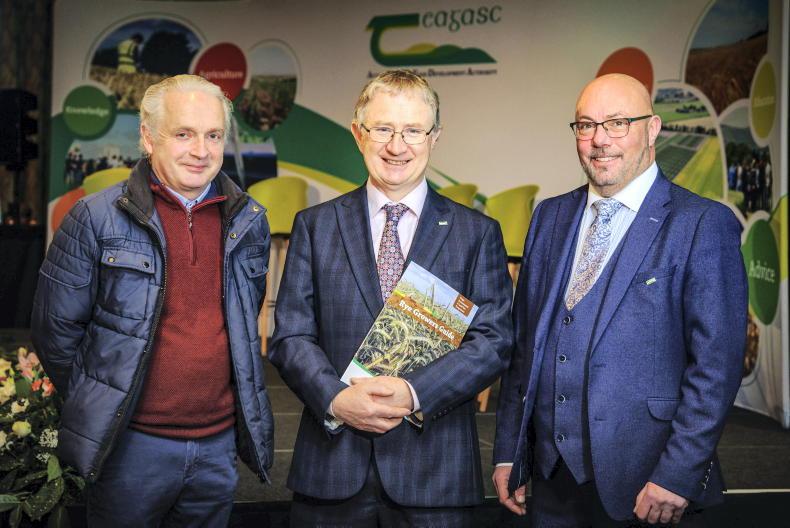
Teagasc launched the Rye Growers Guide at the National Tillage Conference recently.
This guide, similar to guides produced by Teagasc on winter wheat and spring barley, aims to provide information to Irish growers on the agronomy and management practices of rye crops under Irish conditions.
The area of rye has grown in the past number of years from 476ha in 2020 to 3,713ha in 2025.
This led Teagasc to begin researching the crop, as growers were largely reliant on agronomic trials and information coming from abroad.
While this guide contains a large amount of knowledge and trial results, research is still ongoing on the crop and the guide will be updated in due course as new and improved information becomes available.
Sinead Dermody, PhD student at Teagasc Oak Park, spoke on the day of Irish-grown rye’s high-value potential.
She told the crowd that up to 30% of the world’s rye production enters the human food chain, and with an increasing production area in Ireland, the Protein-I project has been looking at the potential of the crop for food markets.
Dermody noted that most of the rye produced in Ireland goes to animal feed, with a very small proportion being used for distilling.
Food-grade specs
The specifications for food-grade rye in England and Germany require a Hagberg falling number of greater than 100 and 120 seconds respectively, a protein content of greater than 8% and a hectolitre weight of greater than 70 and 72KPH respectively.
A three-year field trial was carried out in counties Carlow and Waterford to see if winter rye would meet these specifications.
A number of varieties which are currently available and varieties not currently grown in Ireland were tested.
While a number of varieties could meet the English food-grade specification, only one, Inspector, could meet the higher German specification across both trial sites.
Despite this, Dermody said that it was positive news that a number of currently available varieties can meet food-specifications in Ireland. Many varieties are now bred with two or more purposes in mind. Dermody commented that “some varieties are deemed suitable for anaerobic digestion, distilling, feed, and food”. This gives a grower options when they plant their crop.
The field trials also showed that hybrid varieties yielded higher, with an average yield increase of 1.4t/ha over conventional population varieties.


SHARING OPTIONS