


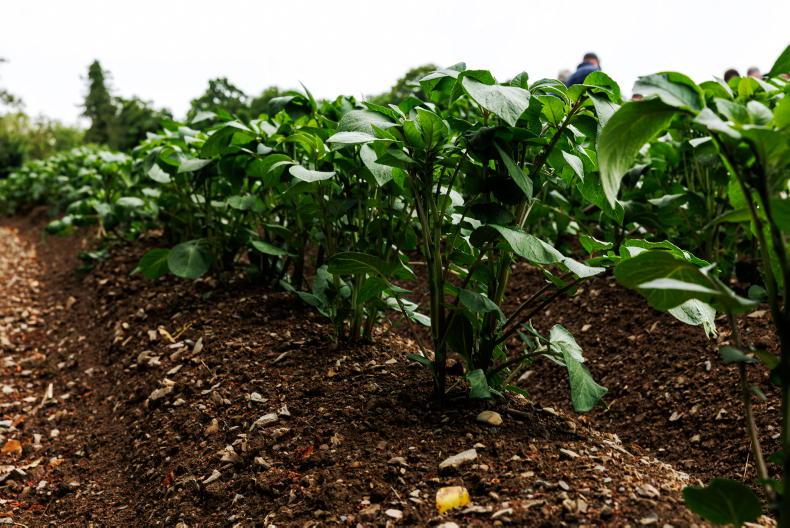
Every potato grower knows how quickly late blight can destroy a crop. A few days of the wrong weather and healthy leaves can turn black almost overnight. To stay ahead of the disease farmers still rely on fixed spray schedules.
Such an approach doesn’t take account of the actual risk of blight developing or what type of strain(s) may actually be present.
However, without readily available information relating to either of these factors it is understandable that farmers are not willing to take the risk.
A new project, funded by Research Ireland, titled AgSense (DCU, Teagasc, Met Éireann), aims to bridge these gaps.
The research team behind the project is aiming to develop a system that combines improved blight-risk forecasting with rapid strain-identification testing, thereby not only guiding farmers when conditions are most favourable to the disease, but what type of fungicide or control measure may be best suited to their crop at that time.
At the core of AgSense is the concept of relevant real-time information. By engaging with growers, agronomists and the wider potato industry from its initiation, AgSense has adapted to reflect their concerns surrounding late blight control.
The recent emergence of fungicide-resistant strains of late blight in 2023 has thrown a spotlight on the need for careful decisions in devising a fungicide programme for potatoes.
While initially AgSense was focused on just the detection of blight, following these discussions with growers/agronomists and their concerns around specific strains of blight, it became apparent that the cutting-edge technology being used could go further and potentially provide this critical information.
The project team is developing testing kits that can analyse blight – be it in the air or potato leaves. The aim is to make this a scalable low-cost portable testing system which farmers, agronomists or researchers can easily use, be it in a lab or the cab of a tractor.
The discussions with growers also highlighted the value of the current forecasting system run by Met Éireann. However, they wondered if increased localisation of risk can be achieved.
Taking this onboard, the second part of AgSense looks at how additional improvements to the blight-risk forecasting system can be made.
Ideally, instead of relying on broad regional warnings, farmers would receive improved local risk ratings that can guide spray timing, something that AgSense is working with Met Éireann to achieve.
Finally, as AgSense is solutions-driven, it is important for the project to ensure the directions it takes meet the needs of those for whom the solutions are developed.
Although the project is initially focused on late blight, the technology and concepts behind it are broad ranging for crop health.
Help AgSense team to develop tools for blight detection
The AgSense team want to better understand the needs of farmers for adopting the proposed tools. You can help with this by filling out the survey.
You can also take part in a one-to-one interview with a member of the team via this link.
For further information please contact alex.neuroth@dcu.ie.
You can listen to some of the AgSense team on this week’s Tillage Podcast on the Irish Farmers Journal website, app or wherever you get your podcasts.



SHARING OPTIONS