


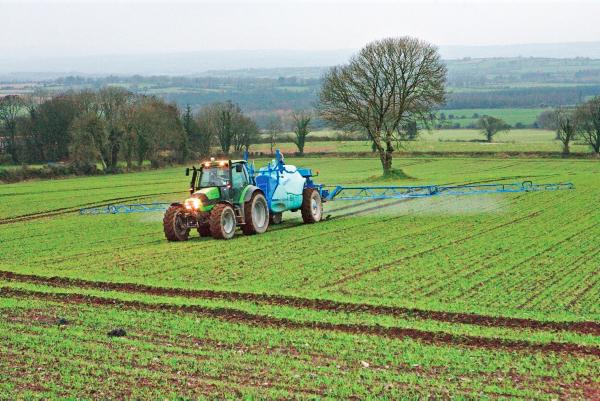
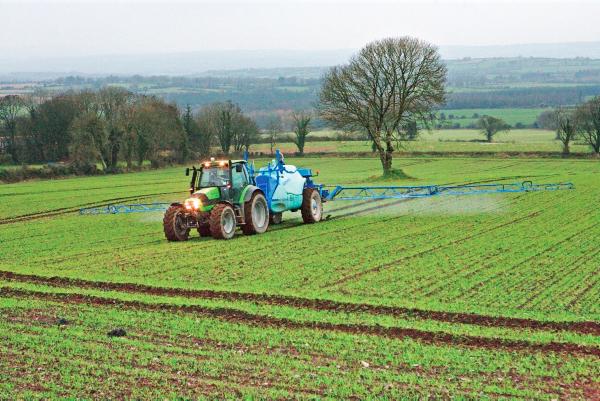
The programme involves the use of a pre or early post emerge autumn herbicide followed six weeks later by a full rate of Broadway Star plus 800g/ha of a pendimethalin product.
As things stand in October 2012, the biggest challenge will be to get crops planted for weeds to become a problem. However, as sterile brome in particular is becoming an increasing problem, its control is increasingly important.
Control options up to now have not proven sufficiently durable or thorough to beat the weed over time.
This latest approach has the potential to give 100% control and so eradicate brome from fields when used to its full potential. But the initial spray is also very important in the process as it provides an initial control and a conditioning of the grasses and other weeds for subsequent kill. Perhaps the biggest problem this year will be getting crops planted rather than killing weeds as spring crops in the rotation provide another option for helping to reduce and control sterile brome specifically.
Indeed, it is worth noting that if a control programme can provide 100% control for two consecutive years, there is a probability that this weed can be eradicated from the sprayed area.
Broadway Star
Broadway Star contains a mixture of Pyroxsulam (70.8g/kg) plus Florasulam (14.2 g/kg). It is formulated as a water dispersible granule and packed in a 1.06kg container which covers four hectares at the 265g/ha recommended rate.
This herbicide is contact only and so can only kill the weeds that are present on the day of spraying. But it must have active growth to be effective and so must be applied in good growing conditions to achieve full control.
Hence it needs to be applied ‘early’ in the autumn to have good conditions for activity.
It can also be applied in the spring up to GS32 of the crop but later application is less likely to provide 100% control, especially of brome. Autumn application is best applied in 130 to 150 l/ha of water through fine to medium nozzles. And Broadway Star must always be applied with a recommended adjuvant like Torpedo II.
Broadway Star is described as a ‘cross-leaved’ herbicide in that it controls the majority of both the grass and broadleaved weeds present at the time of spraying.
Grass weeds include bromes, wild oats, ryegrasses, etc, and fumitory is one of the very few broadleaved weeds that escape. The known weaknesses include annual meadow grass and fumitory and this is why both the early season spray and the tank mix with PDM are important.
Both actives are ASL inhibitors, which means that they have a similar mode of action to the sulfonylurea herbicides. However, they are slightly different in that the current resistance present in chickweed and corn marigold is still controlled by Broadway Star.
Good control of a range of grass weeds is achieved by Broadway Star but the optimum timing for individual weed targets is slightly different, so it is important to check the label in advance.
Brome is best controlled in the autumn but spraying must follow an earlier pre or early post-emerge spray. Control of ryegrasses, wild oats and volunteer oats is possible in the spring.
Isoproturon (IPU), for annual meadow grass control, cannot be tank mixed with Broadway Star. If used as the early spray, a period of at least six weeks must be left between application of IPU and Broadway Star.
A programmed approach
The objective of the programme is to spray the brome plants when they are still relatively small, with three to four leaves present, around early November. Only one treatment of Broadway Star is allowed per crop and this must be applied when there is active growth in the target weeds.
Good leaf coverage is important and an adjuvant is essential to improve uptake. A range of adjuvants is recommended, such as Torpedo II. The initial spray applied pre or early post-emerge has two major objectives:
To provide residual control of weeds, especially annual meadow grass
To help condition any remaining weeds to the subsequent application of Broadway Star.
Control of annual meadow grass is obviously important but so is the conditioning of all other weeds affected to a greater or lesser degree by the herbicide applied.
This is a commonly observed consequence of a sequence of herbicides where the efficacy of the second treatment is improved following the application of the first, even where no visible effect is seen.
Perhaps the earlier autumn application timing is key but Broadway Star is the only product in the market stated as having the ability to control sterile brome (and other brome grasses).
Pacificia is the main product used currently but sterile brome is only stated as being moderately susceptible. And with so many treatments being done in the spring, and sometimes in cold conditions, it is not surprising that control is not always satisfactory.
This new programme recommendation is now offering the potential for 100% control of the weeds and sterile brome present at the time of spraying in autumn. But further germination is possible, especially in fields where clods are present in the seedbed and further germination is possible as these are broken down by weather over winter.
Crops and weeds
Broadway Star is recommended for use on winter wheat, winter rye and triticale. Being a contact only product, with both actives having a short half-life in the plant, there are no restrictions on following crops or the method of planting following Broadway Star use. So there is no need to plough for min-tilled oilseed rape following winter wheat sprayed with Broadway Star.
As well as being good on most grasses, Broadway Star also has a big broadleaved weed profile. Susceptibilities vary slightly for weeds like cleavers, groundsel, ivy-leaved and field speedwell, chickweed, charlock, poppy, volunteer rape and beans, mayweeds, shepherd’s purse and many others. As stated previously, the main weakness is fumitory which can be taken out later in the season. Because it does not control annual meadow grass, this weed must be taken out by pre or early post emergence residual herbicides like IPU, pendimethalin, Firebird or Flight. But for the grower the challenge is to balance cost against efficacy and the size of the problem.
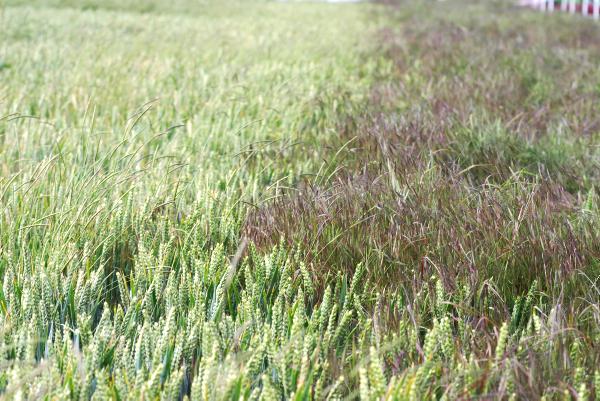
Where brome is the primary driver it is possible that, for many farmers, the sequence treatment for brome grasses may only be needed on headlands and in specific areas of fields.



SHARING OPTIONS