


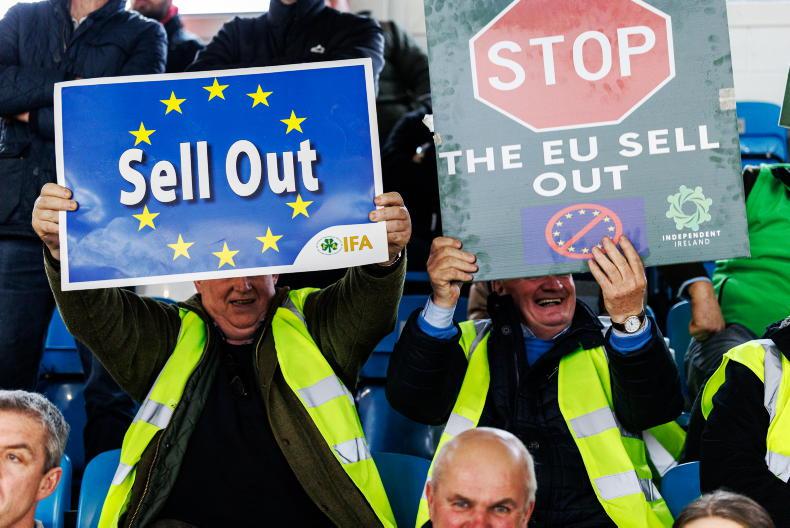
Last Saturday’s protest in Athlone against the Mercosur trade deal was organised by Independent Ireland, a party with four TDs out of 174.
While not formally part of the coalition, it has, along with the non-party regional independents, been supporting the government.
The party also has one member in the European Parliament out of the Irish contingent of 14.
This is a small political party, whose prominence derives from the arithmetic – Fianna Fáil and Fine Gael between them came up short of a majority after the 2024 election, needed support from elsewhere and appointed some non-party TDs to junior ministries, including Michael Healy-Rae and Seán Canney who have also been opposed to Mercosur.
Saturday’s events in Athlone were reported in both print and broadcast media as a ‘farmer protest’, reflecting the forthright opposition to Mercosur of the farm organisations, notably the IFA.
TV footage of long lines of tractors around Athlone will have persuaded the average viewer that this protest was mounted by the farm organisations, or just by farmers, and not by a small political party.
Clear
In the week leading up to last Friday’s vote at the European Council, it had become clear that the Mercosur free trade deal, first proposed 25 years ago, would go through.
Not enough countries would vote against to stop it, with votes weighted by population.
Once Italy came on board, Mercosur was going to win at the Council and will be signed next week by the European Commission president.
There will later be a vote at the European Parliament and Independent Ireland’s sole MEP Ciaran Mullooly has vowed to continue the campaign against Mercosur in that forum.
The futility of a ‘no’ vote at the Council was evident to the Government before Friday.
Just five countries voted no – Austria, France, Hungary, Poland and Ireland; Belgium abstained and 21 countries voted yes. Ireland could have abstained too, with no effect on the outcome.
This had been the Government’s intention, but they changed tack in light of apparent farmer opposition, conscious of two impending by-elections over the next few months.
There could be consequences for what looks like grandstanding by Ireland. The EU has gone along with an extension of the nitrates derogation and supported the Irish Government’s position in the aftermath of Brexit.
There is already jealousy in Europe about the corporation tax bonanza and there will be pressure to increase the Irish contribution to the EU budget to help finance higher defence spending.
For a small member with a budget surplus, however insecure the corporation tax revenue may prove to be, this is not a good time to be drawing attention to yourself.
Four of the five no countries have a credible excuse – the right-wing populist party could win the French presidential election due in April 2027, Austria’s populist Freedom Party leads in the polls, Poland is split down the middle with a centrist prime minister in Donald Tusk and a right-wing populist party that could unseat him, while Hungary’s government is led by Victor Orban, a pro-Russian nationalist.
Extensive
There were extensive farmer protests in Belgium but their government astutely chose to abstain. In Ireland’s case, no such electoral threat to the centrist government from the far-right is credible, nor is it likely that the Independent Ireland party commands the support of most farmers.
In continental Europe, farmer discontent has been a source of populist voting support in all four countries that voted no and is a plausible excuse not available to the Irish.
It seems clear that the Government had intended to avoid a no vote, but changed horses late last week. The availability of an abstention, without any effect on the outcome, was ignored, presumably against the advice of the Department of Foreign Affairs.
In The Irish Times last Saturday, Cliff Taylor wrote disapprovingly about the instant resort to hyperbole which characterised some of the political contributions.
Sinn Féin’s Martin Kenny said the deal was ‘very devastating for everybody across the globe’ no less, while his party leader decried the Government’s failure, having opposed the deal, not to ‘stop’ it, apparently unaware that they could not do so given the voting rules. Just Google it.
It remains to be seen how much damage has been done. Irish farming will suffer very little from the Mercosur deal – only a tiny portion of the European beef market will be open to imports at the lowest tariff rate.
The deal as agreed contains safeguards about food safety and the concerns expressed by the IFA and other farm bodies are grossly overblown.
Our EU partners will have plentiful opportunities to exact retribution, committed as they are to expanding alternative trade opportunities in the light of America’s resort to protectionism.
If there are negative outcomes for the broader Irish economy, I can only see one place where the blame will be attributed: at farm organisations.


SHARING OPTIONS