


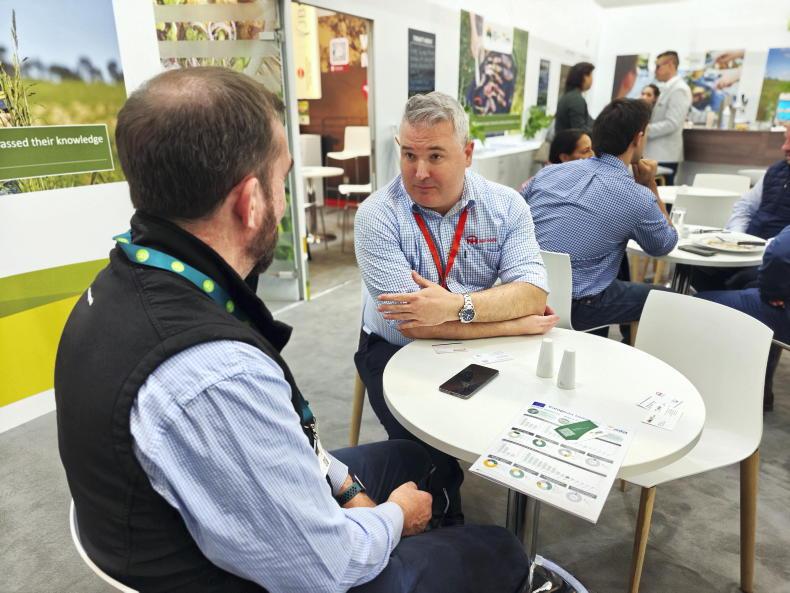
Australia’s red meat industry has put down a marker for a 50,000t beef quota and 67,000t sheepmeat quota to close a trade deal with the EU. Andrew McDonald, chair of the Australia-EU Red Meat Market Access Taskforce (RMMAT), confirmed this in an exclusive interview with the Irish Farmers Journal this week, ahead of another attempt to conclude the negotiation between the EU and Australia.
He explained that the reason for putting a number on the table at this point is because “we’re expecting this to be an end game negotiation [and] we want to be clear for our negotiators, and for our trade minister who’ll be over in Brussels this week, where our position stands for the red meat industry”.
Not asking for a lot
McDonald didn’t accept that these tonnages for beef and sheepmeat were particularly high. He said: “If we look at what comparative exporters [secured in] trade negotiations with Europe, we’d think they’re reasonable numbers.”
He referred to the EU trade deal with New Zealand, where they secured an additional 38,000t sheepmeat quota on top of the 125,769t WTO quota that is a legacy of the UK joining the EU in 1973.
McDonald’s view is that their quota demand is “still a pittance compared to what New Zealand’s access is on sheepmeat”.
On beef he made the comparison with Canada, which has a 50,000t beef quota in its agreement with the EU, and the 99,000t beef quota in the Mercosur trade deal.
McDonald also spoke of Australia facilitating the EU allocation of 35,000t of the 45,000t high-quality beef quota to the US, which had previously been available to a number of other countries, including Australia, on a first come, first served basis.
When asked if these requests on beef and sheepmeat access were a starting point for negotiation, his response was that “we think there’s a line in the sand and that looks like a reasonable outcome, keeping in mind the trade-offs that Australia is looking to be giving back to Europe on the dairy industry and other areas for improved access”.
Give and take
McDonald also pointed out that the potential trade agreement has to work both ways, saying that in “any negotiation of this nature that both sides have to bring something to the table. If Europe’s looking for reasonable and equitable outcomes on their side, we’ll also be looking for reasonable and equitable outcomes in return”.
He pointed out that access for EU dairy and geographical indicators are important to the EU, but a challenge in Australia.
He mentioned that it was a problem “not being able to call Parmesan cheese, Parmesan” and he also referenced Irish pigmeat exports to Australia, which are greater than the combined total of current Australian beef and sheepmeat quotas for the EU.
Currently Australia has a 3,380t beef quota and a 5,851t sheepmeat quota. In 2025, up to the end of November, Bord Bia data shows that Ireland exported 12,672t of pigmeat to Australia.
Won’t flood market with cheap beef
McDonald was keen to put the Australian quota requests in the context of not having been reviewed for over 50 years. He insisted that it wouldn’t lead to a flood of beef and sheepmeat into the European Union.
He mentioned that even when Australia had access to the High Quality Beef quota for 10 years, Australia’s usage “peaked out at around 18,000t”. He also mentioned the UK trade deal, where Australia has exported “less than 10,000t in the first two years and slightly more than that in the third year”.
Figure 1 shows that these figures are broadly correct and growing from a low base. Figure 2 shows that the sheepmeat volumes have also increased to a substantial 26,500t.
He also emphasised that Australian beef and sheepmeat wouldn’t be cheap and that “like Irish product, Australian products are world class. We don’t normally go into a market and bring down the average price.
“If we look at the markets we go to, generally we ship a product at or higher than the local price”.
Trade deal precedents
If the EU-Australia trade deal is concluded in the coming weeks, it will include quotas for beef and sheepmeat, significantly improving access for Australian product. Irish farmers have been preoccupied by the Mercosur trade deal recently, but as referenced by Andrew McDonald, the EU has also deals in place with Canada and New Zealand.
Despite having a 50,000t EU beef quota, Canadian exports to the EU are very small, amounting to just 1,100t in 2025 up to end of November.
This is largely because the Canadian beef industry is in general unwilling to forsake the use of hormones in production as required to serve the EU market. On the other hand, the EU has a growing, if still a small, market for New Zealand beef exports. Meat Industry Association New Zealand figures show a 15% increase on 2024 volumes to 5,965t in 2025. Interestingly, Figure 3 shows that since the New Zealand deal with the UK came into effect in 2023, beef exports have surged, rising to over 21,000t in 2025.
Comment
The pros and cons of trade deals in relation to agriculture have been well debated in the context of the recently signed Mercosur deal. A trade deal with Australia, if it happens, will involve some level of enhanced access for both beef and sheepmeat.
Indications are that the rest of the deal is more or less in place and all that remains is for the number of tonnes to be agreed, which has proven to be a problem to date. Australia had a particularly successful negotiation with the UK in relation to beef and sheepmeat access, but much less so with the EU, hence no agreement.
EU beef and sheepmeat production has been in decline and is forecast to continue this to fall over the next decade. For Irish farmers, the reality is that the EU and UK beef and sheepmeat markets have opened up considerably and are likely to continue this trend. That means more competition for Irish beef and sheepmeat in the market place, notwithstanding the benefit trade deals bring to the wider Irish and EU economies.





SHARING OPTIONS