Throughout 2025, bluetongue virus was very much a prospect to be feared, but in late November with the confirmation of the first case on the island appearing in Co Down, reality was quick to sink in.
It’s now a matter of time before we see the real effect that the disease is going to have.
Preventing transmission is practically impossible, but limiting its effect on animals is not.
To begin with, it’s important to understand that bluetongue poses no risk to human health.
Speaking on a recent Tirlán information webinar for suppliers, Head of Animal Health and Welfare for Tirlán – Joris Somers explained that the disease is not zoonotic, meaning it cannot be contracted by humans.
The disease is also not a food safety risk, meaning milk from infected cows can continue to be processed and any cull animals in a herd still allowed to be slaughtered.
Bluetongue is a vector-borne disease, meaning it’s spread via a carrier. In the case of bluetongue, that vector is the midge.
The midge bites an infected animal and acquires the virus. They then move to other animals, biting them, and so the disease moves from one to the other. Midges are transported by the wind and can be moved hundreds of kilometres at a time.
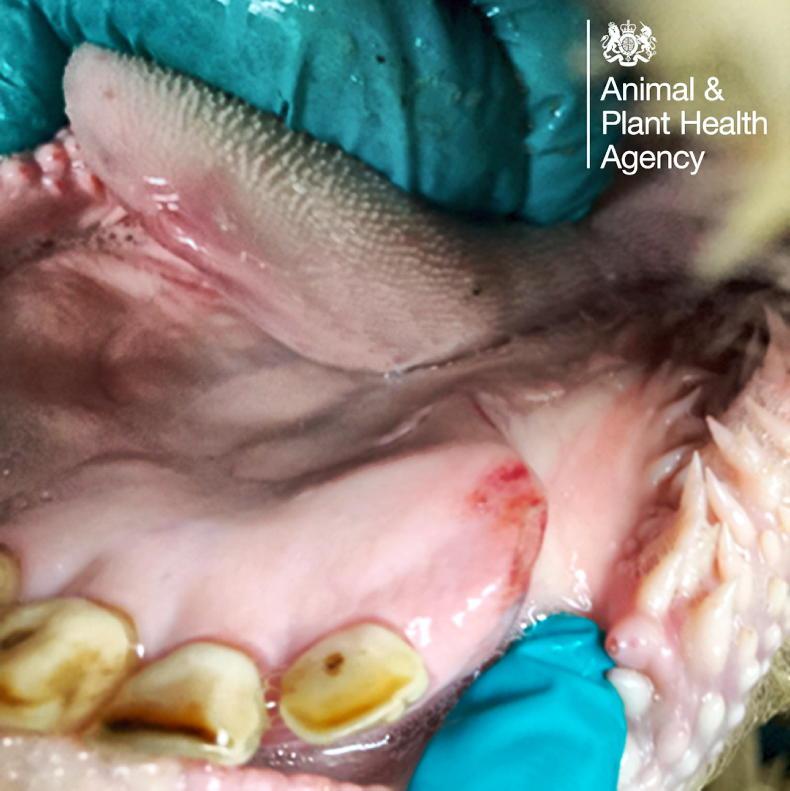
Bluetongue ulcers in a cows mouth.
Speaking on the Tirlán webinar Conor McAloon, professor of veterinary medicine at UCD says “The midge is the most well-recognised route of infection and wind makes long distance dispersal of these midges relatively simple”.
“There’s some evidence out there to suggest that midges can be transported huge distances. An example is midges blown from Indonesia as far as Australia”.
The disease is not contagious however, meaning infected animals won’t pass it from one to the other directly. Experience in continental Europe shows high spread once in a herd, but incidence has varied in Britain.
In-calf cows can pass the infection to their unborn foetus, hence abortion risks are high in the early stages of pregnancy. This is known as vertical transmission of the disease.
Spread is also possible via semen, so infected bulls will be capable of passing it to any cows they might serve over the course of the breeding season.
This is a big concern for dairy farmers who tend to use a lot of AI, as it’s likely that any of the semen already purchased will be coming from unvaccinated bulls.
This is something that may be worth checking with the AI company, prior to breeding start date.
“The incubation period of the disease is between two to four days. Once the animal has been bitten, they will start to show the clinical symptoms after this period” according to Conor.
The virus enters the bloodstream and is transported through the animal’s blood vessels. The resulting clinical signs are cattle with fevers, crusted muzzles and oral ulcers around the tongue which can cause drooling from the mouth.

Evidence of redness on the hoof.
Lameness has been a big issue in European herds, as the blood vessels around the feet become affected. While the clinical effects are noticeable and can be distressing for both the animal and the farmer, it’s the subclinical symptoms that will be the real cost for dairy herds.
Evidence from research in the Netherlands carried out on commercial dairy farms throughout 2024 and 2025, showed drops in milk production of 1-2l/day in infected cows throughout the period of infection. This effect can last up to ten weeks in some cases.
The other big concern is the fertility impact that bluetongue can have on animals. Cows that contract the disease are more likely to repeat after breeding or fail to go in-calf at all.
Those who do go in-calf are at a greater risk of losing the calf in early pregnancy or aborting mid pregnancy.
Where a cow manages to get through the full pregnancy term and the calf is born live, birth defects are common.
The experience with the disease has varied from farm to farm and from one country to the next. Across continental Europe the effect of the disease was catastrophic. Prevalence in the national dairy herd in the Netherlands was upwards of 60%.
Within herds the infection rate was upwards of 36%, meaning over a third of all cows in an affected herd were carrying the disease.
Anecdotal evidence from the Netherlands outlines the devastating impact the disease can have on animals.
Sick pens full of cows suffering the clinical effects of the disease. Animals were lame with ulcers around the mouth, drooping ears and cows becoming thin rapidly.
Not every animal was as equally affected, with some becoming sicker than others, but subclinical effects were noted across the board.
UK farms by and large have not had the same horror stories as those in Europe and this seems to have lulled some Irish farmers into a false sense of security. It’s impossible to know what the real impact of the disease will be as it starts to seep onto farms but there’s sure to be some level of impact.
While vaccination is not capable of stopping the spread of the disease, it is capable of limiting its impact.
The current variant of the virus that’s going through herds is bluetongue serotype-3 (BTV-3).
Vaccinations that are currently available for purchase in Ireland will only be effective against BTV-3. Other strains of the disease will not be protected against.
It’s up to the individual farmer to decide whether or not they wish to vaccinate. It’s a matter of weighing up the costs of the vaccine versus the potential impacts of the disease should one choose not to vaccinate.
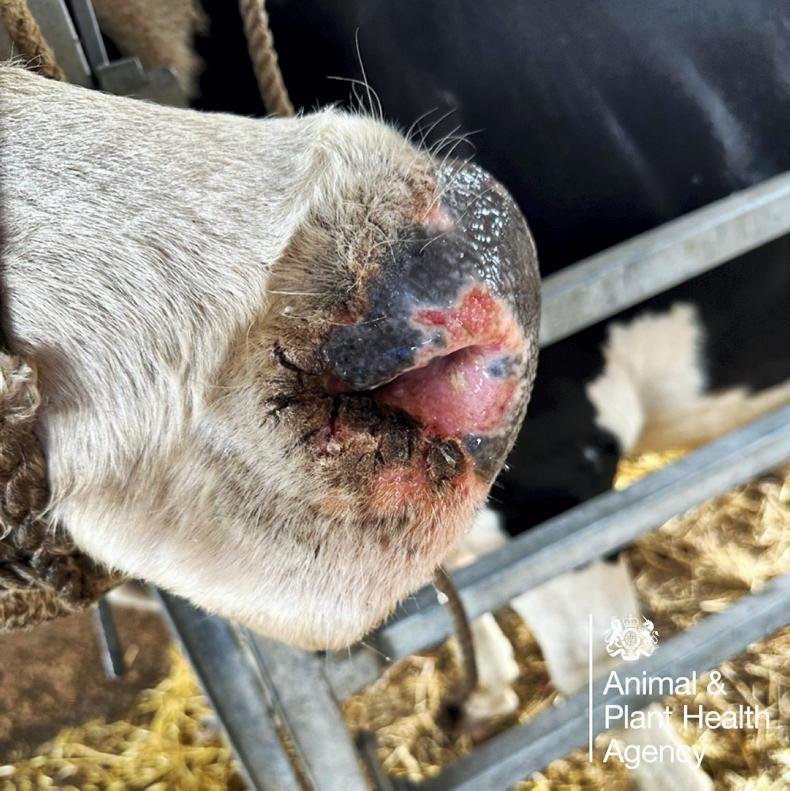
Crusting of the nose is a symptom of bluetongue.
Unsurprisingly, best advice from most vets is to vaccinate.
“In Ireland we have a specific susceptibility to the effects of the disease due to the nature of our seasonally calving herds. Cows are at their most vulnerable when the midges are most active” Cathal said.
Midge activity peaks in July, August and September. At this point spring-calving cows are still in the early stages of pregnancy and the risk of early embryonic losses is high.
During these months milk production will still be at a relatively high level and a drop in yield of 1-2l/cow/day would be significant.
The impact of any production drop in 2026 will inevitably be compounded by the low milk price farmers look set to receive at a time when the cheapest milk can be produced off grass.
Vaccines are now readily available from local vet’s as DAFM have given the green light for their use.
The cost per vaccine varies depending on the make and the vet supplying the product but the rough guide is between €4.50 and €5 per shot with each animal requiring a minimum of two shots.
“The vaccination is brought in under a special licence and therefore purchasing the vaccine requires slightly more red tape.”
“There will be more paperwork involved and animals will need to be identified as having received the vaccination” according to Hazel Mullins a vet and dairy farmer from Cork, who spoke on the webinar.
If a farmer decides to give a vaccine it should be done between calving and breeding to be most effective.
“We will be vaccinating here. The vaccine to us is like having car or home insurance, it’s there to protect against potential problems.”
“All calved cows will get the first shot around St Patrick’s Day and the second shot three weeks later” Hazel says when referring to her own farm.
Ultimately it will be the cost versus the potential benefits that will determine the level of uptake of the vaccine.
A farmer with 100 cows in the herd will require 200 hundred doses of the vaccine for the cows alone.
For the sake of this calculation, we’re also assuming the farmer rears their own replacements and has 25 heifers and 25 calves to vaccinate. At two doses each that’s a further 100 doses giving a requirement for 300 doses altogether.
Therefore, the cost for vaccinating the entire herd at €5 per dose is €1,500 in total.
It must be noted that the benefits of vaccinating the herd will only really be seen should the herd actually contract the disease in the first place.
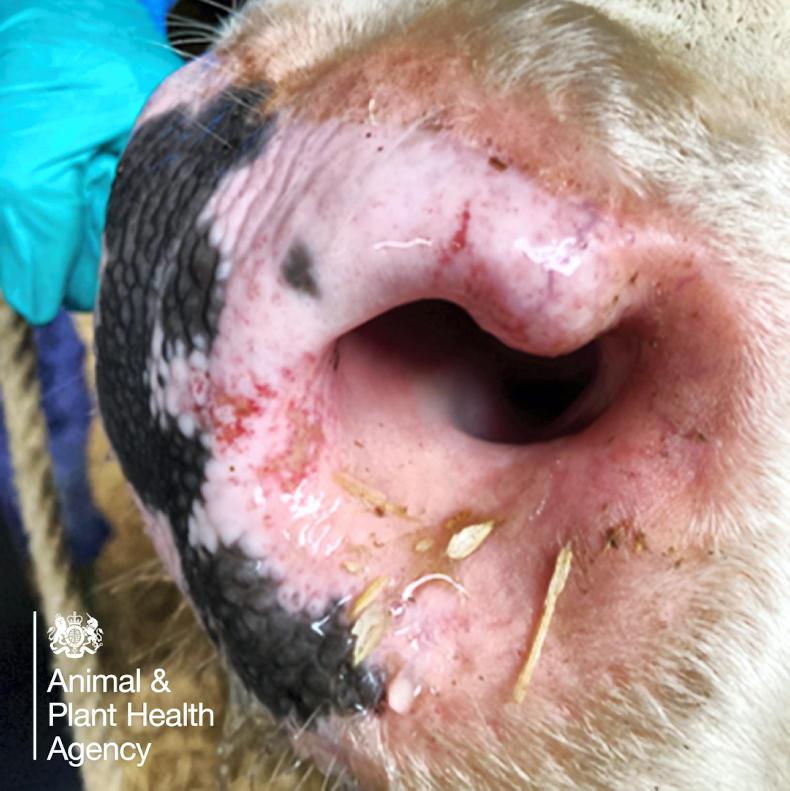
Cow - ulceration in nostrils
These benefits include preventing a milk drop, protecting against lower empty rates and preventing abortions in cows.
Using the figures from the Netherlands study, where the in-herd prevalence rate of bluetongue was 36%, we can assume 36 of the 100 cows will experience a drop in milk production.
The 5% drop in yield that was experienced in Dutch herds, would look like a 1.25l/day drop in a cow yielding 25l/day.
The drop is said to have been experienced for between eight and ten weeks.
Taking the average of nine weeks, a cow will produce a total of 79 litres less milk in total. Across 36 cows, that’s a total reduction of 2,844 litres. At a price of 36c/l that’s a loss in income of €1,024.
Milk production drop is not the only loss.
For the calculation, we will also assume that three more cows than normal from the herd will turn up as empty – this figure is on the low side.
Taking current values of an empty cow straight from the parlour, worth around €1,000 versus an in-calf cow worth €2,000, that’s a total difference of €1,000 per animal and €3,000 for the three cows.
In total the cost of bluetongue in this herd will be €4,024 versus the cost of vaccinating at €1,500.
This is a basic analysis and a more detailed cost/benefit calculator is available on the AHDB website.
Throughout 2025, bluetongue virus was very much a prospect to be feared, but in late November with the confirmation of the first case on the island appearing in Co Down, reality was quick to sink in.
It’s now a matter of time before we see the real effect that the disease is going to have.
Preventing transmission is practically impossible, but limiting its effect on animals is not.
To begin with, it’s important to understand that bluetongue poses no risk to human health.
Speaking on a recent Tirlán information webinar for suppliers, Head of Animal Health and Welfare for Tirlán – Joris Somers explained that the disease is not zoonotic, meaning it cannot be contracted by humans.
The disease is also not a food safety risk, meaning milk from infected cows can continue to be processed and any cull animals in a herd still allowed to be slaughtered.
Bluetongue is a vector-borne disease, meaning it’s spread via a carrier. In the case of bluetongue, that vector is the midge.
The midge bites an infected animal and acquires the virus. They then move to other animals, biting them, and so the disease moves from one to the other. Midges are transported by the wind and can be moved hundreds of kilometres at a time.
Bluetongue ulcers in a cows mouth.
Speaking on the Tirlán webinar Conor McAloon, professor of veterinary medicine at UCD says “The midge is the most well-recognised route of infection and wind makes long distance dispersal of these midges relatively simple”.
“There’s some evidence out there to suggest that midges can be transported huge distances. An example is midges blown from Indonesia as far as Australia”.
The disease is not contagious however, meaning infected animals won’t pass it from one to the other directly. Experience in continental Europe shows high spread once in a herd, but incidence has varied in Britain.
In-calf cows can pass the infection to their unborn foetus, hence abortion risks are high in the early stages of pregnancy. This is known as vertical transmission of the disease.
Spread is also possible via semen, so infected bulls will be capable of passing it to any cows they might serve over the course of the breeding season.
This is a big concern for dairy farmers who tend to use a lot of AI, as it’s likely that any of the semen already purchased will be coming from unvaccinated bulls.
This is something that may be worth checking with the AI company, prior to breeding start date.
“The incubation period of the disease is between two to four days. Once the animal has been bitten, they will start to show the clinical symptoms after this period” according to Conor.
The virus enters the bloodstream and is transported through the animal’s blood vessels. The resulting clinical signs are cattle with fevers, crusted muzzles and oral ulcers around the tongue which can cause drooling from the mouth.
Evidence of redness on the hoof.
Lameness has been a big issue in European herds, as the blood vessels around the feet become affected. While the clinical effects are noticeable and can be distressing for both the animal and the farmer, it’s the subclinical symptoms that will be the real cost for dairy herds.
Evidence from research in the Netherlands carried out on commercial dairy farms throughout 2024 and 2025, showed drops in milk production of 1-2l/day in infected cows throughout the period of infection. This effect can last up to ten weeks in some cases.
The other big concern is the fertility impact that bluetongue can have on animals. Cows that contract the disease are more likely to repeat after breeding or fail to go in-calf at all.
Those who do go in-calf are at a greater risk of losing the calf in early pregnancy or aborting mid pregnancy.
Where a cow manages to get through the full pregnancy term and the calf is born live, birth defects are common.
The experience with the disease has varied from farm to farm and from one country to the next. Across continental Europe the effect of the disease was catastrophic. Prevalence in the national dairy herd in the Netherlands was upwards of 60%.
Within herds the infection rate was upwards of 36%, meaning over a third of all cows in an affected herd were carrying the disease.
Anecdotal evidence from the Netherlands outlines the devastating impact the disease can have on animals.
Sick pens full of cows suffering the clinical effects of the disease. Animals were lame with ulcers around the mouth, drooping ears and cows becoming thin rapidly.
Not every animal was as equally affected, with some becoming sicker than others, but subclinical effects were noted across the board.
UK farms by and large have not had the same horror stories as those in Europe and this seems to have lulled some Irish farmers into a false sense of security. It’s impossible to know what the real impact of the disease will be as it starts to seep onto farms but there’s sure to be some level of impact.
While vaccination is not capable of stopping the spread of the disease, it is capable of limiting its impact.
The current variant of the virus that’s going through herds is bluetongue serotype-3 (BTV-3).
Vaccinations that are currently available for purchase in Ireland will only be effective against BTV-3. Other strains of the disease will not be protected against.
It’s up to the individual farmer to decide whether or not they wish to vaccinate. It’s a matter of weighing up the costs of the vaccine versus the potential impacts of the disease should one choose not to vaccinate.
Crusting of the nose is a symptom of bluetongue.
Unsurprisingly, best advice from most vets is to vaccinate.
“In Ireland we have a specific susceptibility to the effects of the disease due to the nature of our seasonally calving herds. Cows are at their most vulnerable when the midges are most active” Cathal said.
Midge activity peaks in July, August and September. At this point spring-calving cows are still in the early stages of pregnancy and the risk of early embryonic losses is high.
During these months milk production will still be at a relatively high level and a drop in yield of 1-2l/cow/day would be significant.
The impact of any production drop in 2026 will inevitably be compounded by the low milk price farmers look set to receive at a time when the cheapest milk can be produced off grass.
Vaccines are now readily available from local vet’s as DAFM have given the green light for their use.
The cost per vaccine varies depending on the make and the vet supplying the product but the rough guide is between €4.50 and €5 per shot with each animal requiring a minimum of two shots.
“The vaccination is brought in under a special licence and therefore purchasing the vaccine requires slightly more red tape.”
“There will be more paperwork involved and animals will need to be identified as having received the vaccination” according to Hazel Mullins a vet and dairy farmer from Cork, who spoke on the webinar.
If a farmer decides to give a vaccine it should be done between calving and breeding to be most effective.
“We will be vaccinating here. The vaccine to us is like having car or home insurance, it’s there to protect against potential problems.”
“All calved cows will get the first shot around St Patrick’s Day and the second shot three weeks later” Hazel says when referring to her own farm.
Ultimately it will be the cost versus the potential benefits that will determine the level of uptake of the vaccine.
A farmer with 100 cows in the herd will require 200 hundred doses of the vaccine for the cows alone.
For the sake of this calculation, we’re also assuming the farmer rears their own replacements and has 25 heifers and 25 calves to vaccinate. At two doses each that’s a further 100 doses giving a requirement for 300 doses altogether.
Therefore, the cost for vaccinating the entire herd at €5 per dose is €1,500 in total.
It must be noted that the benefits of vaccinating the herd will only really be seen should the herd actually contract the disease in the first place.
Cow - ulceration in nostrils
These benefits include preventing a milk drop, protecting against lower empty rates and preventing abortions in cows.
Using the figures from the Netherlands study, where the in-herd prevalence rate of bluetongue was 36%, we can assume 36 of the 100 cows will experience a drop in milk production.
The 5% drop in yield that was experienced in Dutch herds, would look like a 1.25l/day drop in a cow yielding 25l/day.
The drop is said to have been experienced for between eight and ten weeks.
Taking the average of nine weeks, a cow will produce a total of 79 litres less milk in total. Across 36 cows, that’s a total reduction of 2,844 litres. At a price of 36c/l that’s a loss in income of €1,024.
Milk production drop is not the only loss.
For the calculation, we will also assume that three more cows than normal from the herd will turn up as empty – this figure is on the low side.
Taking current values of an empty cow straight from the parlour, worth around €1,000 versus an in-calf cow worth €2,000, that’s a total difference of €1,000 per animal and €3,000 for the three cows.
In total the cost of bluetongue in this herd will be €4,024 versus the cost of vaccinating at €1,500.
This is a basic analysis and a more detailed cost/benefit calculator is available on the AHDB website.






SHARING OPTIONS