


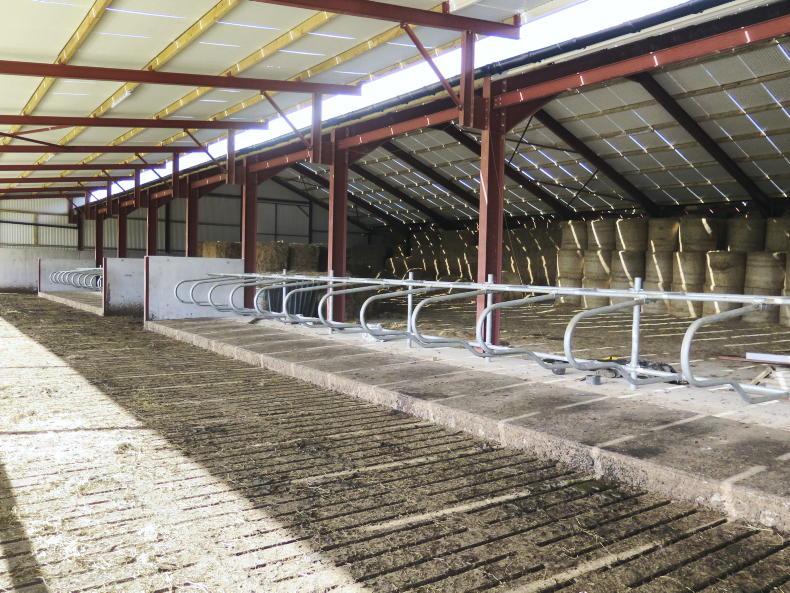
Slurry tanks
After weeks of heavy rainfall, most land is close to saturation point but, more worryingly, slurry tanks are filling up quicker than normal. This tells us that rainwater is getting into tanks.
Some of this could be coming from a high water table seeping in under slats, but in most cases it’s coming in from yards or leaking gutters. The issue here is that clean water mixing with dirty water is a breach of cross-compliance rules.
Some shoots and gutters aren’t big enough to handle the volume of rain that has been falling, resulting in an overflow.
Every 23mm of rain falling on a shed five spans long and two spans wide that gets into a tank reduces the storage by the quantity of slurry from one cow over a 16-week period.
Valleys in between sheds are always a problem, as more often than not the gutter isn’t big enough to take all the water in a downpour.
While they might operate OK 80% of the time, the overflow that happens in a big downpour can have a huge impact. As part of the new nitrates rules, spreading of soiled water is banned this year for all farmers between 21 December and 31 December.
Teat sealing
Some farmers have been asking if there are differences between the various teat sealers on the market. Essentially, they all contain the same active ingredient, bismuth subnitrate, and at the same concentration, which is 2.6g in a 4g tube.
Points of difference may exist among the other ingredients in the tube – colour, air pockets, etc – but the active ingredients are the same.
Antibiotic dry cow tubes and teat sealers should never be dipped in hot water prior to being used. They are generally easier to operate when at room temperature or slightly warmer, so have them in the house for the night prior to use, or gently heat the bucket of tubes by placing it in a bucket of warm water.
Cows that are to get sealer only will require extra cleaning and extra disinfecting, which all adds up to extra time taken to do the job. Best advice is to do half the number of cows with sealer only as you would do with dry cow tubes.
Breeding decisions
There’s a couple of substantial changes coming into the EBI now that carbon is being introduced as a sub-index. Many farmers will be choosing bulls over the coming weeks but the advice is to hold off until the changes have been announced.
There will be a re-ranking of some bulls now that the weighting of individual traits is going to change. Decisions around breed and cow size are important from a profit and climate perspective, but downstream effects such as calf value and beef merit are going to be increasingly important.
With news that the slaughter of calves at less than eight weeks of age is being prohibited from 2024, more emphasis will have to be placed on better beef traits in terminal sires used on dairy cows and reducing the number of lower beef value dairy bull calves through sexed semen.
Farmers should be planning now for what-if scenarios around calves, such as having to keep bull calves for longer.





SHARING OPTIONS