The clocks going forward last weekend brings something of a mindset shift for farmers.
It feels like things are starting to turn a corner.
The peak of calving has come and gone, the cows are out for the most part and grass growth is starting to rise, as days get longer and brighter.
As we move into the next phase, here are some of the key watchpoints to focus on over the coming weeks.
1.Grazing plan
Every farm is different at the moment and therefore one management style won’t suit all.
For drier farms that are starting to move into the second rotation, focus on not dropping average farm cover too quickly.
Ideally, growth will now be in line with or above demand on these farms and it’s just a matter of grazing away.
The real focus for these farms should now be on grass quality for future rotations.
This will be achieved by hitting good residuals of 4cm from now on and cleaning off paddocks well.
For heavier farms that still have some weeks to go before starting the second round, keep moving through area grazed.
First-grazed paddocks
Track covers on the first-grazed paddocks, as once the first three or four hit a cover of 1,200kg DM/ha, it will be time to start the second round.
This may mean skipping one or two paddocks in the first round and taking them out as surplus bales.
However, there’s no excuse for skipping paddocks in a couple of weeks if there’s silage and more than a couple of kilos of meal in the diet now.
Supplement feeding should be low, if there’s grass available.
2. Fertiliser
By now, farms should have close to 60kgs of chemical nitrogen/acre spread.
This is not the case on the vast majority of farms, with some only getting the first round out in the last week or two.
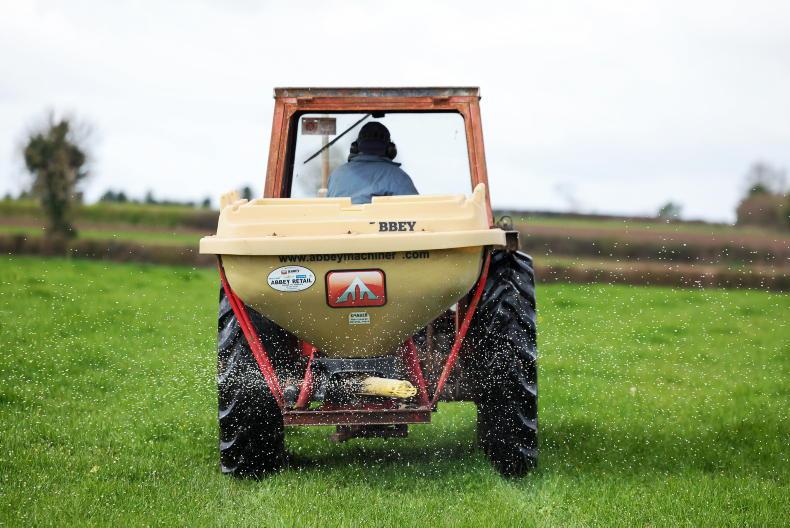
P, K and Sulphur need to be considered in the next round of fertiliser spreading. \ Odhran Ducie
For those who have the first round out since early March, plan to get out in the next week with the second round.
It’s also the time of year to consider getting out with some P, K and sulphur.
A compound fertiliser might be a good option in this round.
Where there is a P allowance, two bags of 18-6-12 to the acre will achieve the targets for P and K nutrients. In the case of no P allowance, a bag and a half of a 29-0-14 + S product will be useful.
In terms of sulphur, the target is 20 units/acre over the course of the year. A little and often approach is best with sulphur.
Five units over three to four spreadings will meet the requirement.
3. Reseeding
April and early May is the best time for a spring reseed. Most farmers who are planning to reseed this spring, will have already decided what paddocks they are going to do.
For those who haven’t, reseeding can boost the grass production on a paddock by three tonnes/ha and improve the efficiency of nitrogen spread.
A reseed will pay for itself in approximately two years and for that reason, it’s a no-brainer.
Every year, at least 10% of the platform should be reseeded. Select the paddocks with lowest production or those that were badly poached in the past two months.
If the plan is to reseed in late April, graze that paddock now and then again in three weeks’ time, to ensure it’s well cleaned off and there’s less dead material on the surface at spraying.
4. Bluetongue
If a farm is going to use the Bluetongue vaccine, it needs to be done now.
The sooner, the better as breeding is fast approaching.
Ideally, all breeding stock should be covered before the breeding season.
While not everyone is aware, the vaccine should be warmed to between 15 and 25C before administering the shot. This isn’t going to make or break the effectiveness of the vaccine but it is best advice.
5. Youngstock
With less than a month to breeding, it’s crucial that heifers are out grazing.
Grass is the best feed they can eat and that high plane of nutrition will improve their chances of going in-calf to first service.
Some farmers will be looking to start monitoring pre-breeding in the next week, particularly with heifers.
Well-grown heifers should be cycling by now and farmers will be hoping to see some activity starting.
Where synchronisation programmes are not being used, a month of pre-breeding with tail paint or scratch cards could be beneficial to identify the dates heifers are likely to come into heat.
The clocks going forward last weekend brings something of a mindset shift for farmers.
It feels like things are starting to turn a corner.
The peak of calving has come and gone, the cows are out for the most part and grass growth is starting to rise, as days get longer and brighter.
As we move into the next phase, here are some of the key watchpoints to focus on over the coming weeks.
1.Grazing plan
Every farm is different at the moment and therefore one management style won’t suit all.
For drier farms that are starting to move into the second rotation, focus on not dropping average farm cover too quickly.
Ideally, growth will now be in line with or above demand on these farms and it’s just a matter of grazing away.
The real focus for these farms should now be on grass quality for future rotations.
This will be achieved by hitting good residuals of 4cm from now on and cleaning off paddocks well.
For heavier farms that still have some weeks to go before starting the second round, keep moving through area grazed.
First-grazed paddocks
Track covers on the first-grazed paddocks, as once the first three or four hit a cover of 1,200kg DM/ha, it will be time to start the second round.
This may mean skipping one or two paddocks in the first round and taking them out as surplus bales.
However, there’s no excuse for skipping paddocks in a couple of weeks if there’s silage and more than a couple of kilos of meal in the diet now.
Supplement feeding should be low, if there’s grass available.
2. Fertiliser
By now, farms should have close to 60kgs of chemical nitrogen/acre spread.
This is not the case on the vast majority of farms, with some only getting the first round out in the last week or two.
P, K and Sulphur need to be considered in the next round of fertiliser spreading. \ Odhran Ducie
For those who have the first round out since early March, plan to get out in the next week with the second round.
It’s also the time of year to consider getting out with some P, K and sulphur.
A compound fertiliser might be a good option in this round.
Where there is a P allowance, two bags of 18-6-12 to the acre will achieve the targets for P and K nutrients. In the case of no P allowance, a bag and a half of a 29-0-14 + S product will be useful.
In terms of sulphur, the target is 20 units/acre over the course of the year. A little and often approach is best with sulphur.
Five units over three to four spreadings will meet the requirement.
3. Reseeding
April and early May is the best time for a spring reseed. Most farmers who are planning to reseed this spring, will have already decided what paddocks they are going to do.
For those who haven’t, reseeding can boost the grass production on a paddock by three tonnes/ha and improve the efficiency of nitrogen spread.
A reseed will pay for itself in approximately two years and for that reason, it’s a no-brainer.
Every year, at least 10% of the platform should be reseeded. Select the paddocks with lowest production or those that were badly poached in the past two months.
If the plan is to reseed in late April, graze that paddock now and then again in three weeks’ time, to ensure it’s well cleaned off and there’s less dead material on the surface at spraying.
4. Bluetongue
If a farm is going to use the Bluetongue vaccine, it needs to be done now.
The sooner, the better as breeding is fast approaching.
Ideally, all breeding stock should be covered before the breeding season.
While not everyone is aware, the vaccine should be warmed to between 15 and 25C before administering the shot. This isn’t going to make or break the effectiveness of the vaccine but it is best advice.
5. Youngstock
With less than a month to breeding, it’s crucial that heifers are out grazing.
Grass is the best feed they can eat and that high plane of nutrition will improve their chances of going in-calf to first service.
Some farmers will be looking to start monitoring pre-breeding in the next week, particularly with heifers.
Well-grown heifers should be cycling by now and farmers will be hoping to see some activity starting.
Where synchronisation programmes are not being used, a month of pre-breeding with tail paint or scratch cards could be beneficial to identify the dates heifers are likely to come into heat.







SHARING OPTIONS