


Over the course of the last four months, the Irish Farmers Journal ran a series analysing the best investment options for dairy farmers on the back of a strong year in terms of performance and profitability.
The series, named ‘Twenty ways to spend €20,000’, analysed a different investment idea every week and rated them based on their return on investment, labour saving capability and contribution to farm compliance and performance.
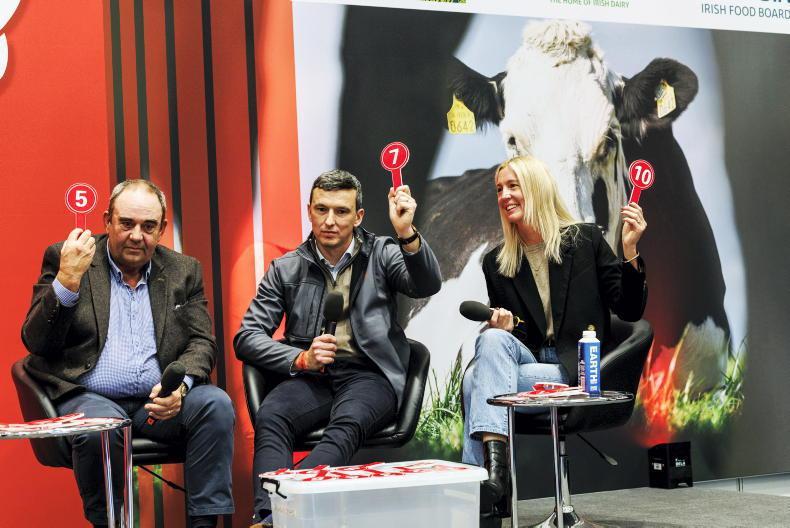
The series reached its close at Dairy Day 2025, where a panel comprising of Paul Hyland (a dairy farmer from Laois), Lisa Lysnkey (a dairy farmer from New Zealand) and Paddy Ryan (business banking manager at PTSB), analysed their approaches to investing and rated their favourite investments from the series.
Why to invest?
A recurring theme of the panel discussion was understanding the importance of understanding why to invest in something. What is the investment going to offer the farm going forward?
This was the starting point for all three panelists. It’s important to determine whether a certain investment is a want or a need and will it add value to the business.
For Paul Hyland, who is farming across multiple units in partnership with his brother David, investing in compliance was the number one priority on their farms.
“We always start with what is a requirement for investment. Anything that can help us sleep better at night is the priority. So, slurry storage for example is a big one for us,” he said.
Law
Lisa Lynskey, who is farming with her husband Simon in Taranakai, New Zealand, was in agreement that anything that has to be done by law will always be first on the list.
The Lynskeys are milking 1,500 cows in total, so there is a big demand for labour on the farm. After compliance, labour-saving tools are a big part of their strategy for investing.
“We have collars on all of the cows. Simon can’t be everywhere at breeding time and with staff rotas changing, days off and everything else that goes on, we need to have some consistency. The collars give us that, as we can see all the cows that are on from the phone,” Lisa said.
“We’re also looking quite a bit now at the halter fencing system. It works off the collars and it’s essentially a fence we can move through the app. Those types of things could be good for us to reduce the labour demand.”
With both Paul and Lisa farming at scale, staff are an essential component of the business. Accommodation for staff was one of the ‘Twenty ways’ and something that both of them rated 10/10.
“Going forward, that is so important for attracting and retaining staff. We have to be able to offer people something above what other jobs can offer,” Paul said.
The Lynskeys currently have 11 different houses that accommodate employees in the business and it’s something that has served them well when competing with other employers in the area.
Bank view
Paddy Ryan of PTSB was on hand to give the bank's view of a good investment on the day. He was in agreement with the rest of the panel in relation to compliance.
A bank is much more comfortable lending money to someone who is farming in a sustainable and future-proofed way, according to Paddy.
After that, a bank likes to see money spent in areas that will generate a good return, such as productive assets such as grazing infrastructure, roadways and water, for example.
Ratings
After the panel had discussed their approaches to investing, the 20 different options were rated in a ‘Strictly Come Dancing’ style.
Each panelist assigned a rating from one to 10, with one being a bad investment and 10 being an excellent investment choice.
At the end of the judging, the ratings were ranked from one to 20 based on their combined score out of 30.
An investment in grazing infrastructure won out as the highest-ranked investment with a rating of 30/30.
This was closely followed by slurry storage with a rating of 29, along with an investment in the milking parlour, to reduce the number of rows of cows to be milked.
The full list of investments and the individual rankings are included in Table 1 below.
An investment that wasn’t part of the series but emerged as a favourite of each of the three panelists was a cash reserve.
With 2026 set to be a tough year with low milk prices, a cash buffer of €400/cow to €500/cow was deemed essential to see the farm through the spring months.
The analysis of the 20 different investment ideas can be viewed on the Irish Farmers Journal website or app by searching for ‘Twenty ways to spend €20,000’.



SHARING OPTIONS