


The announcement last week that Ireland has secured a three-year extension to its nitrates derogation was met with a collective sigh of relief from all those invested in Irish agriculture.
It was a shot in the arm for those that decided that science should trump opinion when it comes to finding solutions to water quality problems and who therefore worked hard to save the derogation. However, Irish farmers and the industry should view this good news as only a battle win in the war to save the derogation. The war isn’t over.
The following are the next steps in the fight to ensure Ireland retains the derogation for the long term.
1. Water quality
Minister for Agriculture Martin Heydon has said on numerous occasions over the last few months that Ireland would not be in a position to negotiate a new derogation were it not for the fact that nitrates levels in Irish rivers is decreasing.
While a lot of concern is being placed on the outcome of the appropriate assessment (AA) process, if water quality doesn’t continue to improve then the outcome of the AA is largely irrelevant. This is because the European Commission are unlikely to grant a derogation where water quality is declining.
Improving water quality is a collective effort, involving all stakeholders and not just farmers. It also requires favourable weather, a key variable in nitrate levels rising and falling in waterbodies. The role of farming should not be dismissed and bad practice and bad actors need to be called out.
While a lot of concern is being placed on the outcome of the appropriate assessment (AA) process, if water quality doesn’t continue to improve then the outcome of the AA is largely irrelevant
Applying too many nutrients to a small area, either in the form of fertiliser, slurry or through excessive stocking rates on milking platforms elevates nutrient losses. Even where farms are far from rivers, these nutrients eventually end up in rivers and estuaries.
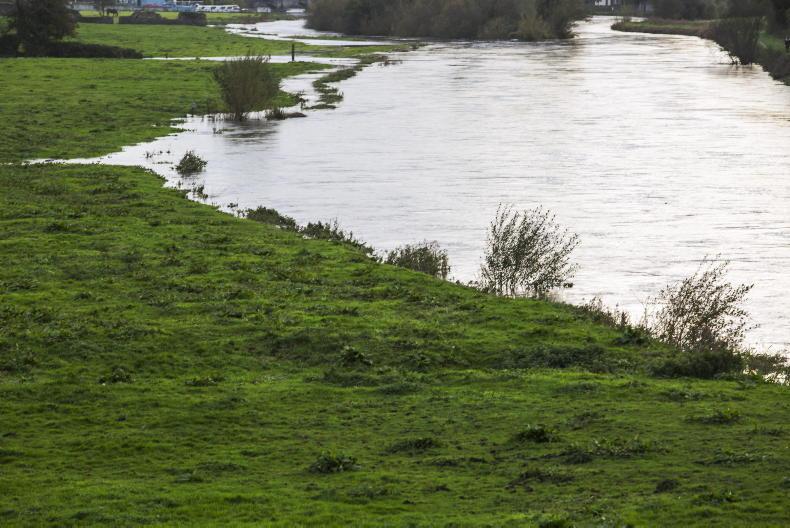
About 80% of the water in our rivers comes from groundwater with 20% from overland flow. Think of it like this, groundwater comes to the surface in springs. These springs feed into drains that feed into streams that feed into rivers.
Groundwaters are connected via aquifers and underground streams. So even what happens in fields far away from rivers and streams can have a big bearing on the quality of water in those rivers and streams.
The other big area is point source pollution, coming from farmyards. Leaks from silage pits, dirty yards flowing into drains and soiled water mixed with storm water are some of the common causes of point source pollution from farming. The Farming for Water EIP has helped thousands of farmers with grant aid towards investments to prevent pollution.
Farmers need to keep the momentum going on water quality, or else the sector may as well wave the white flag on the derogation.
2. Appropriate assessment
The next official step towards applying for a new derogation in 2028 is to complete an appropriate assessment (AA) across almost 583 river sub-catchments. These assessments will determine the impact that derogation farms in a sub-catchment will have on Natura 2000 habitats such as Special Areas of Conservation.
The Irish Farmers Journal understands that the Department of Agriculture is considering outsourcing these reports to third-party consultants as it doesn’t have enough ecologists to do the mammoth task themselves.
This will be the first time that AA will be used to determine the impact of farms on a habitat. Appropriate Assessments are more usually used to determine the impact of a larger industrial or infrastructural development on a habitat.
There is huge uncertainty over the outcome of the AA process and whether or not the reports will conclude that all or any sub-catchments will be able to have derogation farms within the sub-catchment.
If an appropriate assessment concludes that a sub-catchment can have derogation farms, will the NGOs challenge this decision through the courts, saying that the authors erred in some way? Similarly, if the AA concludes that there should be no derogation farms in a catchment, can farmers challenge this decision on the same basis?
3. Habitats Directive
The whole issue of appropriate assessments and the can of worms they have opened is down to the conflation of the Habitats Directive with the Nitrates Directive.
When I met with EU Commissioner for the Environment Jessika Roswall in Dublin back in November, the statements that were repeated again and again was around the importance of creating a “legally robust” agreement and “giving certainty to farmers”.
In this context, legally robust means that the decision to grant a derogation cannot be challenged in the courts. It seems now that the fear of litigation has gripped almost all EU decisions with the terms of the Habitats Directive being the tool of choice used by NGO’s to challenge decisions.
This weaponisation of the Habitats Directive was referenced by Minister Heydon last week, when he called for reform of the directive. He said that the Habitats Directive is being interpreted in a way that was not envisaged by those that wrote it.
All across north west Europe, development, whether agricultural, housing or industrial is being held up as a result of legal challenges on the grounds that the development doesn’t comply with the Habitats Directive.
There is now a move to change the terms of the Habitats Directive, not necessarily to dampen its ambitions but to allow development while at the same time protect habitats. This process is really only just beginning and is unlikely to be complete in time for the next derogation hurdle in 2028.
4. Nitrates Action Programme
Meanwhile, the work begins on implementing the sixth Nitrates Action Programme. The most onerous aspects of this new set of rules concern the requirement for a 21% increase in slurry storage requirements for dairy cows to be in place by October 2028.
Farmers operating higher milking platform stocking rates are faced with a raft of new requirements around nutrient distribution. These farmers will now have to prove that slurry is moved to outside farms. If not, their chemical nitrogen allowance will be cut. The above are just two out of 14 new measures as part of the sixth NAP.
5. Reform
As things stands, Irish farming is facing another cliff-hanger derogation decision at the end of 2028. This time, the outcome will be based on water quality up to 2028 and the outcomes of the appropriate assessment process.
The fact that there is no lead-in time to these decisions is stifling progress. Take the requirement to construct additional slurry storage. This is required to be in place by 1 October 2028 but farmers may not know the outcome of the next derogation until after 1 January 2029.
This is fuelling huge uncertainty at farm and sector levels. In a world where food is getting scarcer, it’s difficult to understand how the EU can preside over a system that is clearly unfit for purpose if dairy farmers are facing potential ruin every three or four years as a result of changes to EU policy.
Reform is needed at a number of levels. Firstly the timeline for trends in water quality is more than looking at a few years in isolation – it’s much longer term. Secondly, renewal of the nitrates derogation should be negotiated years in advance, giving farmers and the whole sector time to plan.


SHARING OPTIONS