As Europe enters a series of key negotiations on the future of CAP and legislation to restore fairness along the food processing chain, one heavyweight player at the table is in a state of flux.
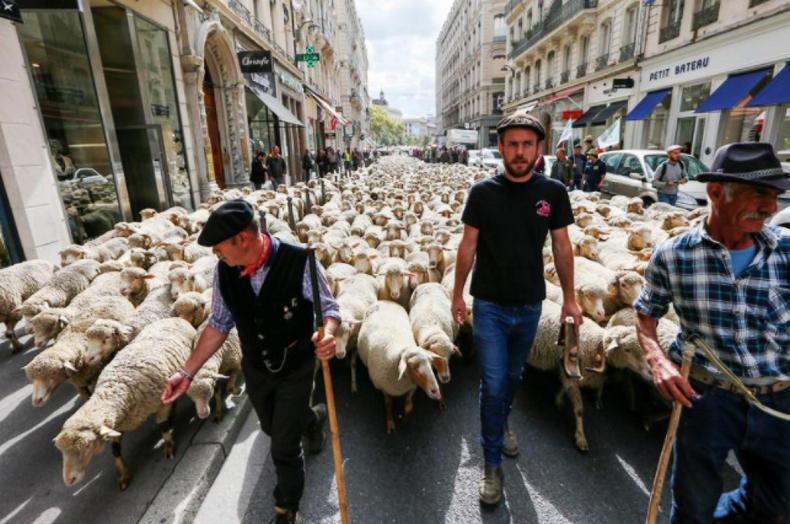
French farmers protest against wolf conservation measures in Lyon. President Macron is offering the industry more protection from unfair trading practices in exchange for more environmentally-friendly practices. \ REUTERS/Robert Pratta
Organic dairy farming on Bruno Pinel's farm in western France: the French government wants 50% of organic, local or sustainably-assured food in school and workplace canteens by 2022.
France, the largest European agricultural power with more than 15% of the EU’s farmland and production, the country that inscribed sitting down for a good meal to the UNSECO world heritage list, is engaged in deep soul-searching about the food it produces, trades and consumes.
When he was elected last spring, President Emmanuel Macron found an industry on the edge, with unprecedented bankruptcy and suicide rates among France’s farming population of half a million. Drought and flood
Successive droughts and floods had decimated the country’s flagship tillage sector, the milk price had crashed, bluetongue and bird flu outbreaks had disrupted the beef and poultry sectors and volatile global prices exposed the French pigmeat industry’s poor competitiveness.
ADVERTISEMENT
President Macron’s priority was to channel this malaise into a large-scale public consultation, which unfolded through the second half of last year under the stewardship of Olivier Allain, a Breton beef farmer and member of the ruling political party. The Etats-Généraux de l’Alimentation (which could translate as National Food Conference) was a huge undertaking, with more than 80 public meetings around the country, online debates and 17,000 submissions received. Participants ranged from farmers to processors, retailers, consumer bodies, environmental organisations and ordinary citizens.
Register for free to read this story and our free stories.
This content is available to digital subscribers and loyalty code users only. Sign in to your account, use the code or subscribe to get unlimited access.
However, if you would like to share the information in this article, you may use the headline, summary and link below:
Title: Deep soul-searching among French farmers
As Europe enters a series of key negotiations on the future of CAP and legislation to restore fairness along the food processing chain, one heavyweight player at the table is in a state of flux.
The reader loyalty code gives you full access to the site from when you enter it until the following Wednesday at 9pm. Find your unique code on the back page of Irish Country Living every week.
CODE ACCEPTED
You have full access to the site until next Wednesday at 9pm.
CODE NOT VALID
Please try again or contact support.
France, the largest European agricultural power with more than 15% of the EU’s farmland and production, the country that inscribed sitting down for a good meal to the UNSECO world heritage list, is engaged in deep soul-searching about the food it produces, trades and consumes.
When he was elected last spring, President Emmanuel Macron found an industry on the edge, with unprecedented bankruptcy and suicide rates among France’s farming population of half a million. Drought and flood
Successive droughts and floods had decimated the country’s flagship tillage sector, the milk price had crashed, bluetongue and bird flu outbreaks had disrupted the beef and poultry sectors and volatile global prices exposed the French pigmeat industry’s poor competitiveness.
President Macron’s priority was to channel this malaise into a large-scale public consultation, which unfolded through the second half of last year under the stewardship of Olivier Allain, a Breton beef farmer and member of the ruling political party. The Etats-Généraux de l’Alimentation (which could translate as National Food Conference) was a huge undertaking, with more than 80 public meetings around the country, online debates and 17,000 submissions received. Participants ranged from farmers to processors, retailers, consumer bodies, environmental organisations and ordinary citizens.
If you would like to speak to a member of our team, please call us on 01-4199525.
Link sent to your email address
We have sent an email to your address. Please click on the link in this email to reset your password. If you can't find it in your inbox, please check your spam folder. If you can't find the email, please call us on 01-4199525.
ENTER YOUR LOYALTY CODE:
The reader loyalty code gives you full access to the site from when you enter it until the following Wednesday at 9pm. Find your unique code on the back page of Irish Country Living every week.







SHARING OPTIONS