“I was married to a farmer for a long time but we separated in the last couple of years when the children were reared. He met someone else and moved in with her. I remained in the farmhouse on the family farm with the children and I still work the farm. Unfortunately, he died unexpectedly a couple of months ago and it has left me in a very precarious position. It looks as if he had no will. I am petrified that this other lady is going to lay claim on the farm. I have recently discovered that I do not qualify for the widow’s pension despite still being married to my husband. On making further enquiries, I might not even qualify for any sort of a pension in my own right, as no PRSI was paid for me on the farm. I am worried sick about the future. Have you any advice?
Answer: If your husband died on or after 1 July 2025, unfortunately you may no longer qualify for the widow’s pension. That’s because in July of this year, the widow’s pension was renamed and extended to include cohabitants. This arose from a 2024 Supreme Court ruling, the O’Meara case, which found that qualified cohabitants may now qualify for the widow’s pension if they can meet certain criteria.
You will not qualify for the widow’s pension, now called the Bereaved Partners (Contributory) Pension, if you lived apart and were not in an intimate and committed relationship for a period of at least two years immediately before the date of death of your partner. If you are a cohabitant, you must be cohabiting for at least five years (or two years if you have dependent children) and either you or your partner must have enough PRSI contributions.
Consequently there is a chance that neither you, as the spouse or this other lady qualify for the widow’s pension.
Checking PRSI contributions
Farm spouses are regularly told that they are not entitled to a contributory state pension despite having farmed alongside their partner for most of their lives.
This is because if an individual (usually the farm wife) is not officially paid for their work, they have not paid PRSI in their own name and cannot claim their own contributory pension. If you have the new social welfare card, you can check your PRSI contributions on the MyGovID website mygovid.ie. The PRSI records section in Donegal can also assist (1890 690 690).
Recognition of a farm partnership retrospectively
An alternative is to retrospectively prove a business partnership has existed between spouses under the Farm Spouses Scheme. When deciding on partnership status, the Department of Employment Affairs and Social Protection (DEASP) and Revenue examine your situation to see if some or all of the following apply:
There is a written partnership agreement (although not legally required).Each person writes cheques on the business accounts in their own right.There is a joint business account.A partnership is apparent to others doing business with the partnership.Each partner makes a significant contribution to the running of the business.The business is owned jointly by the partnership.The profits and losses of the partnership are shared by each partner. Supporting documentation for an informal partnership might include invoices, letters from merchants/suppliers, or herd numbers in joining names.
If some or all of these exist, the arrangement is likely to be viewed as a partnership by the social welfare inspector from the DEASP. The spouse can then pay Class S contributions retrospectively, with the amount worked out by splitting the income from the partnership. This may now need to be actioned by you as the personal representative of your late husband’s estate.
The scope section of the Deptartment of Social Protection administers the Farm Spouses Scheme and can be contacted at scope@welfare.ie or 01 6732585.
Intestate estate and claim by cohabitant
Without a will, your late husband’s assets will be divided up according to the rules of intestacy.
This means that because you are married and have children, you as the spouse would be entitled to two-thirds share while the children equally would be entitled to the remaining one-third.
In the normal course, the children would disclaim their share leaving you as the spouse to inherit the entire and thereafter decide what way the assets would be distributed amongst the family.
However, if the children are under 18 years of age, they cannot disclaim their share as they do not have capacity and so automatically become co-owners with the parent.
If your late husband’s partner claims that she was a qualified cohabitant she can apply for provisions to be made for her from your late husband’s estate. The court may grant a share of the estate to her if proper provision was not made for her in her deceased partner’s lifetime or in a bequest in her late partner’s will.
It is not necessary to prove that she was financially dependent on him. Whether she will be successful in her claim depends on the financial relationship between them, each partner’s financial circumstances and whether a partner was still married or had children, and the size of the estate.
The personal representative must be notified of the claim within six months of an application for a grant of administration.
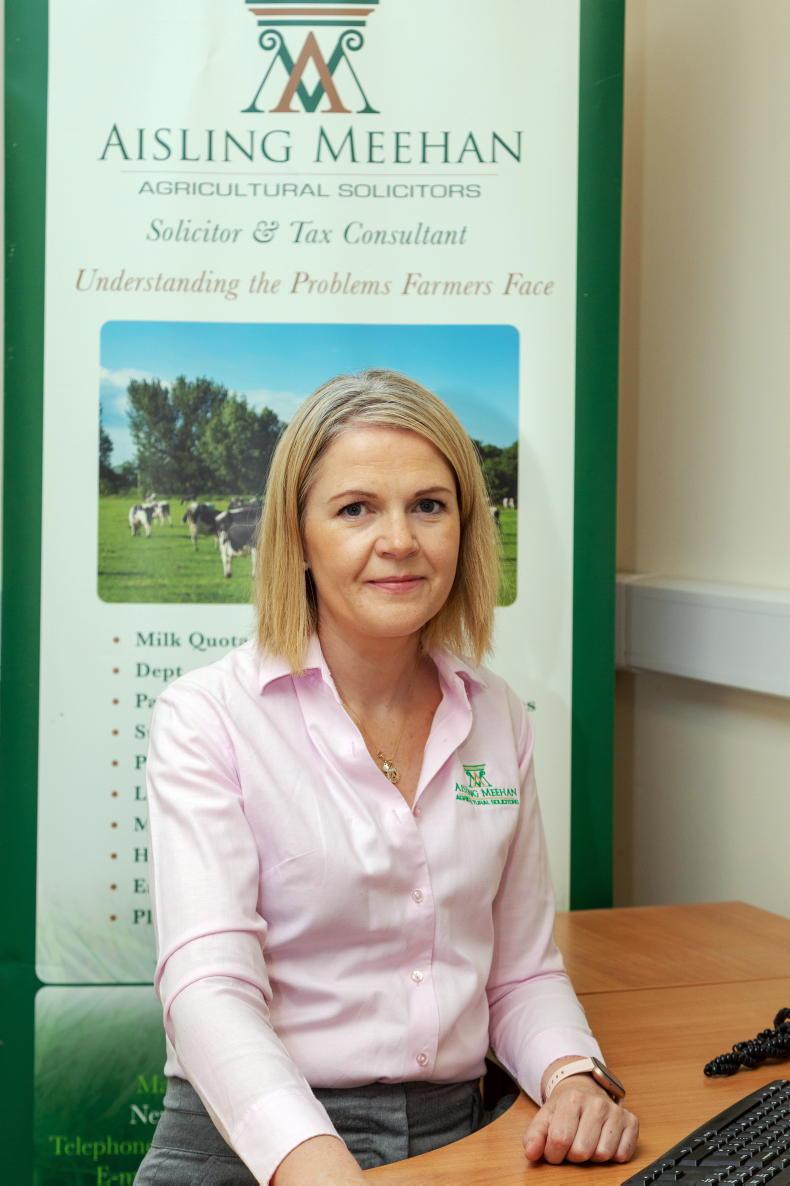
Aisling Meehan, agricultural solicitors and tax consultants.
Disclaimer: The information in this article is intended as a general guide only. While every care is taken to ensure accuracy of information contained in this article, Aisling Meehan, Agricultural Solicitors and Tax Consultants does not accept responsibility for errors or omissions howsoever arising. E-mail aisling@agrisolicitors.ie
“I was married to a farmer for a long time but we separated in the last couple of years when the children were reared. He met someone else and moved in with her. I remained in the farmhouse on the family farm with the children and I still work the farm. Unfortunately, he died unexpectedly a couple of months ago and it has left me in a very precarious position. It looks as if he had no will. I am petrified that this other lady is going to lay claim on the farm. I have recently discovered that I do not qualify for the widow’s pension despite still being married to my husband. On making further enquiries, I might not even qualify for any sort of a pension in my own right, as no PRSI was paid for me on the farm. I am worried sick about the future. Have you any advice?
Answer: If your husband died on or after 1 July 2025, unfortunately you may no longer qualify for the widow’s pension. That’s because in July of this year, the widow’s pension was renamed and extended to include cohabitants. This arose from a 2024 Supreme Court ruling, the O’Meara case, which found that qualified cohabitants may now qualify for the widow’s pension if they can meet certain criteria.
You will not qualify for the widow’s pension, now called the Bereaved Partners (Contributory) Pension, if you lived apart and were not in an intimate and committed relationship for a period of at least two years immediately before the date of death of your partner. If you are a cohabitant, you must be cohabiting for at least five years (or two years if you have dependent children) and either you or your partner must have enough PRSI contributions.
Consequently there is a chance that neither you, as the spouse or this other lady qualify for the widow’s pension.
Checking PRSI contributions
Farm spouses are regularly told that they are not entitled to a contributory state pension despite having farmed alongside their partner for most of their lives.
This is because if an individual (usually the farm wife) is not officially paid for their work, they have not paid PRSI in their own name and cannot claim their own contributory pension. If you have the new social welfare card, you can check your PRSI contributions on the MyGovID website mygovid.ie. The PRSI records section in Donegal can also assist (1890 690 690).
Recognition of a farm partnership retrospectively
An alternative is to retrospectively prove a business partnership has existed between spouses under the Farm Spouses Scheme. When deciding on partnership status, the Department of Employment Affairs and Social Protection (DEASP) and Revenue examine your situation to see if some or all of the following apply:
There is a written partnership agreement (although not legally required).Each person writes cheques on the business accounts in their own right.There is a joint business account.A partnership is apparent to others doing business with the partnership.Each partner makes a significant contribution to the running of the business.The business is owned jointly by the partnership.The profits and losses of the partnership are shared by each partner. Supporting documentation for an informal partnership might include invoices, letters from merchants/suppliers, or herd numbers in joining names.
If some or all of these exist, the arrangement is likely to be viewed as a partnership by the social welfare inspector from the DEASP. The spouse can then pay Class S contributions retrospectively, with the amount worked out by splitting the income from the partnership. This may now need to be actioned by you as the personal representative of your late husband’s estate.
The scope section of the Deptartment of Social Protection administers the Farm Spouses Scheme and can be contacted at scope@welfare.ie or 01 6732585.
Intestate estate and claim by cohabitant
Without a will, your late husband’s assets will be divided up according to the rules of intestacy.
This means that because you are married and have children, you as the spouse would be entitled to two-thirds share while the children equally would be entitled to the remaining one-third.
In the normal course, the children would disclaim their share leaving you as the spouse to inherit the entire and thereafter decide what way the assets would be distributed amongst the family.
However, if the children are under 18 years of age, they cannot disclaim their share as they do not have capacity and so automatically become co-owners with the parent.
If your late husband’s partner claims that she was a qualified cohabitant she can apply for provisions to be made for her from your late husband’s estate. The court may grant a share of the estate to her if proper provision was not made for her in her deceased partner’s lifetime or in a bequest in her late partner’s will.
It is not necessary to prove that she was financially dependent on him. Whether she will be successful in her claim depends on the financial relationship between them, each partner’s financial circumstances and whether a partner was still married or had children, and the size of the estate.
The personal representative must be notified of the claim within six months of an application for a grant of administration.
Aisling Meehan, agricultural solicitors and tax consultants.
Disclaimer: The information in this article is intended as a general guide only. While every care is taken to ensure accuracy of information contained in this article, Aisling Meehan, Agricultural Solicitors and Tax Consultants does not accept responsibility for errors or omissions howsoever arising. E-mail aisling@agrisolicitors.ie







SHARING OPTIONS