


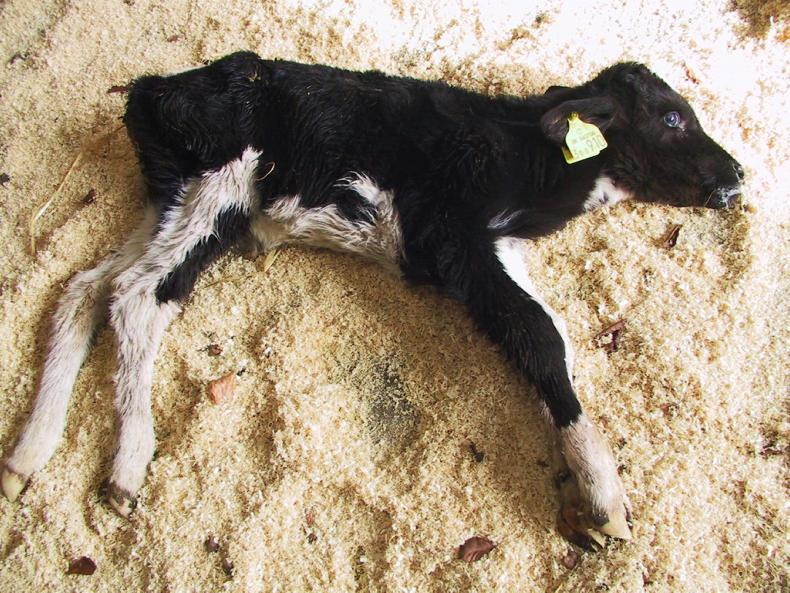
Salmonellosis has a variety of manifestations including abortion, diarrohea, septicaemia, osteomyelitis, and terminal dry gangrene. It mainly affects calves that are two to eight weeks of age and causes diarrhoea, but is also a significant cause of abortion in dairy cows.
Causes
The infection is very contagious with young calves being the most at risk. The mortality rate of calves who contract salmonella is high. However, older stock are also at risk. There is also a chance that the infection can be passed from cattle to humans, so care should be taken if treating an infected animal.
Salmonella dublin is the most common form and is often introduced through bought-in cattle in the form of a carrier. Often an outbreak can occur when a carrier animal becomes stressed and starts shedding into the environment through bacteria in faeces. Stressors include reduced feed, housing, drying off, weaning, transport etc.
Salmonella typhimurium can be spread by contaminated feed, vermin and birds. The main method of the spread of either disease is through the ingestion of contaminated faeces through feed or through water. Concurrent fluke infection makes the infection more severe.
Symptoms
Salmonella usually manifests itself as diarrhoea. Infected animals present as being very sick and usually dehydrated. Even if animals don’t die, the disease can be quite severe, and affected animals may often be very stunted after they recover. As well as diarrhoea, it may also cause septicaemia. Affected animals are usually very depressed and may suffer from pneumonia.
The scour produced is often bloody and it may cause terminal dry gangrene where it damages the blood vessels at the extremities of the feet, tail and ears. In some situations, it lodges in the blood vessels of bones in the lower neck, causing the bone to become infected, resulting in such animals becoming paralysed. Salmonella dublin outbreaks are often devastating and severe, and are best avoided.
The infection in dairy herds can also manifest itself in the form of abortion between months five and eight of pregnancy.
Treatment
Once an animal presents itself with an infection, the first step should be to isolate it to try and reduce the risk of spreading infection. Treating the disease depends on the clinical manifestation of the disease. Animals with diarrhoea should be treated with antibiotics and given fluids to aid in rehydration. If an animal presents with cervical osteomyelitis, they should be treated with antibiotics and anti-inflammatories, however the prognosis is generally poor.
Treatment is often difficult and can be quite expensive, so therefore prevention is much more preferable than treatment. Salmonella dublin in particular is one of the most difficult diseases to eradicate once it gets into a herd and response to antibiotic treatment will vary from poor to reasonable.
Prevention and control
All control measures must first focus on ensuring that bacterial contamination of feed is avoided. Vets advise farmers to avoid feeding milk from clinically infected cows and to ensure that bedding, water troughs and feeding equipment is clean. Hot water should be used to clean feeders between feeding calves and calves should also be bedded daily. Calves with strong and healthy immune systems are often better able to deal with the disease. To achieve this, farmers should ensure that calves consume adequate colostrum.
Newborn calves should receive 10% of their bodyweight of colostrum within two hours of birth. For a Holstein Friesian calf (35-45kg), this is approximately three litres while for a heavier continental calf (60kg), up to six litres would be required. This will ensure the calf has a strong immune system to fight disease. Absorption of antibodies from colostrum drops off dramatically by 24 hours of age, so ideally a 12-hour-old dairy calf should have received five to six litres while a large continental calf should have received 10 litres.
If a herd has been reasonably diligent in monitoring its disease status and no evidence of salmonella has been found in the last five years, it can be assumed to be clear of infection. Conversely, if salmonella dublin has been confirmed in a breeding herd, there is a significant risk of persistent infection in carrier cows for as long as animals which were present at the time of the outbreak remain in the herd. The larger the herd, the greater is the risk. Such herds typically experience repeated clinical outbreaks at five to six year intervals as turnover in the herd produces a new population of susceptible animals.
Vaccination may be required at herd level to control the disease in the long term. However, vaccines by themselves will not be effective if hygiene and stressors are not also addressed. Annual booster vaccination should be maintained in herds with a history of salmonella dublin.
Organisms such as salmonella may persist for many months in slurry, so slurry should be spread on arable/silage fields rather than on land that will be grazed soon to aid in the prevention of the disease.


SHARING OPTIONS