No two growing seasons are ever the same.
No truer words could be said for the season that impacted the 2025 winter wheat crop.
Wet, dry, cold and warm, 2025 had it all. Blocking highs to blocking lows brought periods of incessant rain, through to periods of wanting rain.
These unusual weather patterns led to high septoria pressures in our trials in Meath, relative to the those we had in Cork.
Yellow rust
However, it was not septoria that caught most of the attention with regards to disease control in 2025, that was left to yellow rust. In late March/early April it was apparent that something had changed in the yellow rust population.
Typically, yellow rust is a relatively minor disease with sporadic reports that are easy to take care of. In 2025, reports started coming in about unusual patches of yellowing appearing in fields of varieties such as Champion and KWS Dawsum, with these confirmed as foci of yellow rust.
Varieties
At the start of 2025 these varieties had a resistance score of eight for yellow rust, based on the Department of Agriculture’s recommended list (RL). This score pretty much means that these varieties were as close as possible to completely resistant.
However, the rust which was appearing was not just an Irish problem, with reports of similar foci being observed across the UK, and key wheat growing regions of north-western Europe.
Researchers in the UK (NIAB and John Innes Centre) quickly confirmed that what was being observed was a breakdown in the resistant gene Yr15 by Puccina striiformis the pathogen that causes yellow rust.
The Global Rust Reference Centre in Denmark have since named this race the ‘Champion’ race, as its appearance was first reported on Champion and severely impacted on this variety.
Even though the race has been named after this variety, all varieties that were reliant on the Yr15 gene for yellow rust resistance can now be regarded as susceptible.
This change has been reflected in the 2026 Recommneded List (RL) yellow rust ratings (see page 39), with no varieties on the list now having a score of eight for resistance to rust. Champion for example now has a score of four.
What does this mean for control?
What does this all mean for winter wheat disease control for 2026? The first thing to say is that in typical Irish weather conditions septoria is always the greatest threat to winter wheat.
While there are no varieties with a septoria resistance score of four on the RL list, there are equally none with eight, so septoria will likely always be present.
The mild temperatures that prevailed over the winter months, as they have been during the winter of 2025/2026, coupled with typically damp-wet conditions from spring onwards suit the biology of septoria, and disease control programmes should be built around a foundation aiming for septoria control.
With the majority of winter wheat crops in the ground now regarded as either very susceptible – moderately susceptible (at most) to yellow rust, the disease has become a major disease threat to the 2026 crop and disease control programmes must also reflect this.
Efficacy
Thankfully, unlike septoria, yellow rust remains relatively easy to control, with all the major fungicide groups providing good-excellent levels of efficacy – the exception being the multisite fungicides folpet and sulphur, which do not provide control.
If there is no yellow rust present in a crop when it is being sprayed for septoria, such as at leaf three fully emerged and again at flag leaf, a fungicide programme built to control septoria can be expected to provide control of yellow rust also.
There are of course some caveats, the key being the assumption that no yellow rust is present.
Monitoring crops in early season is a critical measure of Integrated Pest Management (IPM) and yellow rust is a prime example of where this can be effective to support disease control.
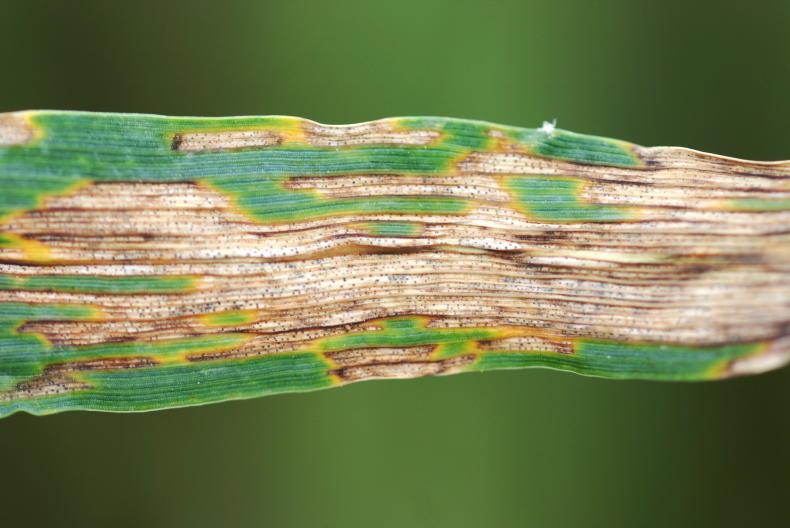
Septoria tritici has become less sensitive to many fungicide actives over recent years.
However, yellow rust is one of those few diseases that if you end up chasing control you are losing the battle. It is a clonal pathogen, meaning that every lesion or strip in a field of wheat are likely the exact same genetically, the complete opposite of septoria. This has consequences for how the disease develops at a field scale.
For septoria, infections are typically uniform across a field from the start. There is almost a base level of the disease coming out of the winter and you will struggle to reduce the size of the population in any meaningful way before stem extension.
We also know that the time it takes to infect a crop and produce the new spores that cause new infections is relatively long and therefore we can apply effective fungicides in a protective and curative manner to the upper canopy and be confident that even on the new growth, such as the lower part of leaf two and upper leaf one that is typically unprotected for a period we will be able to achieve septoria control.
Yellow rust is slightly different, in that typically it starts as a few foci or spots here and there, resulting from windblown spores, and if conditions are favourable these foci increase in size, with satellite foci or patches being initiated from them, until the point where the entire field is covered.
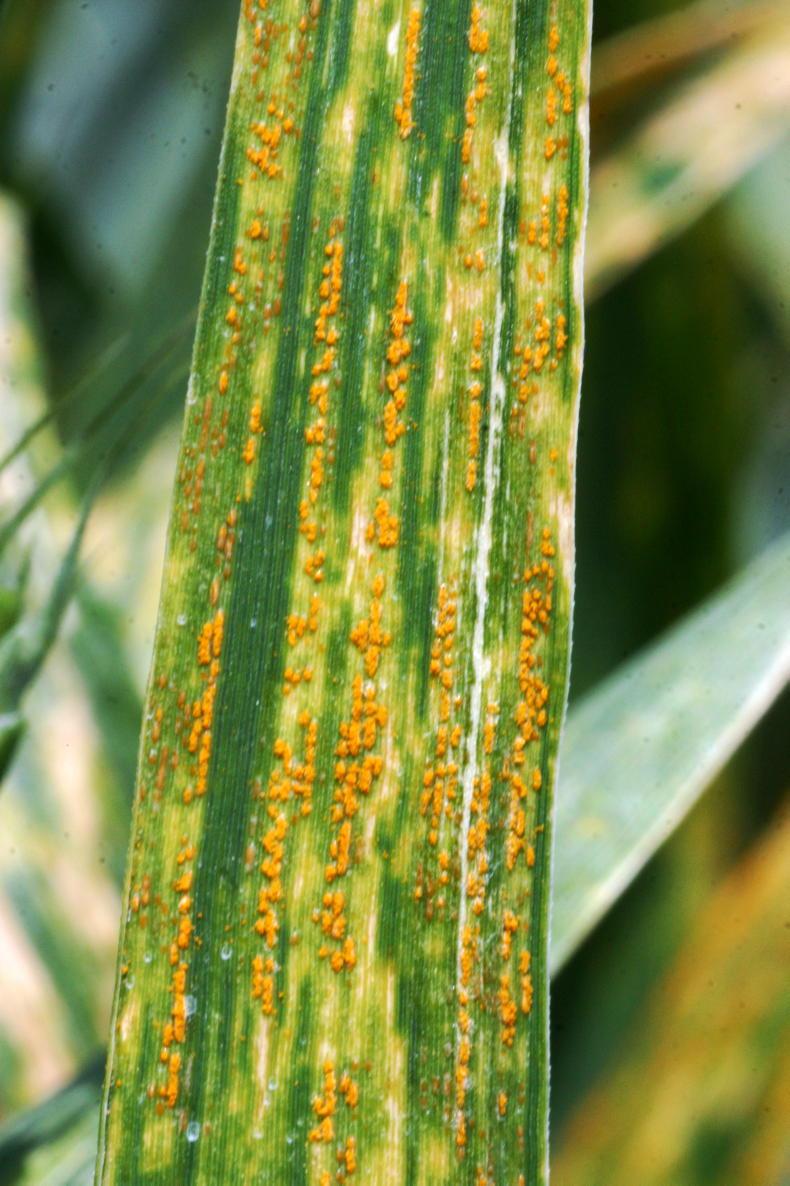
Yellow rust proved to be a significant challenge in winter wehat in 2017.
Unlike septoria, the life cycle of yellow rust is much shorter and, if the levels of disease are high then using our traditional fungicide approach, the unprotected new growth as described above may be susceptible to infection.
Therefore, unlike septoria, these initial infections are critical to how the disease develops. Managing these infections effectively becomes critically important to achieve yellow rust control. This is actually where the concept for T0 or pre-stem extension fungicide applications originally came from.
So what does a fungicide programme for winter wheat now look like and what do you do with a field that appears not to have yellow rust?
Disease control programmes
The change in yellow rust resistance for varieties such as Champion have created a headache for how we devise disease control programmes in winter wheat.
As mentioned previously, monitoring crops for yellow rust is crucial, however, we must equally recognise the risks associated with yellow rust infections and the costs (both economically and environmentally) from not getting effective control of the disease early on – it would unfortunately probably result in more fungicides needing to be applied later on.
Given the susceptibilities of some of the varieties (eg Champion), even if there appears to be no yellow rust present, it is almost impossible not to recommend a fungicide application before stem extension.
Infection
On these varieties, the presence or absence of yellow rust should dictate what fungicides are applied.
Where infection is present across a field, then it requires a combination of an azole and strobilurin. The azole (tebuconazole or indeed prothioconazole) will provide the curativitiy or knockdown required to stop the ongoing infection, while the strobilurin will provide the protection to prevent it getting going again before the follow up septoria fungicide.
If no yellow rust is identified in these crops early in the season, an application of either an azole or strobilurin in combination with a multisite will provide the protection required to prevent infections getting established in the first place.
See Figure 1 for a decision tree that guides what type of strategy should be taken this coming spring.
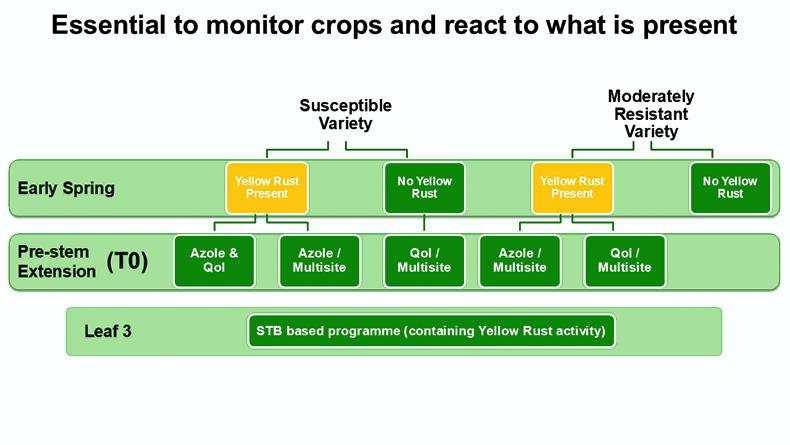
Figure 1. Teagasc chart to help growers decide on a wheat disease control programme.
Such early intervention should in most instances take care of yellow rust, assuming of course it is followed with a robust fungicide programme.
Where high levels of yellow rust are observed early the inclusion of the SDHI solatenol in the follow up programme should be considered.
It sets the standard for yellow rust control, but we do need to be aware that its strength against septoria has slipped considerably in the last number of seasons.
Any follow up fungicide programme will typically include a combination of azoles, SDHIs, the QiI Inatreq and multisites folpet and/or sulphur and it is the combination of all of these that are required to prevent and protect against septoria.
Over the past decade we have continued to see an erosion of sensitivity to the azoles and the SDHIs.
To some extent in the last number of seasons we have seen a stabilisation of this erosion, however, this has stabilised at a significantly reduced level of sensitivity.
Thankfully, there has been no indication of resistance to Inatreq. It is critical to ensure we use the diversity of sensitivity that exists amongst the azoles, and to maximise the level of sensitivity that still remains for the SDHIs.
Alternate between groups
To achieve this, we should where possible alternate between the different azole groups, with tebuconazole and mefentrifluconazole in one camp, and prothioconazole in the other.
If you are using an azole at T0 or pre-stem extension for yellow rust control, then you should be thinking what azole it is and what the follow up azole will be.
For septoria a major factor in resistance development and spread is the amount of fungicide applied, be it the number of applications of a fungicide (or group of fungicides such as the SDHIs) or the rates applied.
Minimising either of these to reflect the disease pressures experienced is our best way of protecting against resistance.
Equal to this is ensuring that when they are applied it is in a mixture with additional modes of action that are providing disease control, including a multisite, such as folpet or sulphur.

Steven Kildea, research officer, Teagasc.
No two growing seasons are ever the same.
No truer words could be said for the season that impacted the 2025 winter wheat crop.
Wet, dry, cold and warm, 2025 had it all. Blocking highs to blocking lows brought periods of incessant rain, through to periods of wanting rain.
These unusual weather patterns led to high septoria pressures in our trials in Meath, relative to the those we had in Cork.
Yellow rust
However, it was not septoria that caught most of the attention with regards to disease control in 2025, that was left to yellow rust. In late March/early April it was apparent that something had changed in the yellow rust population.
Typically, yellow rust is a relatively minor disease with sporadic reports that are easy to take care of. In 2025, reports started coming in about unusual patches of yellowing appearing in fields of varieties such as Champion and KWS Dawsum, with these confirmed as foci of yellow rust.
Varieties
At the start of 2025 these varieties had a resistance score of eight for yellow rust, based on the Department of Agriculture’s recommended list (RL). This score pretty much means that these varieties were as close as possible to completely resistant.
However, the rust which was appearing was not just an Irish problem, with reports of similar foci being observed across the UK, and key wheat growing regions of north-western Europe.
Researchers in the UK (NIAB and John Innes Centre) quickly confirmed that what was being observed was a breakdown in the resistant gene Yr15 by Puccina striiformis the pathogen that causes yellow rust.
The Global Rust Reference Centre in Denmark have since named this race the ‘Champion’ race, as its appearance was first reported on Champion and severely impacted on this variety.
Even though the race has been named after this variety, all varieties that were reliant on the Yr15 gene for yellow rust resistance can now be regarded as susceptible.
This change has been reflected in the 2026 Recommneded List (RL) yellow rust ratings (see page 39), with no varieties on the list now having a score of eight for resistance to rust. Champion for example now has a score of four.
What does this mean for control?
What does this all mean for winter wheat disease control for 2026? The first thing to say is that in typical Irish weather conditions septoria is always the greatest threat to winter wheat.
While there are no varieties with a septoria resistance score of four on the RL list, there are equally none with eight, so septoria will likely always be present.
The mild temperatures that prevailed over the winter months, as they have been during the winter of 2025/2026, coupled with typically damp-wet conditions from spring onwards suit the biology of septoria, and disease control programmes should be built around a foundation aiming for septoria control.
With the majority of winter wheat crops in the ground now regarded as either very susceptible – moderately susceptible (at most) to yellow rust, the disease has become a major disease threat to the 2026 crop and disease control programmes must also reflect this.
Efficacy
Thankfully, unlike septoria, yellow rust remains relatively easy to control, with all the major fungicide groups providing good-excellent levels of efficacy – the exception being the multisite fungicides folpet and sulphur, which do not provide control.
If there is no yellow rust present in a crop when it is being sprayed for septoria, such as at leaf three fully emerged and again at flag leaf, a fungicide programme built to control septoria can be expected to provide control of yellow rust also.
There are of course some caveats, the key being the assumption that no yellow rust is present.
Monitoring crops in early season is a critical measure of Integrated Pest Management (IPM) and yellow rust is a prime example of where this can be effective to support disease control.
Septoria tritici has become less sensitive to many fungicide actives over recent years.
However, yellow rust is one of those few diseases that if you end up chasing control you are losing the battle. It is a clonal pathogen, meaning that every lesion or strip in a field of wheat are likely the exact same genetically, the complete opposite of septoria. This has consequences for how the disease develops at a field scale.
For septoria, infections are typically uniform across a field from the start. There is almost a base level of the disease coming out of the winter and you will struggle to reduce the size of the population in any meaningful way before stem extension.
We also know that the time it takes to infect a crop and produce the new spores that cause new infections is relatively long and therefore we can apply effective fungicides in a protective and curative manner to the upper canopy and be confident that even on the new growth, such as the lower part of leaf two and upper leaf one that is typically unprotected for a period we will be able to achieve septoria control.
Yellow rust is slightly different, in that typically it starts as a few foci or spots here and there, resulting from windblown spores, and if conditions are favourable these foci increase in size, with satellite foci or patches being initiated from them, until the point where the entire field is covered.
Yellow rust proved to be a significant challenge in winter wehat in 2017.
Unlike septoria, the life cycle of yellow rust is much shorter and, if the levels of disease are high then using our traditional fungicide approach, the unprotected new growth as described above may be susceptible to infection.
Therefore, unlike septoria, these initial infections are critical to how the disease develops. Managing these infections effectively becomes critically important to achieve yellow rust control. This is actually where the concept for T0 or pre-stem extension fungicide applications originally came from.
So what does a fungicide programme for winter wheat now look like and what do you do with a field that appears not to have yellow rust?
Disease control programmes
The change in yellow rust resistance for varieties such as Champion have created a headache for how we devise disease control programmes in winter wheat.
As mentioned previously, monitoring crops for yellow rust is crucial, however, we must equally recognise the risks associated with yellow rust infections and the costs (both economically and environmentally) from not getting effective control of the disease early on – it would unfortunately probably result in more fungicides needing to be applied later on.
Given the susceptibilities of some of the varieties (eg Champion), even if there appears to be no yellow rust present, it is almost impossible not to recommend a fungicide application before stem extension.
Infection
On these varieties, the presence or absence of yellow rust should dictate what fungicides are applied.
Where infection is present across a field, then it requires a combination of an azole and strobilurin. The azole (tebuconazole or indeed prothioconazole) will provide the curativitiy or knockdown required to stop the ongoing infection, while the strobilurin will provide the protection to prevent it getting going again before the follow up septoria fungicide.
If no yellow rust is identified in these crops early in the season, an application of either an azole or strobilurin in combination with a multisite will provide the protection required to prevent infections getting established in the first place.
See Figure 1 for a decision tree that guides what type of strategy should be taken this coming spring.
Figure 1. Teagasc chart to help growers decide on a wheat disease control programme.
Such early intervention should in most instances take care of yellow rust, assuming of course it is followed with a robust fungicide programme.
Where high levels of yellow rust are observed early the inclusion of the SDHI solatenol in the follow up programme should be considered.
It sets the standard for yellow rust control, but we do need to be aware that its strength against septoria has slipped considerably in the last number of seasons.
Any follow up fungicide programme will typically include a combination of azoles, SDHIs, the QiI Inatreq and multisites folpet and/or sulphur and it is the combination of all of these that are required to prevent and protect against septoria.
Over the past decade we have continued to see an erosion of sensitivity to the azoles and the SDHIs.
To some extent in the last number of seasons we have seen a stabilisation of this erosion, however, this has stabilised at a significantly reduced level of sensitivity.
Thankfully, there has been no indication of resistance to Inatreq. It is critical to ensure we use the diversity of sensitivity that exists amongst the azoles, and to maximise the level of sensitivity that still remains for the SDHIs.
Alternate between groups
To achieve this, we should where possible alternate between the different azole groups, with tebuconazole and mefentrifluconazole in one camp, and prothioconazole in the other.
If you are using an azole at T0 or pre-stem extension for yellow rust control, then you should be thinking what azole it is and what the follow up azole will be.
For septoria a major factor in resistance development and spread is the amount of fungicide applied, be it the number of applications of a fungicide (or group of fungicides such as the SDHIs) or the rates applied.
Minimising either of these to reflect the disease pressures experienced is our best way of protecting against resistance.
Equal to this is ensuring that when they are applied it is in a mixture with additional modes of action that are providing disease control, including a multisite, such as folpet or sulphur.
Steven Kildea, research officer, Teagasc.





SHARING OPTIONS