


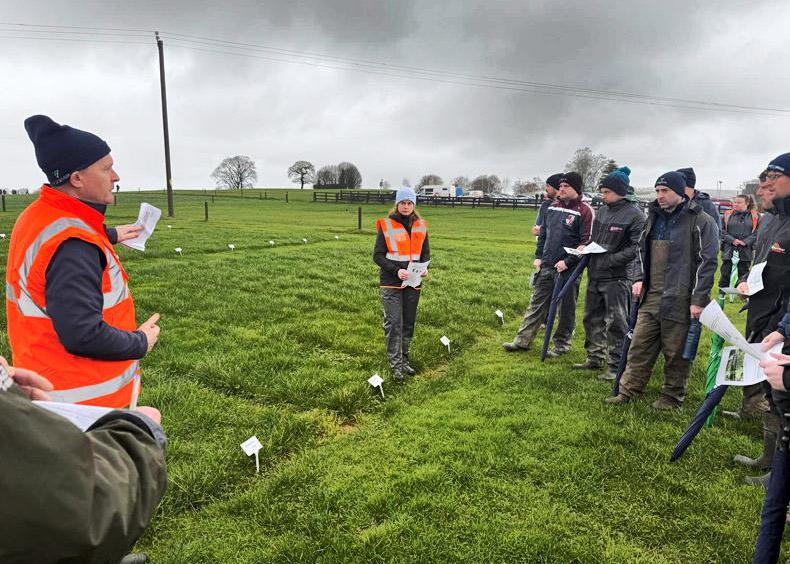
There was a strong turnout at the Goldcrop grass and clover technical day which took place in Teagasc Moorepark last month.
The audience on the day, heard the latest updates in the grassland research space, as well as the top-performing grass seeds currently available on the market.
In terms of ongoing research, Michael O’Donovan, grassland researcher with Teagasc addressed the attendees.
“Our ultimate target is to continue improving the performance and production of grass swards. If a farm is growing, say 12t DM/ha, we want to be able to shove that on towards 14 or 15 tonnes.”
“Moving forward, we’re looking at more clover in swards and getting better at managing that clover, whether that’s clover in the grazing swards or the use of red clover in the conservation of silage.” Michael said.
Reseeding is one of the key strategies to achieving these targets and according to Michael it’s an annual cost that needs to be budgeted into the business.
Teagasc research is showing the top-performing reseeded swards on farms, are those using seed varieties from the Pasture Profit Index (PPI).
“The varieties used from the recommended list and the pasture profit index are consistently performing better in swards, they are lasting longer and have higher utilisation. That’s just a fact” Michael said.
Top performers
Before a grass seed goes into the recommended list it must first go through a rigorous testing process.
This testing process is independent of all seed companies and is run by the Department of Agriculture. There are five DAFM sites across the country as well as the Teagasc site at Moorepark, where grazing utilisation of the different varieties is tested.
Each variety goes through two separate sowings and two different management practices; one for grazing and the other for silage management. Each trial lasts for two years.
According to Pat Cashman of Goldcrop, there is no other trialling system in Europe or the world that tests candidate varieties to this level.
Banbridge came in as the top performing perennial ryegrass on the PPI for 2026.
“The PPI is a sum of the parts calculation and therefore you can be confident the variety is a strong performer in each area.”
“In the case of Banbridge, its early spring growth, total production, grazing utilisation and silage yield were some of the key standout traits.”
“For that reason, Banbridge is a key variety for any seed mix going forward” Pat said.
In terms of clover, Clodagh won out as the number one-yielding large-leaf white clover variety, while Dungloe topped the medium-leaf white clover varieties.
According to Pat this is not just an Irish phenomenon; Clodagh and Dungloe have came out on top of Scottish, English and French recommended lists, highlighting the repeatability and consistency of the varieties.




SHARING OPTIONS