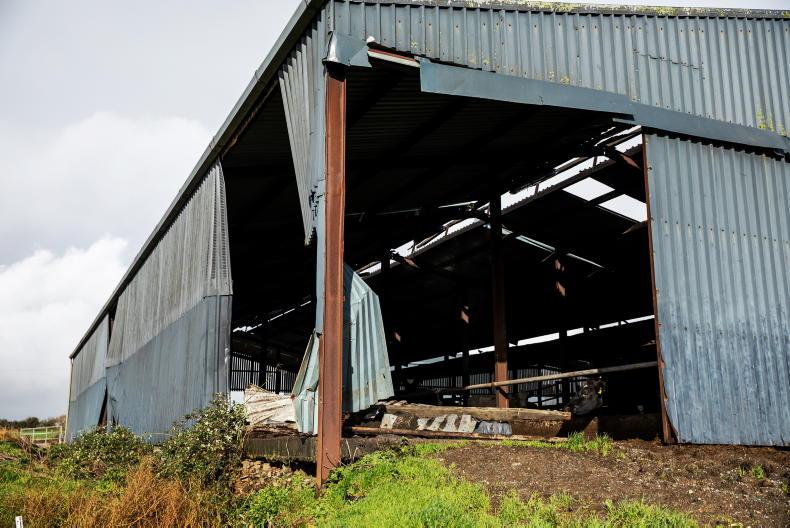
The storms of last year caused significant damage to farms and dwellings; trees knocked, roofs ripped off sheds and power outages for days on end.
While plenty of remedial work has been done in the interim, there are several checks that farms should complete ahead of the possible storm season.
Replacing sheeting
Roofing took a hammering during the storm, especially older round roof sheds over 40 years of age. While some roofs suffered total damage, with trusses, timbers and sheeting all having to be replaced, some sheds got away lighter and only some re-screwing or replacement of skylights is required.
To ascertain the length and curving of sheeting required, then the round roof trusses will have to be measured. If a truss is on the ground, then it is simple to measure the length of the truss and the height from the lowest point to the highest, with these figures then supplied to the sheeting manufacturer.
The number of cleats per truss (the bracket which holds the roof timber) should also be noted, and where there is uneven spacing between cleats this should also be measured and passed on to the manufacturer to ensure correct length of the sheeting.
To roll a sheet is approximately €3-€5, but sheets tend to be much shorter than for standard portal frame or lean-to roofs with straight sheeting.
Checks and repairs
Even where sheeting hasn’t been ripped off roofs, older sheeting will likely be loosened and is prone to be removed should we have strong winds again. When inspecting roofs, do so from a mobile elevating work platform (MEWP) – commonly known as a cherry picker, in which the person completing the work has full control of the machine – coupled with an appropriate safety harness and head protection.

Use of a Mobile Elevated Work Platform (MEWP) should always be implemented for working on roofs.
Be sure that you are competent in using a cherry picker before completing any work from heights. Complete as much work as possible from the safety of the work platform, and when working on the roof surface itself, use crawl boards to help spread your weight across a larger area.
Assess how tight the roofing material is. Where appropriate, remove older nails or Tek screws and replace with longer screws to ensure that they have sufficient ‘bite’ into the timber or steel purlins.
Where appropriate, add additional screws to the sheeting or install stitcher screws to corner flashings to prevent wind getting in underneath these.
Gutters and valleys
Gutters are prone to getting smashed, be it from a falling tree or an ill-placed front loader.
Check, clean and repair all gutters on farm, especially valley gutters as these are usually internal and especially prone to causing issue, with the result being leaking onto animal or feed passage areas.
It’s also important that clean water is directed away from soiled water ie soiled water or slurry tanks. Teagasc data has shown that on dairy farms, 20-40 litres of rain water per cow enters slurry stores each week.
While a portion of this is due to open tanks, run-off from gutters and clean yards also contribute to this.
Doors
Swinging doors pose a serious risk to farmer safety in stormy conditions, and should ideally be replaced by sliding or roller doors. Sliding and roller doors aren’t without their faults either.
Ensure sliding doors have a guide bracket at the bottom welded in to an upright RSJ to prevent it from being blown out from the bottom and off its tracking or to prevent the door being rolled off the tracking. Roller doors, especially wider ones, have been known to buckle in extreme winds.
Placing straw or silage bales inside these in extreme conditions may aid in preventing this.
The storms of last year caused significant damage to farms and dwellings; trees knocked, roofs ripped off sheds and power outages for days on end.
While plenty of remedial work has been done in the interim, there are several checks that farms should complete ahead of the possible storm season.
Replacing sheeting
Roofing took a hammering during the storm, especially older round roof sheds over 40 years of age. While some roofs suffered total damage, with trusses, timbers and sheeting all having to be replaced, some sheds got away lighter and only some re-screwing or replacement of skylights is required.
To ascertain the length and curving of sheeting required, then the round roof trusses will have to be measured. If a truss is on the ground, then it is simple to measure the length of the truss and the height from the lowest point to the highest, with these figures then supplied to the sheeting manufacturer.
The number of cleats per truss (the bracket which holds the roof timber) should also be noted, and where there is uneven spacing between cleats this should also be measured and passed on to the manufacturer to ensure correct length of the sheeting.
To roll a sheet is approximately €3-€5, but sheets tend to be much shorter than for standard portal frame or lean-to roofs with straight sheeting.
Checks and repairs
Even where sheeting hasn’t been ripped off roofs, older sheeting will likely be loosened and is prone to be removed should we have strong winds again. When inspecting roofs, do so from a mobile elevating work platform (MEWP) – commonly known as a cherry picker, in which the person completing the work has full control of the machine – coupled with an appropriate safety harness and head protection.
Use of a Mobile Elevated Work Platform (MEWP) should always be implemented for working on roofs.
Be sure that you are competent in using a cherry picker before completing any work from heights. Complete as much work as possible from the safety of the work platform, and when working on the roof surface itself, use crawl boards to help spread your weight across a larger area.
Assess how tight the roofing material is. Where appropriate, remove older nails or Tek screws and replace with longer screws to ensure that they have sufficient ‘bite’ into the timber or steel purlins.
Where appropriate, add additional screws to the sheeting or install stitcher screws to corner flashings to prevent wind getting in underneath these.
Gutters and valleys
Gutters are prone to getting smashed, be it from a falling tree or an ill-placed front loader.
Check, clean and repair all gutters on farm, especially valley gutters as these are usually internal and especially prone to causing issue, with the result being leaking onto animal or feed passage areas.
It’s also important that clean water is directed away from soiled water ie soiled water or slurry tanks. Teagasc data has shown that on dairy farms, 20-40 litres of rain water per cow enters slurry stores each week.
While a portion of this is due to open tanks, run-off from gutters and clean yards also contribute to this.
Doors
Swinging doors pose a serious risk to farmer safety in stormy conditions, and should ideally be replaced by sliding or roller doors. Sliding and roller doors aren’t without their faults either.
Ensure sliding doors have a guide bracket at the bottom welded in to an upright RSJ to prevent it from being blown out from the bottom and off its tracking or to prevent the door being rolled off the tracking. Roller doors, especially wider ones, have been known to buckle in extreme winds.
Placing straw or silage bales inside these in extreme conditions may aid in preventing this.






SHARING OPTIONS