Oysters have been harvested from Ballinakill Bay in Co Galway for thousands of years, since the Bronze Age brought nomadic communities to Connemara’s vibrant coastline. Naturally clean Atlantic waters and its untouched surrounding landscape have kept the bay in its pristine condition in the centuries since, and the tradition of harvesting oysters there has also endured.
Today, David and Christina Keane operate DK Connemara Oysters, and if you ask, they will say that they are just a small part of the bay’s rich oyster history.
“This oyster farm dates all the way back to 1893, we hold a very old licence,” David tells Irish Country Living. “There have been numerous owners of the farm to date. They’ve all operated the farm as best they could at the time and now it’s our turn.”
Growing oysters
Undeterred by its lack of long-term success, David and Christina purchased the oyster farm in 2014. At this time, most Irish oyster farmers worked within a commodity market. They would grow oysters and sell directly to buyers – mainly from France – where they would be exported and processed. David and Christina quickly realised this type of farming would not work for them, and that they would need to forge their own path.
“It takes three years to grow an oyster,” David explains. “[When we began], we saw ourselves simply growing oysters, and from September to December each year we would be busy bees harvesting. The reality is, this type of operation is not sustainable. It was very much a ‘cash out’ situation since we began, so in 2017 we started to do farm tours to support the business. This made sense as we’re so close to Connemara National Park and Kylemore Abbey. Then, 2018 was our first main crop, but we got hit with some form of mortality which wiped out about two thirds of our oysters.
“As you can imagine, life here [at that time] was pretty stressful,” he continues. “All I could do was say, ‘Look – we didn’t lose it all.’ We didn’t have enough stock to stay within the bulk [commodity] market, but we were never going to make money at that, anyway. I started to look at the idea of moving into food service.
“We made connections with restaurants, pubs and chefs [‘collecting badges’, as I called it] and, as a small operation, we were able to get things done correctly. We put in a HACCP system and brought in a purification system and began to sell direct.”
By diversifying into tourism and food service, and with support from BIM and Bord Bia, David and Christina built a community around them and were able to get through those difficult first few years. As their next batch of oysters approached maturity, however, they knew they would have to consider export because the domestic market was simply not large enough.
“In 2019, I went on a trip to Singapore, I worked with Bord Bia over there,” David says. “I made some very good contacts. Then, COVID-19 hit. Suddenly, there were no French agents coming in, no one was buying anything. All of the restaurants and bars in Ireland were shut. South Korea didn’t close, though, so we started exporting to Seoul. I had made some Korean contacts at a trade show in Brussels, and this was brilliant because it meant we were actually selling oysters. We were proving the concept that this oyster farm was really important to the local economy.”
In the late-1800s to early-1900s, the farm provided locals with an extra bit of income as it was very hard to make a living here. “Then, fast forward over 100 years and everything has stopped, but the guys working for us were still coming in and we stayed open,” he says. “Now don’t get me wrong – we were hugely supported by the COVID subsidy schemes. We were also selling small amounts into supermarkets in Dublin and shipping oysters to homes all over Ireland. But the fact that we were exporting to Korea really made the difference.”

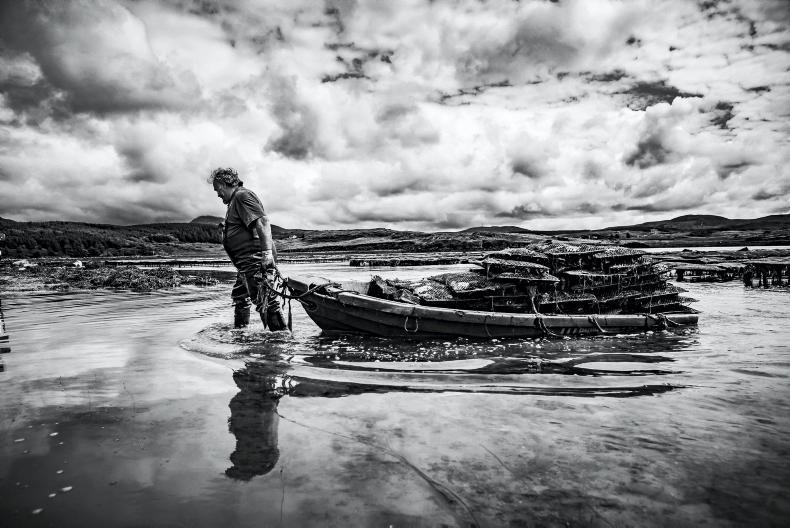
David Keane hasn't just taken up the mantle of keeping this historic oyster farm going; he and his wife, Christina, have innovated and diversified to strengthen their brand and business. \ Philip Doyle
Innovation and flavour
Innovation comes in many formats – it’s not a one size fits all approach. David and Christina have been able to innovate through relationship and community-building efforts. When things were challenging, they found sales routes in their own backyard. If things were on the up, they made connections further afield. To say they are skilled business people would be an understatement, but without an excellent product, it’s also safe to say their work would have been for nothing.
They cultivate their oysters with the end user in mind, and thanks to this, they have been consistently recognised for their product’s quality, freshness and flavour.
“We could be supplying a fine dining restaurant, or a gastropub,” David says. “Imagine the difference between someone coming in with a glass of champagne, or someone coming in from a rugby match with a pint of Guinness. We wanted to give diners the option of a nice, balanced oyster – one where you wouldn’t need a knife and fork to eat it,” he says, jokingly. “With this in mind, we developed an oyster we called the Ladies Choice, which won gold [at the Blas na hÉireann awards] in 2023.
Then, we developed the Pearl of Connemara, which is a slightly bigger oyster, and that won gold this year.”
On tasting their Pearl of Connemara oysters, Blas judges commented on the creamy meat, gentle liquor and the fact that, while they tasted of the sea, their brininess was not overpowering. These accolades act as confirmation to the pair that they’re on the right track.
This past year, in addition to their gold at the Blas na hÉireann awards, they were also recognised at the Great Taste Awards in the United Kingdom and the International Taste Awards in Brussels.
“An oyster makes three juices,” David explains. “Because we’re on the Atlantic, the first will be so briny it may assault your tastebuds – so, we suggest you pour that off. We’d also recommend pouring off the second juice, at least for the first few oysters.
The third juice is the true flavour of the oyster. It takes on the flavour of the bay that it was grown in, similarly to wine’s terroir – an oyster has a ‘merroir’.
“It’s great when we have a group of 10-20 people on a farm tour,” Christina adds. “Some of them might be oyster lovers, and some might have never tasted one before. I go through the whole idea of the three juices. I say to people, ‘Don’t think about eating the oyster, feel the texture in your mouth.’
“The muscle tends to be chewy, but it’s incredibly sweet. The surrounding flesh is creamy and slightly saline. With some oysters, sometimes we have what we call ‘cucumber notes’ when you swallow the oyster.
“We have great discussions about it, and visitors think more about the whole experience of tasting. It’s a whole sensory experience.”

In 2017, David and Christina started operating oyster farm tours and oyster tastings for visitors to Connemara National Park. \ Philip Doyle
dkconnemaraoysters.com
The perfect time to indulge in oysters is the festive season
If you’ve never had an oyster before, there is no better time than the festive season to take the plunge (no pun intended). In the past, there was a saying that oysters should only be consumed in months that have an “R” (so, September to April).
Today, thanks to food safety technology, this rule no longer applies, and you can enjoy Irish oysters throughout the year. The idea of getting sick from a “bad oyster” has also been debunked thanks to advanced purification methods and high food safety standards to which oysters farmers must adhere.
That said, many oyster lovers feel the autumn and winter months are when the bivalves are at their peak – partly due to their natural reproductive and life cycle, but mostly thanks to the colder waters from which they are harvested.
So traditionally, oysters were consumed at Christmas as a celebration, but also because this was always considered the best time to eat them.
As Christina says, a true sensory experience, oysters are a tangible part of Irish coastal heritage and food history.
This Christmas, you’ll be able to purchase DK Connemara Oysters from select SuperValus throughout the country, or you might find them on the menu of your favourite gastropub.
If you’re planning on serving oysters at home for the first time, check out Irish Country Living’s oyster shucking tutorial video by scanning the QR code below.

Christmas is a great time to try oysters. \iStock
Safety first: wear protective gloves to avoid cuts and wrap the hand holding the oyster in a towel for grip. Position the oyster: hold the oyster curved-side down on a flat surface with the hinge facing you. Insert the knife: wedge the oyster knife tip into the hinge seam and twist to pop it open. Sever the muscle: run the knife along the inside of the top shell to sever the adductor muscle. Detach the oyster: slide the knife under the oyster to detach it from the bottom shell. How to shuck an oyster. Scan the QR code below.

QR code.
Oysters have been harvested from Ballinakill Bay in Co Galway for thousands of years, since the Bronze Age brought nomadic communities to Connemara’s vibrant coastline. Naturally clean Atlantic waters and its untouched surrounding landscape have kept the bay in its pristine condition in the centuries since, and the tradition of harvesting oysters there has also endured.
Today, David and Christina Keane operate DK Connemara Oysters, and if you ask, they will say that they are just a small part of the bay’s rich oyster history.
“This oyster farm dates all the way back to 1893, we hold a very old licence,” David tells Irish Country Living. “There have been numerous owners of the farm to date. They’ve all operated the farm as best they could at the time and now it’s our turn.”
Growing oysters
Undeterred by its lack of long-term success, David and Christina purchased the oyster farm in 2014. At this time, most Irish oyster farmers worked within a commodity market. They would grow oysters and sell directly to buyers – mainly from France – where they would be exported and processed. David and Christina quickly realised this type of farming would not work for them, and that they would need to forge their own path.
“It takes three years to grow an oyster,” David explains. “[When we began], we saw ourselves simply growing oysters, and from September to December each year we would be busy bees harvesting. The reality is, this type of operation is not sustainable. It was very much a ‘cash out’ situation since we began, so in 2017 we started to do farm tours to support the business. This made sense as we’re so close to Connemara National Park and Kylemore Abbey. Then, 2018 was our first main crop, but we got hit with some form of mortality which wiped out about two thirds of our oysters.
“As you can imagine, life here [at that time] was pretty stressful,” he continues. “All I could do was say, ‘Look – we didn’t lose it all.’ We didn’t have enough stock to stay within the bulk [commodity] market, but we were never going to make money at that, anyway. I started to look at the idea of moving into food service.
“We made connections with restaurants, pubs and chefs [‘collecting badges’, as I called it] and, as a small operation, we were able to get things done correctly. We put in a HACCP system and brought in a purification system and began to sell direct.”
By diversifying into tourism and food service, and with support from BIM and Bord Bia, David and Christina built a community around them and were able to get through those difficult first few years. As their next batch of oysters approached maturity, however, they knew they would have to consider export because the domestic market was simply not large enough.
“In 2019, I went on a trip to Singapore, I worked with Bord Bia over there,” David says. “I made some very good contacts. Then, COVID-19 hit. Suddenly, there were no French agents coming in, no one was buying anything. All of the restaurants and bars in Ireland were shut. South Korea didn’t close, though, so we started exporting to Seoul. I had made some Korean contacts at a trade show in Brussels, and this was brilliant because it meant we were actually selling oysters. We were proving the concept that this oyster farm was really important to the local economy.”
In the late-1800s to early-1900s, the farm provided locals with an extra bit of income as it was very hard to make a living here. “Then, fast forward over 100 years and everything has stopped, but the guys working for us were still coming in and we stayed open,” he says. “Now don’t get me wrong – we were hugely supported by the COVID subsidy schemes. We were also selling small amounts into supermarkets in Dublin and shipping oysters to homes all over Ireland. But the fact that we were exporting to Korea really made the difference.”
David Keane hasn't just taken up the mantle of keeping this historic oyster farm going; he and his wife, Christina, have innovated and diversified to strengthen their brand and business. \ Philip Doyle
Innovation and flavour
Innovation comes in many formats – it’s not a one size fits all approach. David and Christina have been able to innovate through relationship and community-building efforts. When things were challenging, they found sales routes in their own backyard. If things were on the up, they made connections further afield. To say they are skilled business people would be an understatement, but without an excellent product, it’s also safe to say their work would have been for nothing.
They cultivate their oysters with the end user in mind, and thanks to this, they have been consistently recognised for their product’s quality, freshness and flavour.
“We could be supplying a fine dining restaurant, or a gastropub,” David says. “Imagine the difference between someone coming in with a glass of champagne, or someone coming in from a rugby match with a pint of Guinness. We wanted to give diners the option of a nice, balanced oyster – one where you wouldn’t need a knife and fork to eat it,” he says, jokingly. “With this in mind, we developed an oyster we called the Ladies Choice, which won gold [at the Blas na hÉireann awards] in 2023.
Then, we developed the Pearl of Connemara, which is a slightly bigger oyster, and that won gold this year.”
On tasting their Pearl of Connemara oysters, Blas judges commented on the creamy meat, gentle liquor and the fact that, while they tasted of the sea, their brininess was not overpowering. These accolades act as confirmation to the pair that they’re on the right track.
This past year, in addition to their gold at the Blas na hÉireann awards, they were also recognised at the Great Taste Awards in the United Kingdom and the International Taste Awards in Brussels.
“An oyster makes three juices,” David explains. “Because we’re on the Atlantic, the first will be so briny it may assault your tastebuds – so, we suggest you pour that off. We’d also recommend pouring off the second juice, at least for the first few oysters.
The third juice is the true flavour of the oyster. It takes on the flavour of the bay that it was grown in, similarly to wine’s terroir – an oyster has a ‘merroir’.
“It’s great when we have a group of 10-20 people on a farm tour,” Christina adds. “Some of them might be oyster lovers, and some might have never tasted one before. I go through the whole idea of the three juices. I say to people, ‘Don’t think about eating the oyster, feel the texture in your mouth.’
“The muscle tends to be chewy, but it’s incredibly sweet. The surrounding flesh is creamy and slightly saline. With some oysters, sometimes we have what we call ‘cucumber notes’ when you swallow the oyster.
“We have great discussions about it, and visitors think more about the whole experience of tasting. It’s a whole sensory experience.”
In 2017, David and Christina started operating oyster farm tours and oyster tastings for visitors to Connemara National Park. \ Philip Doyle
dkconnemaraoysters.com
The perfect time to indulge in oysters is the festive season
If you’ve never had an oyster before, there is no better time than the festive season to take the plunge (no pun intended). In the past, there was a saying that oysters should only be consumed in months that have an “R” (so, September to April).
Today, thanks to food safety technology, this rule no longer applies, and you can enjoy Irish oysters throughout the year. The idea of getting sick from a “bad oyster” has also been debunked thanks to advanced purification methods and high food safety standards to which oysters farmers must adhere.
That said, many oyster lovers feel the autumn and winter months are when the bivalves are at their peak – partly due to their natural reproductive and life cycle, but mostly thanks to the colder waters from which they are harvested.
So traditionally, oysters were consumed at Christmas as a celebration, but also because this was always considered the best time to eat them.
As Christina says, a true sensory experience, oysters are a tangible part of Irish coastal heritage and food history.
This Christmas, you’ll be able to purchase DK Connemara Oysters from select SuperValus throughout the country, or you might find them on the menu of your favourite gastropub.
If you’re planning on serving oysters at home for the first time, check out Irish Country Living’s oyster shucking tutorial video by scanning the QR code below.
Christmas is a great time to try oysters. \iStock
Safety first: wear protective gloves to avoid cuts and wrap the hand holding the oyster in a towel for grip. Position the oyster: hold the oyster curved-side down on a flat surface with the hinge facing you. Insert the knife: wedge the oyster knife tip into the hinge seam and twist to pop it open. Sever the muscle: run the knife along the inside of the top shell to sever the adductor muscle. Detach the oyster: slide the knife under the oyster to detach it from the bottom shell. How to shuck an oyster. Scan the QR code below.
QR code.





SHARING OPTIONS