If asked, most of the Irish farming community would probably say they regularly drank raw milk – unpasteurised, straight from the tank – growing up, and a good few dairy farmers likely still do.
A growing consumer movement believes raw milk is a healthier, tastier option than the milk we find in shops, due to pasteurisation killing its natural beneficial bacteria.
Bodies like the Food Safety Authority of Ireland (FSAI) say unpasteurised milk is inherently high-risk due to potential harmful pathogens like E coli, salmonella and listeria. Serious illnesses, like tuberculosis and brucellosis, have also been connected to the consumption of unpasteurised milk.
Many supporters attribute health benefits to raw milk – especially those living with allergies, severe eczema, asthma or digestive problems – and there is some academic research which supports these ideas.
They also believe official attitudes to raw milk are outdated and the way we used to produce milk (during the first half of the 20th century, when pasteurisation saved countless lives) is incomparable to milk produced today with the current food safety standards in place.
Creating best practice
In the United States, raw milk has been heavily politicised, but in Ireland, it’s always been more about preference, choice and access. Consumers of raw milk enjoy its traditional flavour profile. Some try raw milk to see if it might help with a health issue. Gastronomes appreciate it because it is non-homogenised, usually produced in a closed system and can offer a unique ‘taste of place’.
Currently, six Irish farms are registered to sell raw milk, and these are generally micro-dairies, milking fewer than 20 cows. Their milk is tested regularly for pathogens, and their herds are tested twice per year for tuberculosis (conventional dairy farms are usually only tested once per year).
Any farm selling less than 30ltr of raw milk within a 20km radius on a weekly basis does not need to register with the Department of Agriculture, Food and the Marine (DAFM). To become DAFM approved, farms first have an inspection followed by a three-month period of conditional approval.
Irish raw milk producers (under the Raw Milk Ireland organisation) were key to the creation of Government regulations, which came into effect in 2018. Previous to this, in the early 2010s, the Government was considering banning all sales of raw milk in Ireland.
Mimi Crawford, of Crawford’s Farm in Cloughjordan, Co Tipperary (crawfordsfarm.ie), started selling raw milk in 2015 with her partner, Owen, and was heavily involved in the regulation process.
“There were some very good, prominent raw milk producers who were selling milk around the time the Government proposed banning it,” she recalls.
“When we had a meeting of farmers who were selling a year or so before the regulations came into effect, there were about 19 who showed up.
“Of those, the only ones remaining are us and Ballymaloe.”
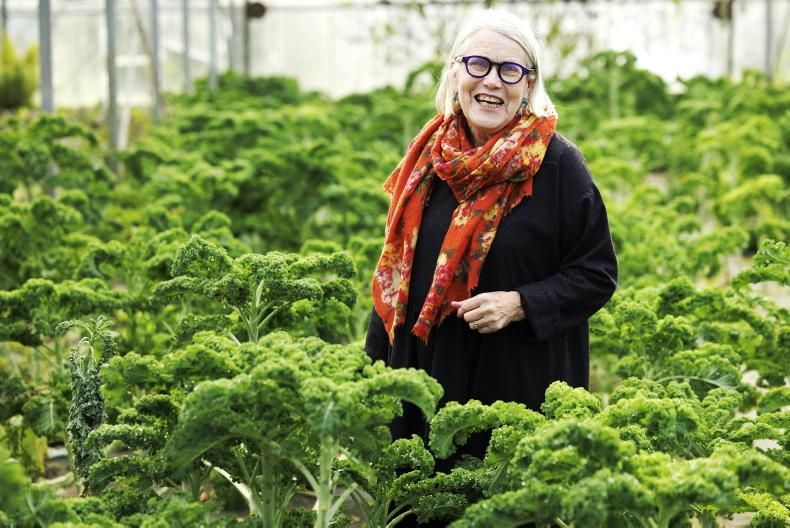
Darina Allen of Ballymaloe Cookery School. \Donal O’Leary
Local production
Darina and Tim Allen of Ballymaloe Cookery School have been producing raw milk since the 1980s. When the ban was proposed in 2011, Darina sent an official letter to the Minister for Agriculture, Food and the Marine (Simon Coveney, at the time) on behalf of Slow Food Ireland.
In part, it read: “Should the Government be considering changing the regulations on the production and sale of raw milk in Ireland we would like to emphasise that a significant lobby wish that the FSAI would ask the Department of Agriculture to draw up a protocol for best practise for the production and sale of unpasteurised milk to the 100,000 Irish people who currently avail of it.
“We have a much better understanding now – of not only the huge potential benefits, but also the risks that come with raw milk – than we did back in the day when hand-milking into a bucket was the norm,” Mimi explains. “This gives us the opportunity to diligently produce as safe a product as possible and offer it to consumers so that they have choice.
“Raw milk production, on a local scale, has the potential to be a vital community asset, especially in a changing world where shortened food supply chains, improved land stewardship and animal welfare, and natural foodstuffs are all of value to address the destruction of the environment and declining human health.”
The Government ultimately decided to liaise with farmers and develop criteria for best practise. These include the current rules and regulations for raw milk farming, production, packaging, labelling and distribution that we see today.
The FSAI requires all raw milk and raw milk products to carry a health advisory on their label, reading: “This milk has not been heat treated and may contain harmful bacteria. The FSAI strongly advises that, unless it’s boiled first, it should not be consumed by children, pregnant women, older people or those who are unwell or have chronic illness.”
Irish Country Living reached out to the FSAI for comment but received no reply. We also asked the DAFM what best practice for raw dairy looks like through a Government lens.
A representative responded, saying: “Raw milk and raw milk products are higher risk than heat treated milk and milk products, as there is higher potential for the presence of pathogens which heat treatment will normally destroy. Strict hygiene measures must be adhered to by raw milk producers during milking to reduce the bacterial load present in raw milk; however, this will only reduce rather than eliminate the risks associated with the consumption of raw milk.”
Mimi feels that the FSAI’s firm stance on raw milk is outdated. A clear case in point is the serious food recalls we have seen in recent years.
“Risks are inherent in all foods consumed, as very clearly evidenced by the extensive listeria outbreak last year in pre-prepared, ready-to-heat foods – or the substantial recalls of toxic baby formula this year,” she says, referring to the recent United States outbreak of infant botulism from contaminated ByHeart baby formula.
“Throughout history, public authorities have been very good at making consumers fearful of raw milk, and fear is a strong motivator,” she adds. “This is where I think the FSAI could change tactic. They can better choose their wording to adequately portray potential risks in all foods, not just foods they themselves are fearful of.”
‘Being small works with raw dairy, because of the way we farm’ – Gleann Buí
Sinéad McGrath and MJ Moran operate Gleann Buí Farm in Co Mayo, where since 2021, they have produced certified organic raw milk with their 14-strong shorthorn- cross herd.
Operating on roughly 35ac of owned and rented land, the couple incorporate a 100% pasture-fed system. Their journey to raw milk was the result of their desire to farm productively, with nature, and on a smaller scale.
“When we first started out, we went to the local Teagasc office and they were of the opinion that we couldn’t survive as a dairy farm on 27ac, but they said we could run 30 cows if we rented a few more acres,” Sinéad says. “We will be milking 14 this year, but of those 14 there’s only ever 10 or 11 being milked at a time.”
A shorthorn’s milk yield decreases dramatically once they go into calf. To offset this, Sinéad and MJ stagger their calving season. By the time their early cows are back in calf, the later ones have given birth and can be milked. They leave the new calves and to feed off the early calvers.
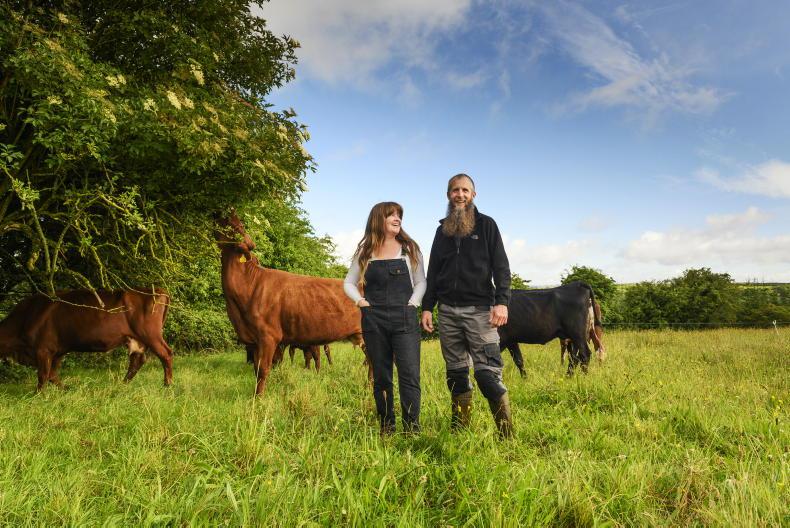
Sinéad McGrath and MJ Moran operate Gleann Buí Farm in Co Mayo. \Michael McLaughlin.
“This is just one example of how they have adapted methodology to suit their business. Sinéad says every farm is different and will require a unique approach.
“You have to figure it out yourself,” she says. “There’s loads of advice out there, and mine is to take a little bit of everyone’s advice before figuring out your own thing. We ran 100% grass-fed sucklers for years, and we realised traditional breeds did better on our land, so when it came to dairy there was no point in bringing in high yield breeds. Now, we’ve built up a good herd, and our system works for us.
“MJ always wanted to do something different – he had farmed conventionally in the past and he didn’t want to go back that way. Between the two of us, we found a way to make a living. Sometimes with business, people just want to know how you’re going to scale up. It’s not always about scaling up. We could make more money, but we’d also have to do more – take someone on and train them in food safety.
“I’d have to update all my food safety documents. We make a small income to sustain ourselves, but we have a nice lifestyle. They talk about stars aligning and I think that’s what happened for us – it’s why we ended up where we are.”
Does size matter? Could this system work in Co Tipperary with an 80-cow milking platform?
“I think being small works with raw dairy, because of the way we farm – our approach is completely different to a conventional dairy farm,” Sinéad says. “That’s not a reflection on anyone’s way of farming – with the regulations, the way you need to approach raw dairy is different.”
See gleannbuifarm.ie
If asked, most of the Irish farming community would probably say they regularly drank raw milk – unpasteurised, straight from the tank – growing up, and a good few dairy farmers likely still do.
A growing consumer movement believes raw milk is a healthier, tastier option than the milk we find in shops, due to pasteurisation killing its natural beneficial bacteria.
Bodies like the Food Safety Authority of Ireland (FSAI) say unpasteurised milk is inherently high-risk due to potential harmful pathogens like E coli, salmonella and listeria. Serious illnesses, like tuberculosis and brucellosis, have also been connected to the consumption of unpasteurised milk.
Many supporters attribute health benefits to raw milk – especially those living with allergies, severe eczema, asthma or digestive problems – and there is some academic research which supports these ideas.
They also believe official attitudes to raw milk are outdated and the way we used to produce milk (during the first half of the 20th century, when pasteurisation saved countless lives) is incomparable to milk produced today with the current food safety standards in place.
Creating best practice
In the United States, raw milk has been heavily politicised, but in Ireland, it’s always been more about preference, choice and access. Consumers of raw milk enjoy its traditional flavour profile. Some try raw milk to see if it might help with a health issue. Gastronomes appreciate it because it is non-homogenised, usually produced in a closed system and can offer a unique ‘taste of place’.
Currently, six Irish farms are registered to sell raw milk, and these are generally micro-dairies, milking fewer than 20 cows. Their milk is tested regularly for pathogens, and their herds are tested twice per year for tuberculosis (conventional dairy farms are usually only tested once per year).
Any farm selling less than 30ltr of raw milk within a 20km radius on a weekly basis does not need to register with the Department of Agriculture, Food and the Marine (DAFM). To become DAFM approved, farms first have an inspection followed by a three-month period of conditional approval.
Irish raw milk producers (under the Raw Milk Ireland organisation) were key to the creation of Government regulations, which came into effect in 2018. Previous to this, in the early 2010s, the Government was considering banning all sales of raw milk in Ireland.
Mimi Crawford, of Crawford’s Farm in Cloughjordan, Co Tipperary (crawfordsfarm.ie), started selling raw milk in 2015 with her partner, Owen, and was heavily involved in the regulation process.
“There were some very good, prominent raw milk producers who were selling milk around the time the Government proposed banning it,” she recalls.
“When we had a meeting of farmers who were selling a year or so before the regulations came into effect, there were about 19 who showed up.
“Of those, the only ones remaining are us and Ballymaloe.”
Darina Allen of Ballymaloe Cookery School. \Donal O’Leary
Local production
Darina and Tim Allen of Ballymaloe Cookery School have been producing raw milk since the 1980s. When the ban was proposed in 2011, Darina sent an official letter to the Minister for Agriculture, Food and the Marine (Simon Coveney, at the time) on behalf of Slow Food Ireland.
In part, it read: “Should the Government be considering changing the regulations on the production and sale of raw milk in Ireland we would like to emphasise that a significant lobby wish that the FSAI would ask the Department of Agriculture to draw up a protocol for best practise for the production and sale of unpasteurised milk to the 100,000 Irish people who currently avail of it.
“We have a much better understanding now – of not only the huge potential benefits, but also the risks that come with raw milk – than we did back in the day when hand-milking into a bucket was the norm,” Mimi explains. “This gives us the opportunity to diligently produce as safe a product as possible and offer it to consumers so that they have choice.
“Raw milk production, on a local scale, has the potential to be a vital community asset, especially in a changing world where shortened food supply chains, improved land stewardship and animal welfare, and natural foodstuffs are all of value to address the destruction of the environment and declining human health.”
The Government ultimately decided to liaise with farmers and develop criteria for best practise. These include the current rules and regulations for raw milk farming, production, packaging, labelling and distribution that we see today.
The FSAI requires all raw milk and raw milk products to carry a health advisory on their label, reading: “This milk has not been heat treated and may contain harmful bacteria. The FSAI strongly advises that, unless it’s boiled first, it should not be consumed by children, pregnant women, older people or those who are unwell or have chronic illness.”
Irish Country Living reached out to the FSAI for comment but received no reply. We also asked the DAFM what best practice for raw dairy looks like through a Government lens.
A representative responded, saying: “Raw milk and raw milk products are higher risk than heat treated milk and milk products, as there is higher potential for the presence of pathogens which heat treatment will normally destroy. Strict hygiene measures must be adhered to by raw milk producers during milking to reduce the bacterial load present in raw milk; however, this will only reduce rather than eliminate the risks associated with the consumption of raw milk.”
Mimi feels that the FSAI’s firm stance on raw milk is outdated. A clear case in point is the serious food recalls we have seen in recent years.
“Risks are inherent in all foods consumed, as very clearly evidenced by the extensive listeria outbreak last year in pre-prepared, ready-to-heat foods – or the substantial recalls of toxic baby formula this year,” she says, referring to the recent United States outbreak of infant botulism from contaminated ByHeart baby formula.
“Throughout history, public authorities have been very good at making consumers fearful of raw milk, and fear is a strong motivator,” she adds. “This is where I think the FSAI could change tactic. They can better choose their wording to adequately portray potential risks in all foods, not just foods they themselves are fearful of.”
‘Being small works with raw dairy, because of the way we farm’ – Gleann Buí
Sinéad McGrath and MJ Moran operate Gleann Buí Farm in Co Mayo, where since 2021, they have produced certified organic raw milk with their 14-strong shorthorn- cross herd.
Operating on roughly 35ac of owned and rented land, the couple incorporate a 100% pasture-fed system. Their journey to raw milk was the result of their desire to farm productively, with nature, and on a smaller scale.
“When we first started out, we went to the local Teagasc office and they were of the opinion that we couldn’t survive as a dairy farm on 27ac, but they said we could run 30 cows if we rented a few more acres,” Sinéad says. “We will be milking 14 this year, but of those 14 there’s only ever 10 or 11 being milked at a time.”
A shorthorn’s milk yield decreases dramatically once they go into calf. To offset this, Sinéad and MJ stagger their calving season. By the time their early cows are back in calf, the later ones have given birth and can be milked. They leave the new calves and to feed off the early calvers.
Sinéad McGrath and MJ Moran operate Gleann Buí Farm in Co Mayo. \Michael McLaughlin.
“This is just one example of how they have adapted methodology to suit their business. Sinéad says every farm is different and will require a unique approach.
“You have to figure it out yourself,” she says. “There’s loads of advice out there, and mine is to take a little bit of everyone’s advice before figuring out your own thing. We ran 100% grass-fed sucklers for years, and we realised traditional breeds did better on our land, so when it came to dairy there was no point in bringing in high yield breeds. Now, we’ve built up a good herd, and our system works for us.
“MJ always wanted to do something different – he had farmed conventionally in the past and he didn’t want to go back that way. Between the two of us, we found a way to make a living. Sometimes with business, people just want to know how you’re going to scale up. It’s not always about scaling up. We could make more money, but we’d also have to do more – take someone on and train them in food safety.
“I’d have to update all my food safety documents. We make a small income to sustain ourselves, but we have a nice lifestyle. They talk about stars aligning and I think that’s what happened for us – it’s why we ended up where we are.”
Does size matter? Could this system work in Co Tipperary with an 80-cow milking platform?
“I think being small works with raw dairy, because of the way we farm – our approach is completely different to a conventional dairy farm,” Sinéad says. “That’s not a reflection on anyone’s way of farming – with the regulations, the way you need to approach raw dairy is different.”
See gleannbuifarm.ie






SHARING OPTIONS