While January tends to be a quiet month in the garden, one project that can be undertaken is planting a hedge. We’ve just completed planting a stretch of bare-root beech hedging to replace a section of our garden boundary hedge destroyed when uprooted with a fallen tree during a storm.
Although deciduous, beech colours beautifully in autumn and it retains its rusty brown leaves through winter, making it a good hedging choice for year-round interest. Requiring clipping only once a year, it forms an excellent windbreak and grows well in all but wet, heavy soils. If you have a heavy clay soil, hornbeam, Carpinus betulus, is a superb alternative that also retains its brown leaves through winter when clipped.
You can plant a hedge any time of year, but winter and early spring are the ideal times for planting bare-root deciduous plants, like hawthorn, beech and hornbeam, as they are still dormant and more cost-effective than container-grown options.
Evergreen hedges, such as yew, holly and laurel establish better from container-grown plants and are best planted in autumn or spring.
If you have a new garden and are wondering where to start, planting a hedge can often be a good first step.
Almost every garden needs some form of boundary or internal division, and whilst walls and fences each have their advantages, hedges have a unique appeal, providing interest all year round, as well as shelter and food for wildlife.
A hedge also makes a better windbreak than a fence, as wind is gently filtered through it rather than being deflected over the top, causing turbulence on the other side.
Primary function
When choosing a hedge, consider its purpose. Will its primary function be to provide screening and privacy?
Will it provide wind protection, inhibit intruders or add to the aesthetics of your garden by forming a backdrop to flowerbeds and other plantings?
Further key factors to consider will be the desired height, growth rate, soil and site conditions, maintenance, and whether the plants should be deciduous or evergreen.
If you want to break your garden up into ‘rooms’ or defined areas, box, yew and privet are the traditional hedges for this purpose as they withstand close clipping.
A smartly clipped yew (Taxus baccata) hedge is perfect for creating formality in a garden, both as a tall boundary or as a short internal divider hedge, and very effective when used as a contrasting backdrop for billowing perennials and more informal planting. However, it is poisonous and should not be planted where livestock can access it. In mild areas, evergreen or holm oak, Quercus ilex, is also a good candidate for trimming into formal shapes.
Boundary screen
When choosing a boundary screen, many people look immediately for fast-growing hedging plants, but these won’t suddenly stop growing once they have reached your desired height. If you choose a fast-growing plant, cutting back once and sometimes twice a year will become an essential job.
It’s often better to look for a slower-growing variety, such as laurel or native holly (Ilex aquifolium), and either wait for it to establish to the desired height or purchase mature plants or instant hedges which are already at the height.
Evergreen plants are typically chosen for year-round privacy and screening. For an evergreen, coniferous hedge that is quick to establish, western red cedar, Thuja plicata, is a good alternative to the once popular leylandii, which can become problematic. It grows at a rate of 45-60cm a year and the leaves release a fruity fragrance when crushed or clipped. If you live near the coast, your hedge must tolerate salty air and strong winds. Olearias, Griselinia littoralis and Elaeagnus x ebbingei are all suitable for seaside gardens.
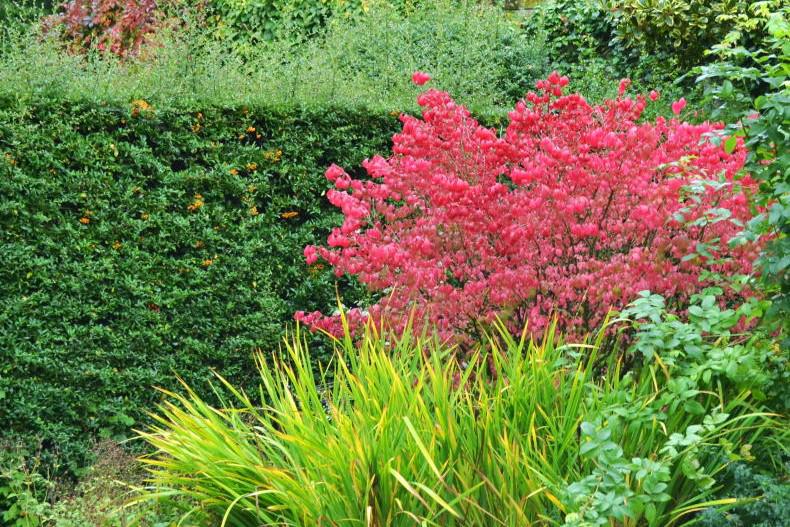
Deciduous hedges generally require less maintenance and offer seasonal interest, often taking on attractive autumn leaf colour or producing bountiful berries that provide sustenance for birds.
Flowering hedges offer added colour, and many attract pollinating insects in summer. Among those well worth trying are berberis, Hypericum ‘Hidcote’ and Rosa rugosa. In milder parts of the country, Fuchsia magellanica and escallonia can be grown.
For winter interest, Viburnum tinus makes a lovely, informal flowering hedge. It has dark green, evergreen leaves and posies of pink-budded, white flowers from November to March.
The newest trend in hedging is probably the increased popularity of mixed native hedging.
Common combinations of plants sold together to make a native hedge include blackthorn, wild cherry, spindle, guelder rose, dogrose, elder, hazel and hawthorn.
These shrubs will provide food, shelter and habitat for wildlife but can also provide delightful edible foraging opportunities.
Mary Keenan and Ross Doyle run Gash Gardens in Co Laois. See gashgardens.ie
Q&A: Is my Japanese maple dying?
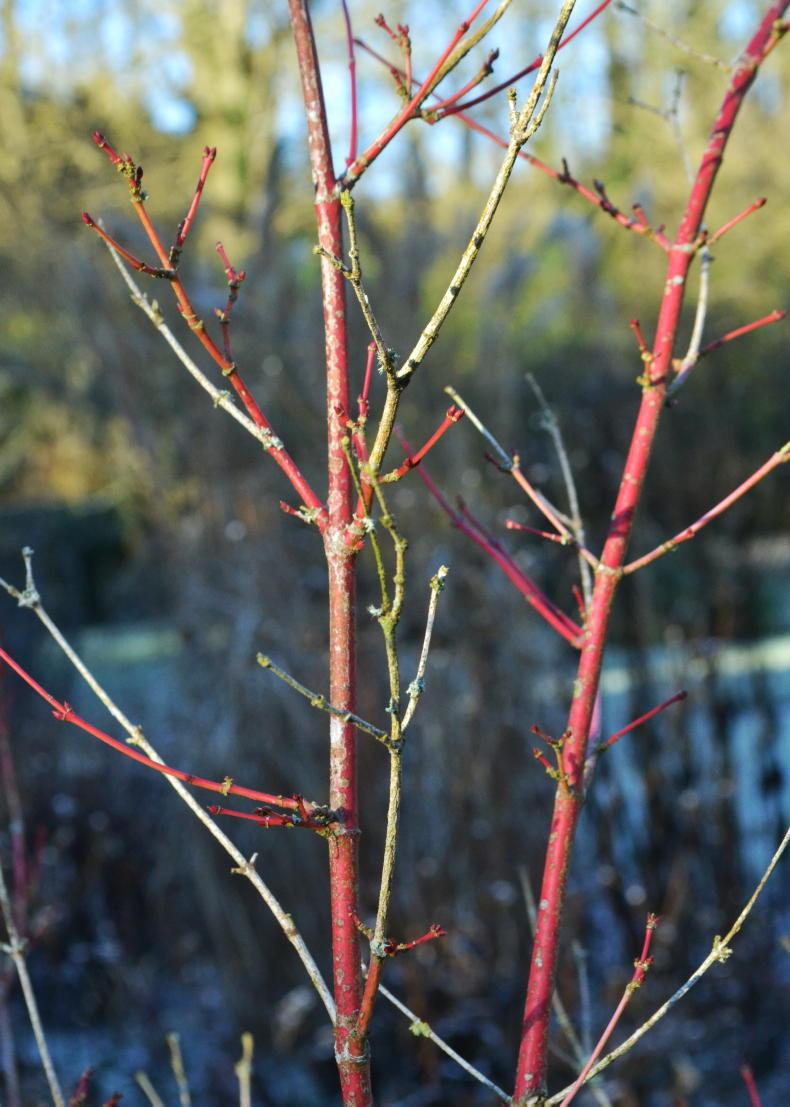
Dieback on Acer palmatum ‘Sango-kaku’.
Several twigs and stems on my coral-bark maple, are dying back from the tips. Is the plant dying or what can I do? – Nuala, Co Galway
Dieback on young stems of Japanese maples is a common issue, especially in their early years and this variety is particularly prone. The most frequent cause of dieback is weather damage, such as frost burn where young growth may not have hardened sufficiently before winter exposure to strong winds, drought or waterlogging.
Prune off the affected dead twigs and branches where possible, cutting back to healthy, live tissue or a healthy node.
Ensure the tree is adequately sheltered from wind and planted in a well-draining soil.
During the growing season, provide regular, even watering, in very dry periods, ensuring the roots are moist but never waterlogged. If the issue is minor and contained, general good care is often enough for the tree to recover.
Bulbs: if you’ve still got unplanted spring bulbs, it isn’t too late to get them in. To aid late establishment, it can help to sit the root plate of each bulb into shallow water for up to 24 hours before planting to rehydrate them quickly for faster rooting,
Plant: press mistletoe berries into the bark of apple trees to establish your own mistletoe plants.
Trim: time to trim back ivy, Virginia creeper and other climbers that have outgrown their space, before birds start nesting.
While January tends to be a quiet month in the garden, one project that can be undertaken is planting a hedge. We’ve just completed planting a stretch of bare-root beech hedging to replace a section of our garden boundary hedge destroyed when uprooted with a fallen tree during a storm.
Although deciduous, beech colours beautifully in autumn and it retains its rusty brown leaves through winter, making it a good hedging choice for year-round interest. Requiring clipping only once a year, it forms an excellent windbreak and grows well in all but wet, heavy soils. If you have a heavy clay soil, hornbeam, Carpinus betulus, is a superb alternative that also retains its brown leaves through winter when clipped.
You can plant a hedge any time of year, but winter and early spring are the ideal times for planting bare-root deciduous plants, like hawthorn, beech and hornbeam, as they are still dormant and more cost-effective than container-grown options.
Evergreen hedges, such as yew, holly and laurel establish better from container-grown plants and are best planted in autumn or spring.
If you have a new garden and are wondering where to start, planting a hedge can often be a good first step.
Almost every garden needs some form of boundary or internal division, and whilst walls and fences each have their advantages, hedges have a unique appeal, providing interest all year round, as well as shelter and food for wildlife.
A hedge also makes a better windbreak than a fence, as wind is gently filtered through it rather than being deflected over the top, causing turbulence on the other side.
Primary function
When choosing a hedge, consider its purpose. Will its primary function be to provide screening and privacy?
Will it provide wind protection, inhibit intruders or add to the aesthetics of your garden by forming a backdrop to flowerbeds and other plantings?
Further key factors to consider will be the desired height, growth rate, soil and site conditions, maintenance, and whether the plants should be deciduous or evergreen.
If you want to break your garden up into ‘rooms’ or defined areas, box, yew and privet are the traditional hedges for this purpose as they withstand close clipping.
A smartly clipped yew (Taxus baccata) hedge is perfect for creating formality in a garden, both as a tall boundary or as a short internal divider hedge, and very effective when used as a contrasting backdrop for billowing perennials and more informal planting. However, it is poisonous and should not be planted where livestock can access it. In mild areas, evergreen or holm oak, Quercus ilex, is also a good candidate for trimming into formal shapes.
Boundary screen
When choosing a boundary screen, many people look immediately for fast-growing hedging plants, but these won’t suddenly stop growing once they have reached your desired height. If you choose a fast-growing plant, cutting back once and sometimes twice a year will become an essential job.
It’s often better to look for a slower-growing variety, such as laurel or native holly (Ilex aquifolium), and either wait for it to establish to the desired height or purchase mature plants or instant hedges which are already at the height.
Evergreen plants are typically chosen for year-round privacy and screening. For an evergreen, coniferous hedge that is quick to establish, western red cedar, Thuja plicata, is a good alternative to the once popular leylandii, which can become problematic. It grows at a rate of 45-60cm a year and the leaves release a fruity fragrance when crushed or clipped. If you live near the coast, your hedge must tolerate salty air and strong winds. Olearias, Griselinia littoralis and Elaeagnus x ebbingei are all suitable for seaside gardens.
Deciduous hedges generally require less maintenance and offer seasonal interest, often taking on attractive autumn leaf colour or producing bountiful berries that provide sustenance for birds.
Flowering hedges offer added colour, and many attract pollinating insects in summer. Among those well worth trying are berberis, Hypericum ‘Hidcote’ and Rosa rugosa. In milder parts of the country, Fuchsia magellanica and escallonia can be grown.
For winter interest, Viburnum tinus makes a lovely, informal flowering hedge. It has dark green, evergreen leaves and posies of pink-budded, white flowers from November to March.
The newest trend in hedging is probably the increased popularity of mixed native hedging.
Common combinations of plants sold together to make a native hedge include blackthorn, wild cherry, spindle, guelder rose, dogrose, elder, hazel and hawthorn.
These shrubs will provide food, shelter and habitat for wildlife but can also provide delightful edible foraging opportunities.
Mary Keenan and Ross Doyle run Gash Gardens in Co Laois. See gashgardens.ie
Q&A: Is my Japanese maple dying?
Dieback on Acer palmatum ‘Sango-kaku’.
Several twigs and stems on my coral-bark maple, are dying back from the tips. Is the plant dying or what can I do? – Nuala, Co Galway
Dieback on young stems of Japanese maples is a common issue, especially in their early years and this variety is particularly prone. The most frequent cause of dieback is weather damage, such as frost burn where young growth may not have hardened sufficiently before winter exposure to strong winds, drought or waterlogging.
Prune off the affected dead twigs and branches where possible, cutting back to healthy, live tissue or a healthy node.
Ensure the tree is adequately sheltered from wind and planted in a well-draining soil.
During the growing season, provide regular, even watering, in very dry periods, ensuring the roots are moist but never waterlogged. If the issue is minor and contained, general good care is often enough for the tree to recover.
Bulbs: if you’ve still got unplanted spring bulbs, it isn’t too late to get them in. To aid late establishment, it can help to sit the root plate of each bulb into shallow water for up to 24 hours before planting to rehydrate them quickly for faster rooting,
Plant: press mistletoe berries into the bark of apple trees to establish your own mistletoe plants.
Trim: time to trim back ivy, Virginia creeper and other climbers that have outgrown their space, before birds start nesting.





SHARING OPTIONS