Growing slurry tanker size combined with the influx of low-emission slurry spreading (LESS) systems across Irish farms has resulted in substantial weight increases, benefiting all but our most valuable asset: the soil.
The shoulders of the year can be especially damaging times for soil structure.
Therefore, correct tyre choice and inflation pressures as well as the use of alternative methods such as umbilical spreading need to be considered in order to reduce the load.
It’s a vicious cycle, because not only has tanker size increased on average – along with the added weight of a LESS system hanging off the back – but tractor size has too in many situations, all just to handle this increased weight and power requirement.
While being able to shift slurry in a hurry is convenient, it’s worth considering the weights involved.
Table 1 from a Teagasc study compares tanker sizes, excluding a LESS applicator which will add on a further 800kg-1,500kg depending on size and configuration.
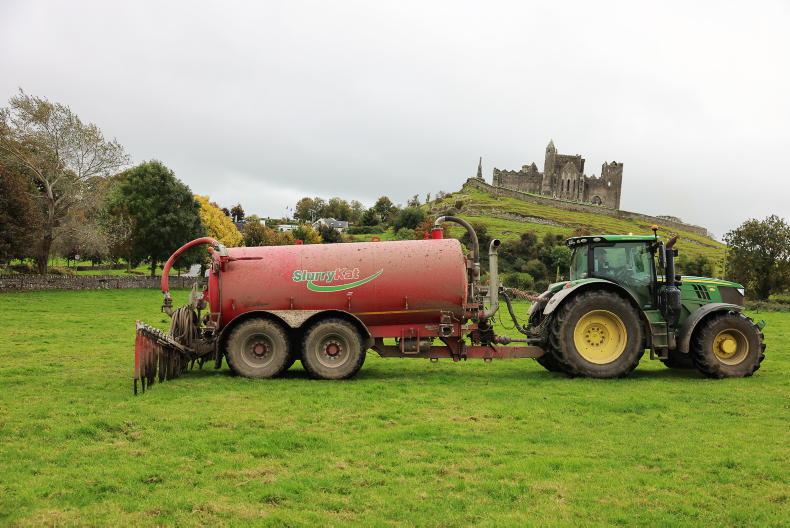
In current times, a 2,500- to 3,000-gallon recessed wheel tanker working behind a 200hp tractor is a standard sight.
On many farms where there was previously a 2,000-gallon tanker, this is now closer to 3,000 gallons.
Table 1 shows that on average, a 2,000-gallon tanker has an axle load of 9.5t, while a 3,000-gallon tanker has an axle load of 15t.
The latter is substantially more for a machine which is more often than not, fitted with the same tyres (800s or 900s if optioned).

A full 3,000-gallon single-axle tanker will have an axle loading somewhere in the region of 15t before fitting a LESS applicator. \ Odhran Ducie
Tri-axle tankers offer capacities which translate to over 30t of slurry and an empty weight of 12t.
What are the consequences?
The damage that can be caused by such heavy machinery – especially in soft or more challenging conditions – can be broken down into three categories.
Sward damage: Here, damage is clearly visible. The surface is often smeared and cut up into ruts, affecting grass growth. Reducing tyre ground pressure by fitting larger flotation tyres – ideally those comprising IF or VF technology and running at low pressures will help. Large-diameter wheels will have a big impact in soft conditions, allowing the tyre to stay turning rather than dragging.
Near-surface compaction: Here, the soil structure in the top 20cm is compacted, affecting water drainage, root growth and nutrient availability to plants. This too is reduced by running at lower ground pressures by either reducing weight or increasing tyre size. This sort of damage is more noticeable in reseeded leys following the use of heavy machinery. Soil may take years to recover.
Deeper compaction: Here, the soil is damaged below 20cm and can be very slow to repair. Very large axle loads will tend to cause this damage even at ground pressures which would prevent such damage with lower axle loads. Just because there are no ruts doesn’t mean that damage is being done below the surface.
The best way to reduce subsoil compaction is to limit individual axle loads, but this can be challenging.

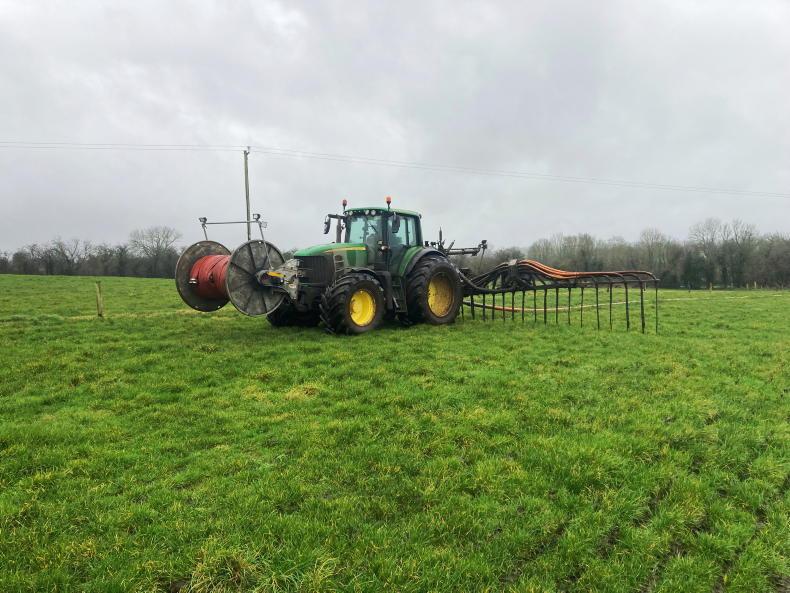
A tractor and umbilical system running on standard 650/65 R38 rear tyres at 0.9bar pressure is a massive improvement in terms of soil stress over the majority of tractor and tanker combinations. \ Donal O'Leary
Single-axle v tandem-axle v umbilical systems
A Teagasc study compared three high-capacity systems.
A large 3,000-gallon recessed-wheel tanker with a 180-200hp tractor.A 3,000-gallon tandem-axle tanker with a 180-200hp tractor.An umbilical system with a 140hp tractor and trailing shoe applicator and front reeler.The axle loads of each were calculated, tyre options noted and the inflation pressures were based on the specific axle load at 40km/h.
Finally, a soil stress model was used to calculate soil stresses in moist/wet conditions with the selected loads, tyres and pressures.
According to the study, the target in moist soil is to have a soil stress value of less than 100kPa to avoid soil structure damage.
The key outcomes were:
A 3,000-gallon (13,600l) recessed single-axle tanker has an axle load that makes it very difficult to prevent structure damage in moist or wet soil. Even the very large tyre option still poses a threat. Unless conditions are dry, this size and type of tanker should be restricted.A tandem-axle tanker of similar size can achieve low ground pressure and low soil stresses, but only if very large tyres are used, which will add considerably to the cost of the tanker.An umbilical system imposes much less load on the soil and is easier to sort from a tyre selection perspective. The calculation here assumed that the tanker options were operated at 40km/h on the road transporting the slurry. If the tanker had little to no road travel and speeds could be kept to a minimum, then inflation pressures could be lowered, thus reducing soil stress.
Alternatively, a central inflation would offer the best of both for optimum performance in the field and on the road.
Large tankers can be a serious threat to soil structure, especially on the shoulders of the year, when conditions tend to be less than ideal. It is recommended that single axle tankers should be limited to 2,000 gallons in such conditions. Otherwise, where possible, consider travelling the more vulnerable areas with half loads to help reduce axle loading.Regardless of the time of year or tanker size, tyre pressures should be monitored and set as low as possible for the weight being carried. Consider fitting larger tyres, to help spread the load. This can be costly but has the potential to pay dividends in terms of soil health. Finally, umbilical systems should be seriously considered from a soil health and a time-saving perspective, if possible.
Growing slurry tanker size combined with the influx of low-emission slurry spreading (LESS) systems across Irish farms has resulted in substantial weight increases, benefiting all but our most valuable asset: the soil.
The shoulders of the year can be especially damaging times for soil structure.
Therefore, correct tyre choice and inflation pressures as well as the use of alternative methods such as umbilical spreading need to be considered in order to reduce the load.
It’s a vicious cycle, because not only has tanker size increased on average – along with the added weight of a LESS system hanging off the back – but tractor size has too in many situations, all just to handle this increased weight and power requirement.
While being able to shift slurry in a hurry is convenient, it’s worth considering the weights involved.
Table 1 from a Teagasc study compares tanker sizes, excluding a LESS applicator which will add on a further 800kg-1,500kg depending on size and configuration.
In current times, a 2,500- to 3,000-gallon recessed wheel tanker working behind a 200hp tractor is a standard sight.
On many farms where there was previously a 2,000-gallon tanker, this is now closer to 3,000 gallons.
Table 1 shows that on average, a 2,000-gallon tanker has an axle load of 9.5t, while a 3,000-gallon tanker has an axle load of 15t.
The latter is substantially more for a machine which is more often than not, fitted with the same tyres (800s or 900s if optioned).
A full 3,000-gallon single-axle tanker will have an axle loading somewhere in the region of 15t before fitting a LESS applicator. \ Odhran Ducie
Tri-axle tankers offer capacities which translate to over 30t of slurry and an empty weight of 12t.
What are the consequences?
The damage that can be caused by such heavy machinery – especially in soft or more challenging conditions – can be broken down into three categories.
Sward damage: Here, damage is clearly visible. The surface is often smeared and cut up into ruts, affecting grass growth. Reducing tyre ground pressure by fitting larger flotation tyres – ideally those comprising IF or VF technology and running at low pressures will help. Large-diameter wheels will have a big impact in soft conditions, allowing the tyre to stay turning rather than dragging.
Near-surface compaction: Here, the soil structure in the top 20cm is compacted, affecting water drainage, root growth and nutrient availability to plants. This too is reduced by running at lower ground pressures by either reducing weight or increasing tyre size. This sort of damage is more noticeable in reseeded leys following the use of heavy machinery. Soil may take years to recover.
Deeper compaction: Here, the soil is damaged below 20cm and can be very slow to repair. Very large axle loads will tend to cause this damage even at ground pressures which would prevent such damage with lower axle loads. Just because there are no ruts doesn’t mean that damage is being done below the surface.
The best way to reduce subsoil compaction is to limit individual axle loads, but this can be challenging.
A tractor and umbilical system running on standard 650/65 R38 rear tyres at 0.9bar pressure is a massive improvement in terms of soil stress over the majority of tractor and tanker combinations. \ Donal O'Leary
Single-axle v tandem-axle v umbilical systems
A Teagasc study compared three high-capacity systems.
A large 3,000-gallon recessed-wheel tanker with a 180-200hp tractor.A 3,000-gallon tandem-axle tanker with a 180-200hp tractor.An umbilical system with a 140hp tractor and trailing shoe applicator and front reeler.The axle loads of each were calculated, tyre options noted and the inflation pressures were based on the specific axle load at 40km/h.
Finally, a soil stress model was used to calculate soil stresses in moist/wet conditions with the selected loads, tyres and pressures.
According to the study, the target in moist soil is to have a soil stress value of less than 100kPa to avoid soil structure damage.
The key outcomes were:
A 3,000-gallon (13,600l) recessed single-axle tanker has an axle load that makes it very difficult to prevent structure damage in moist or wet soil. Even the very large tyre option still poses a threat. Unless conditions are dry, this size and type of tanker should be restricted.A tandem-axle tanker of similar size can achieve low ground pressure and low soil stresses, but only if very large tyres are used, which will add considerably to the cost of the tanker.An umbilical system imposes much less load on the soil and is easier to sort from a tyre selection perspective. The calculation here assumed that the tanker options were operated at 40km/h on the road transporting the slurry. If the tanker had little to no road travel and speeds could be kept to a minimum, then inflation pressures could be lowered, thus reducing soil stress.
Alternatively, a central inflation would offer the best of both for optimum performance in the field and on the road.
Large tankers can be a serious threat to soil structure, especially on the shoulders of the year, when conditions tend to be less than ideal. It is recommended that single axle tankers should be limited to 2,000 gallons in such conditions. Otherwise, where possible, consider travelling the more vulnerable areas with half loads to help reduce axle loading.Regardless of the time of year or tanker size, tyre pressures should be monitored and set as low as possible for the weight being carried. Consider fitting larger tyres, to help spread the load. This can be costly but has the potential to pay dividends in terms of soil health. Finally, umbilical systems should be seriously considered from a soil health and a time-saving perspective, if possible. 






SHARING OPTIONS