


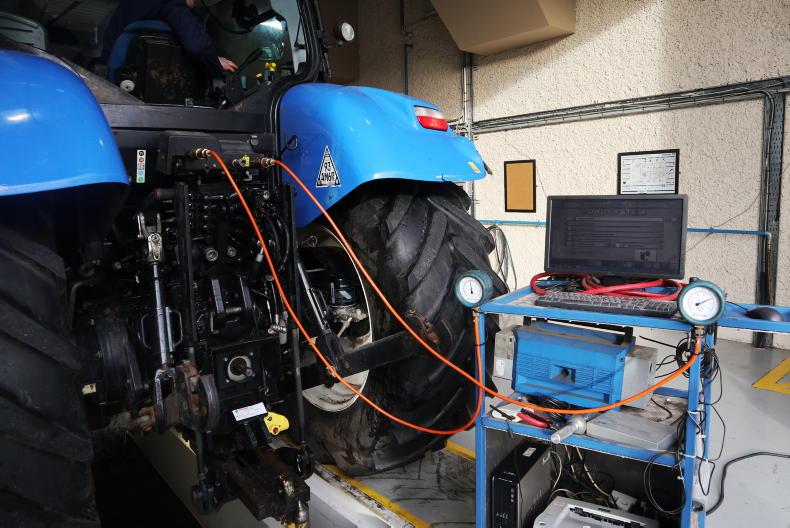
The Irish Farmers Journal can reveal that a total of 516 ‘full’ RSA tractor tests has been carried out since testing first began in June 2018. By and large, the pass rate has been improving year on year, with the exception of 2023 and 2025.
In 2024, the pass rate peaked at 64%. Over the test’s eight-year existence, its average pass rate has risen to 55%.
The legislation requiring fast tractors to undergo a roadworthiness test, similar to that of an NCT for cars, was introduced in May 2018.
Brands
A total of 17 different brands of tractors has been tested to date. As expected, JCB continues to be the most popular brand tested. Its high-speed Fastrac tractors account for 28% of all units tested to date.
John Deere is the second most popular brand tested, accounting for 17.5%.
New Holland accounted for a further 15.7% of all tests to date.
This means that the three brands combined have accounted for over 61% of all tests carried out to date. The next in line were Fendt (7.7%), Case IH (6.9%) and Massey Ferguson (6.2%).
Which tractors need to be tested?
The Road Safety Authority (RSA) states that the requirement for a fast tractor (design speed exceeding 40km/h) to be tested is based on its use.
Any fast tractor which is used for a non-exempted activity (non-agricultural work) requires a certificate of roadworthiness (CRW).
Such examples of tractors required to be tested include those involved in local authority work, the construction, quarrying, manufacturing or mining industries or road construction/roadworks.
‘Fast’ tractors will not have to be tested if they are being used for the purposes of agricultural, horticultural, forestry, farming or fishery activity, on the land where such activity takes place.
Eligible tractors are required to display a CRW on the vehicle’s windscreen.
The tractor test mirrors the CVRT (Commercial Vehicle Roadworthiness Testing) test currently carried out on heavy commercial vehicles (HCVs), but has been modified to suit tractors.
Eligible tractors are required to be tested after they have reached their fourth birthday, and every second year after that. As with any CVRT, DOE or NCT vehicle test, the reading on the hour meter is recorded at the time of the test.
Retest
Similar to other vehicle tests, if the initial test is failed, the retest must be carried out within 21 days.
The agricultural trailers used behind these tractors, which are not commercial trailers, do not require a test. However, the RSA has said that under road traffic law, a trailer must be roadworthy at all times if you use it on a public road.
What are tractors failing on?
The test is broken down into seven stages – starting with braking equipment, then steering, onto visibility, lamps, reflectors and electrical equipment, axles, wheels, tyres and suspension, the chassis, cab and bodywork, safety restraints, locks, horn, speedometer and finally emissions/noise.
Over the past eight years of testing, steering linkage condition and speed discs have come out in the top five reasons for failure each year.
Meanwhile, lights’ condition and operation, mechanical coupling and towing device and the transmission have also been among the most common failure items year on year.
How much does it cost?
There are 40 RSA-approved test centres scattered across 21 counties throughout the country. All of these centres are also heavy commercial vehicle (HCV) testing centres.
In 2024, the RSA increased the price of carrying out the roadworthiness test by 11.5% and the retest fee by 13%.
To test a fast tractor having a DGVW exceeding 3,500kg but not exceeding 7,500kg is €165.50 plus VAT, while the larger fast tractor category having a DGVW exceeding 7,500kg, costs €193.08 plus VAT.





SHARING OPTIONS