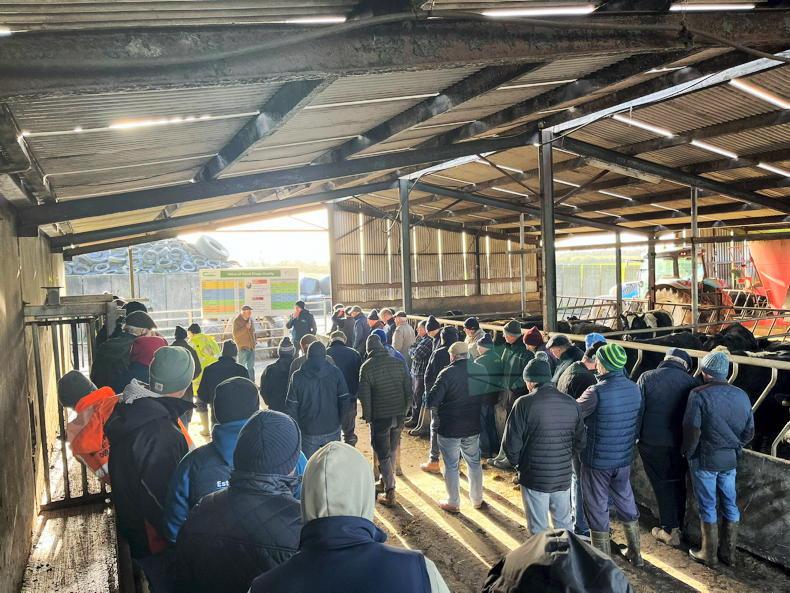
A cold morning did not deter the large turnout of farmers who gathered on the Limerick farm of dairy-beef and tillage farmer Tom Costello recently.
The event marked the first of three on-farm demonstrations to take place over the next five years as part of the ClimateFarmDemo project.
Tom farms just outside Adare, running a dairy-beef calf-to-beef system finishing steers under 24 months, alongside a complementary tillage enterprise that reduces purchased feed costs and increases overall efficiency.
Each spring, Tom purchases around 120 calves – mainly Aberdeen Angus crosses with some Holstein Friesian steers from five local dairy farmers with whom he has built strong relationships.
All stock are reared through to finish on the farm and processed through ABP Rathkeale under the Advantage Programme.
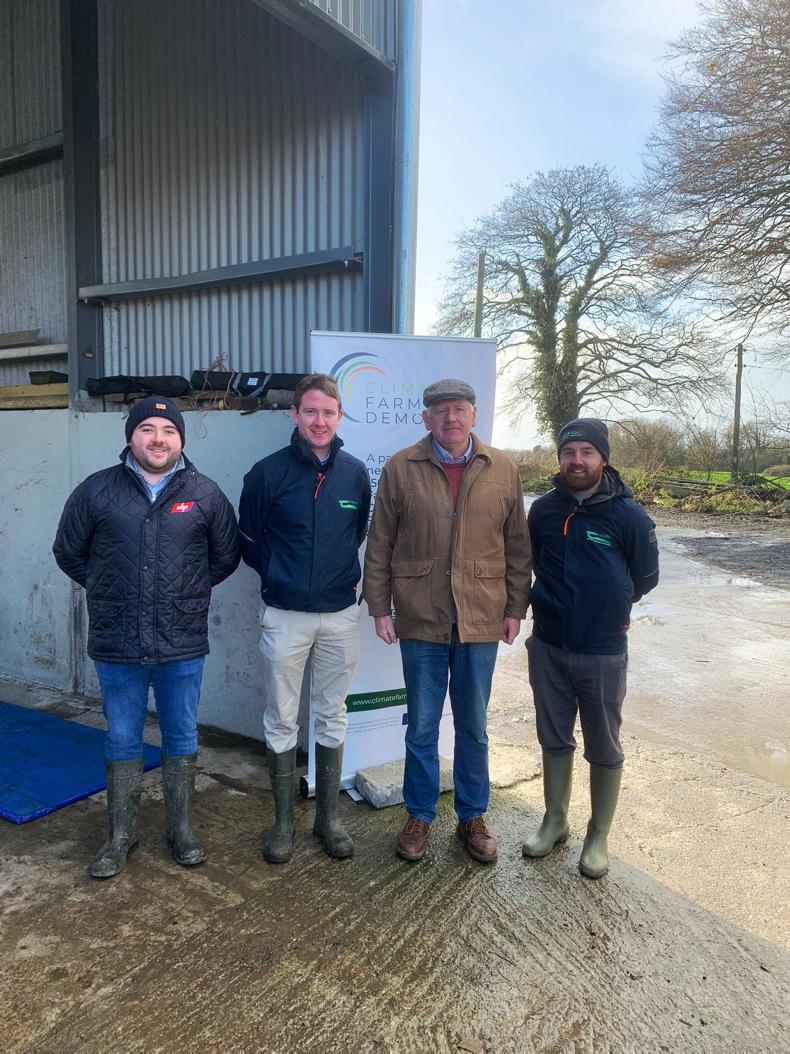
Gavin Healy, ABP farm liaison officer; Jack Kennedy, Teagasc ClimateFarmDemo advisor; Tom Costello, host farmer and Maurice Shine, Teagasc advisor from the Newcastlewest office.
ClimateFarmDemo project
Tom is one of 60 Irish farmers taking part in the ClimateFarmDemo project, a European initiative involving 1,500 pilot demonstration farms across 28 countries.
The programme aims to accelerate the adoption of climate-smart farming (CSF) practices and technologies, using commercial farms to show practical and research-backed solutions. It also supports the EU target of achieving a carbon-neutral agricultural sector by 2050.
Irish activities in the project are delivered by Teagasc advisors John Greaney and Jack Kennedy, who work closely with local advisory staff and project partners. Speakers at last week’s event included Maurice Shine of Teagasc Newcastlewest, Teagasc cattle specialist Niall Kerins, DairyBeef500 adviser Gordon Peppard, with veterinary support from Edwin Murphy of Adare Vets along with ABP Rathkeale procurement representatives Gavin Healy and Kieran O’Sullivan.
The farm walk centred on three key themes influencing both profitability and environmental outcomes on the Costello farm:
1. High-quality silage.2. Accurate dosing and parasite management.3. The selection of high-genetic-merit calves through the use of CBV.High-quality silage: the foundation of the system
Silage quality is something Tom has always prioritised. This year’s analysis averaged 72% DMD, slightly below the 75% DMD achieved in 2024, but still capable of supporting strong daily liveweight gains and lowered concentrate use.
Tom attributes this consistency to grazing silage ground tightly in spring, cutting early, achieving a rapid wilt, and ensuring good consolidation of the pit. Much of the silage ground has been reseeded as part of the tillage rotation, helping maintain productivity and quality. Teagasc’s Niall Kerins stressed the economic value of quality forage. Improving silage DMD, he noted, can save the average farmer up to €105 per head over a 100 day finishing period and €74 per head for weanlings.
The cost savings are due to reduced concentrate bills and improved animal performance, and Niall added that forage quality remains “one of the most influential, yet often under-valued, drivers of profitability on dairy-beef farms.”
Changing regulations shaping parasite control
Parasite control formed the second major focus of the event. Vet Edwin Murphy highlighted the performance losses associated with liver fluke and pneumonia – two issues that can significantly affect animal performance in under-24-month systems.
He also discussed upcoming changes to dosing regulations, which will require farmers to present dung sample results before receiving prescriptions from their vet.
Although some farmers expressed concern, Edwin reassured the group that targeted dosing does not have to compromise performance.
Tom’s experience demonstrates the benefits: by routinely submitting dung samples and working closely with his vet, he has reduced his use of wormers and lowered his risk of anthelmintic resistance.
Edwin encouraged farmers to view the new rules not as a burden but as an opportunity to “become more precise and cost-effective in their dosing programmes”.
Genetics driving profitability and sustainability
Genetics has also become a key part of Tom’s system. Working with his calf suppliers, he promotes the use of beef AI straws with strong carcase weight and age-at-slaughter traits while ensuring calving difficulty stays manageable for the dairy farmer.
DairyBeef500’s Gordon Peppard outlined the value of the Commercial Beef Value (CBV) and Dairy Beef Index (DBI) in identifying profitable and efficient animals.
Data from cattle slaughtered in spring 2024 showed the impact clearly: five-star animals finished 58 days earlier and generated €307 more revenue than one-star animals, excluding feed savings.
These gains also deliver environmental benefits by reducing the number of days animals spend on farm.
AgNav: tracking sustainability progress
Teagasc’s Jack Kennedy presented the farm’s most recent sustainability metrics, showing Tom’s carbon footprint fell by 4% in the past year, dropping to 8.04 kg CO2 equivalent per kg liveweight gain – one of the strongest outcomes among the Irish dairy–beef farms in the project.
Tom expects further progress as he continues to work with Jack and Maurice during the course of the project and is keen to complete another AgNav audit next year.
“While it shows me the environmental benefits of the actions I’m doing on farm, it’s easy to see the financial benefits that come with the actions too – it’s a win-win and so simple to do.”
ABP perspective: cattle hitting market specs
The event concluded with a drafting demonstration led by ABP’s Gavin Healy and Kieran O’Sullivan, using a group of factory-ready steers from the Costello farm.
Kieran outlined the key traits and areas to look for when selecting cattle – fat score, conformation, weight and consistency – and noted that a strong proportion of Tom’s cattle were ready for immediate slaughter. This he said, reflected effective feeding and management throughout the system.
“These cattle represent exactly the type of low-carbon, high-efficiency beef the ABP Advantage Programme aims to encourage.” Their performance is the result of the careful integration of genetics, forage quality, animal health, and overall management on the Costello farm.
For more information on the ClimateFarmDemo project, to see farms in your local area and for more events log on to www.climatefarmdemo.eu.
A cold morning did not deter the large turnout of farmers who gathered on the Limerick farm of dairy-beef and tillage farmer Tom Costello recently.
The event marked the first of three on-farm demonstrations to take place over the next five years as part of the ClimateFarmDemo project.
Tom farms just outside Adare, running a dairy-beef calf-to-beef system finishing steers under 24 months, alongside a complementary tillage enterprise that reduces purchased feed costs and increases overall efficiency.
Each spring, Tom purchases around 120 calves – mainly Aberdeen Angus crosses with some Holstein Friesian steers from five local dairy farmers with whom he has built strong relationships.
All stock are reared through to finish on the farm and processed through ABP Rathkeale under the Advantage Programme.
Gavin Healy, ABP farm liaison officer; Jack Kennedy, Teagasc ClimateFarmDemo advisor; Tom Costello, host farmer and Maurice Shine, Teagasc advisor from the Newcastlewest office.
ClimateFarmDemo project
Tom is one of 60 Irish farmers taking part in the ClimateFarmDemo project, a European initiative involving 1,500 pilot demonstration farms across 28 countries.
The programme aims to accelerate the adoption of climate-smart farming (CSF) practices and technologies, using commercial farms to show practical and research-backed solutions. It also supports the EU target of achieving a carbon-neutral agricultural sector by 2050.
Irish activities in the project are delivered by Teagasc advisors John Greaney and Jack Kennedy, who work closely with local advisory staff and project partners. Speakers at last week’s event included Maurice Shine of Teagasc Newcastlewest, Teagasc cattle specialist Niall Kerins, DairyBeef500 adviser Gordon Peppard, with veterinary support from Edwin Murphy of Adare Vets along with ABP Rathkeale procurement representatives Gavin Healy and Kieran O’Sullivan.
The farm walk centred on three key themes influencing both profitability and environmental outcomes on the Costello farm:
1. High-quality silage.2. Accurate dosing and parasite management.3. The selection of high-genetic-merit calves through the use of CBV.High-quality silage: the foundation of the system
Silage quality is something Tom has always prioritised. This year’s analysis averaged 72% DMD, slightly below the 75% DMD achieved in 2024, but still capable of supporting strong daily liveweight gains and lowered concentrate use.
Tom attributes this consistency to grazing silage ground tightly in spring, cutting early, achieving a rapid wilt, and ensuring good consolidation of the pit. Much of the silage ground has been reseeded as part of the tillage rotation, helping maintain productivity and quality. Teagasc’s Niall Kerins stressed the economic value of quality forage. Improving silage DMD, he noted, can save the average farmer up to €105 per head over a 100 day finishing period and €74 per head for weanlings.
The cost savings are due to reduced concentrate bills and improved animal performance, and Niall added that forage quality remains “one of the most influential, yet often under-valued, drivers of profitability on dairy-beef farms.”
Changing regulations shaping parasite control
Parasite control formed the second major focus of the event. Vet Edwin Murphy highlighted the performance losses associated with liver fluke and pneumonia – two issues that can significantly affect animal performance in under-24-month systems.
He also discussed upcoming changes to dosing regulations, which will require farmers to present dung sample results before receiving prescriptions from their vet.
Although some farmers expressed concern, Edwin reassured the group that targeted dosing does not have to compromise performance.
Tom’s experience demonstrates the benefits: by routinely submitting dung samples and working closely with his vet, he has reduced his use of wormers and lowered his risk of anthelmintic resistance.
Edwin encouraged farmers to view the new rules not as a burden but as an opportunity to “become more precise and cost-effective in their dosing programmes”.
Genetics driving profitability and sustainability
Genetics has also become a key part of Tom’s system. Working with his calf suppliers, he promotes the use of beef AI straws with strong carcase weight and age-at-slaughter traits while ensuring calving difficulty stays manageable for the dairy farmer.
DairyBeef500’s Gordon Peppard outlined the value of the Commercial Beef Value (CBV) and Dairy Beef Index (DBI) in identifying profitable and efficient animals.
Data from cattle slaughtered in spring 2024 showed the impact clearly: five-star animals finished 58 days earlier and generated €307 more revenue than one-star animals, excluding feed savings.
These gains also deliver environmental benefits by reducing the number of days animals spend on farm.
AgNav: tracking sustainability progress
Teagasc’s Jack Kennedy presented the farm’s most recent sustainability metrics, showing Tom’s carbon footprint fell by 4% in the past year, dropping to 8.04 kg CO2 equivalent per kg liveweight gain – one of the strongest outcomes among the Irish dairy–beef farms in the project.
Tom expects further progress as he continues to work with Jack and Maurice during the course of the project and is keen to complete another AgNav audit next year.
“While it shows me the environmental benefits of the actions I’m doing on farm, it’s easy to see the financial benefits that come with the actions too – it’s a win-win and so simple to do.”
ABP perspective: cattle hitting market specs
The event concluded with a drafting demonstration led by ABP’s Gavin Healy and Kieran O’Sullivan, using a group of factory-ready steers from the Costello farm.
Kieran outlined the key traits and areas to look for when selecting cattle – fat score, conformation, weight and consistency – and noted that a strong proportion of Tom’s cattle were ready for immediate slaughter. This he said, reflected effective feeding and management throughout the system.
“These cattle represent exactly the type of low-carbon, high-efficiency beef the ABP Advantage Programme aims to encourage.” Their performance is the result of the careful integration of genetics, forage quality, animal health, and overall management on the Costello farm.
For more information on the ClimateFarmDemo project, to see farms in your local area and for more events log on to www.climatefarmdemo.eu.






SHARING OPTIONS