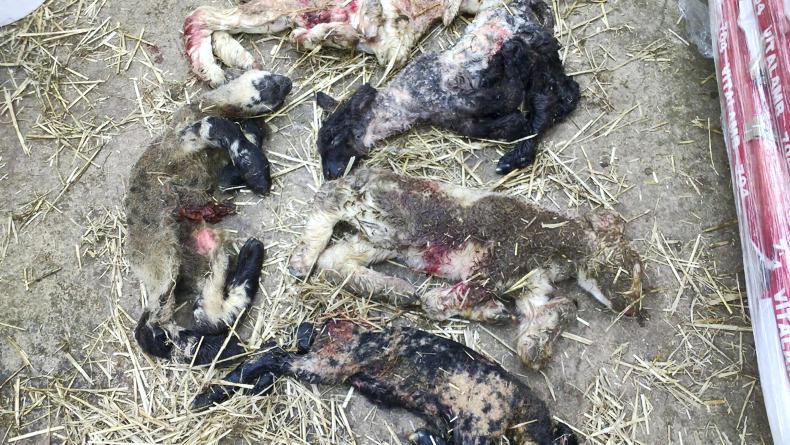
Dead lambs pictured on a Tyrone farm this week were all suspected to have the Schmallenberg virus. The farmer has had seven suspect lambs in the last five days.
ADVERTISEMENT
There has been a significant increase in the number of sheep farmers reporting cases of Schmallenberg virus (SBV) in the last week.
The problem seems to have been initially identified in early lambing flocks in Fermanagh, but has now also spread into Tyrone. Large numbers of dead lambs suspected as being infected by the virus have been presented to the veterinary lab in Omagh – the outbreak is much greater than anything seen in previous years.
The first indication that SBV might be a problem this year came in late 2017 when the Department of Agriculture in the Republic of Ireland warned that the virus had travelled north. Since then, suspect cases have been found in a number of border counties.
ADVERTISEMENT
Clinical signs include congenital abnormalities in aborted animals or in animals born alive or dead. Abnormalities include bent limbs or fixed joints, stiff necks, curved spines and a shortened lower jaw. That can make lambing difficult, and in some cases a caesarean is required.
SBV is spread by midges, and with a mild and wet autumn in 2017, this favoured increased problems with the disease.
This content is available to digital subscribers and loyalty code users only. Sign in to your account, use the code or subscribe to get unlimited access.
The reader loyalty code gives you full access to the site from when you enter it until the following Wednesday at 9pm. Find your unique code on the back page of Irish Country Living every week.
CODE ACCEPTED
You have full access to the site until next Wednesday at 9pm.
CODE NOT VALID
Please try again or contact support.
There has been a significant increase in the number of sheep farmers reporting cases of Schmallenberg virus (SBV) in the last week.
The problem seems to have been initially identified in early lambing flocks in Fermanagh, but has now also spread into Tyrone. Large numbers of dead lambs suspected as being infected by the virus have been presented to the veterinary lab in Omagh – the outbreak is much greater than anything seen in previous years.
The first indication that SBV might be a problem this year came in late 2017 when the Department of Agriculture in the Republic of Ireland warned that the virus had travelled north. Since then, suspect cases have been found in a number of border counties.
Clinical signs include congenital abnormalities in aborted animals or in animals born alive or dead. Abnormalities include bent limbs or fixed joints, stiff necks, curved spines and a shortened lower jaw. That can make lambing difficult, and in some cases a caesarean is required.
SBV is spread by midges, and with a mild and wet autumn in 2017, this favoured increased problems with the disease.
If you would like to speak to a member of our team, please call us on 01-4199525.
Link sent to your email address
We have sent an email to your address. Please click on the link in this email to reset your password. If you can't find it in your inbox, please check your spam folder. If you can't find the email, please call us on 01-4199525.
ENTER YOUR LOYALTY CODE:
The reader loyalty code gives you full access to the site from when you enter it until the following Wednesday at 9pm. Find your unique code on the back page of Irish Country Living every week.








SHARING OPTIONS