There is a lot of hope riding on this week’s weather forecast ringing true and a settled spell of weather following. Leaving aside the challenges in getting ewes and lambs turned outdoors in recent weeks and limiting lamb mortality, the big challenge in the coming weeks will be keeping sufficient grass ahead of stock.
Grass growth rates have been running at a lower level than normal meaning grass reserves are typically behind target. Throw poor grass utilisation in to the mix and an inability to get fertiliser applied delaying sward recovery and the outlook is more testing.
Options available to farmers are not plentiful, with the only real choice open to many flocks to supplement ewes in a bid to conserve existing supplies. The table at the bottom of this page outlines supplementation rates for a number of feeding scenarios using grass height/silage quality and ewe condition as two variables.
Ewes which are in good body condition (BCS 3+) post-lambing are a welcome addition in overcoming current difficulties. Such ewes can utilise some body reserves in early lactation to help meet a nutritional deficit but this is a short-term aid and not a scenario to rely upon.
This is due to the fact that a significant loss in body condition and prolonged nutritional deficit will limit a ewe’s ability to reach peak milk production (peaks in week 3.5 in twins at approximately 3.5l/day and in week five in singles at about 2.3l/day).
A ewe utilising 100g of body reserves daily can reduce her energy intake from over 10% where she is high yielding to 20% where she is low yielding (3kg/day versus 1kg/day). This shows that while there is a benefit, ewes still need sufficient feeding to avoid excessive weight loss.
The other challenge is ewes being capable of physically eating enough to meet nutritional demands. Ewe intake does not peak until six to eight weeks into lactation meaning that the energy and protein content of the diet in early lactation is critical.
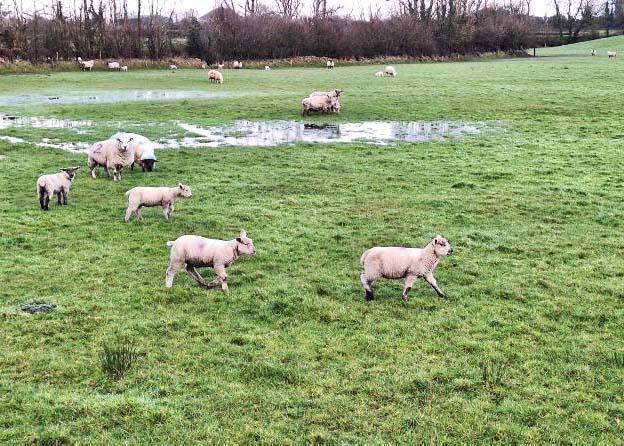
Under normal circumstances turning ewes outdoors to a plentiful supply of grass (4cm plus) and reasonable levels of grass utilisation will be sufficient to meet the energy and protein demands for a twin suckling ewe in good body condition.
The dry matter of grass is currently at a lower level given recent torrential rainfall and waterlogged soils. If grass utilisation is also under pressure then a twin suckling ewe in good body condition may warrant a small volume of concentrates to increase the dry matter of the diet, slow down the rate of passage of grass through the ewe’s digestive system and improve nutrient absorption.
A small volume of concentrates, even in the region of 0.5kg, will deliver big benefits in this regards, even if only offered for the first week to 10 days. It will also help in minimising the risk of grass tetany. Where grass supplies are inadequate and body condition is lacking then the supplementation rates detailed in the table will need to be adopted.
It has not been ideal weather up to now for ewes rearing triplet lambs to be let outdoors. If weather conditions improve then there is an opportunity to get such ewes turned outdoors, but supplementation will remain critical until conditions return to normal.
The general advice is to offer such ewes 0.5kg concentrates daily but in light of current weather this should be targeted at 1kg, plus, offered in two feeds daily.
Where there is a doubt about a ewe’s ability to rear three lambs, or likewise where there is a doubt about the ability of yearling hoggets to rear two lambs, then consideration should be strongly given to removing one lamb.
If retaining ewes and lambs indoors for a period of time then feeding levels should be gradually increased over the space of a few days, avoiding overfeeding in the first 24 hours. Pressure on space is an obvious challenge of retaining ewes indoors. The increase in intake in early lactation will increase straw requirements by up to 40% to 50% depending on the type of forage being offered.
It is also important to satisfy a higher water intake demand with lactating ewes requiring upwards of 10l of fresh water per day. Teagasc advice where feeding a high concentrate diet is a recommended crude fibre content of at least 7%.
The high demand for protein in the final two weeks of gestation continues to build in early lactation. Where ewes are supplemented indoors it is important to continue to feed an 18% to 20% nut or ration. Where high levels of concentrates are fed this can be reduced but the overall saving is small and therefore it is best not to alter the diet significantly when ewes are settled on high levels of meal.
Grass supplies should be closely monitored and a feeding programme put in place early where there is any doubt that supplies are running tight. Take account of a lower dry matter content in grass and possibly lower grass utilisation when deciding on the need to supplement ewes.Where supplementing ewes with high levels of concentrates then feeding management is critical including trough management and ensuring ewes have access to adequate forage / water. If supplementing at grass then retaining smaller batch sizes will help. Prioritise ewes depending on age and condition for supplementation.
There is a lot of hope riding on this week’s weather forecast ringing true and a settled spell of weather following. Leaving aside the challenges in getting ewes and lambs turned outdoors in recent weeks and limiting lamb mortality, the big challenge in the coming weeks will be keeping sufficient grass ahead of stock.
Grass growth rates have been running at a lower level than normal meaning grass reserves are typically behind target. Throw poor grass utilisation in to the mix and an inability to get fertiliser applied delaying sward recovery and the outlook is more testing.
Options available to farmers are not plentiful, with the only real choice open to many flocks to supplement ewes in a bid to conserve existing supplies. The table at the bottom of this page outlines supplementation rates for a number of feeding scenarios using grass height/silage quality and ewe condition as two variables.
Ewes which are in good body condition (BCS 3+) post-lambing are a welcome addition in overcoming current difficulties. Such ewes can utilise some body reserves in early lactation to help meet a nutritional deficit but this is a short-term aid and not a scenario to rely upon.
This is due to the fact that a significant loss in body condition and prolonged nutritional deficit will limit a ewe’s ability to reach peak milk production (peaks in week 3.5 in twins at approximately 3.5l/day and in week five in singles at about 2.3l/day).
A ewe utilising 100g of body reserves daily can reduce her energy intake from over 10% where she is high yielding to 20% where she is low yielding (3kg/day versus 1kg/day). This shows that while there is a benefit, ewes still need sufficient feeding to avoid excessive weight loss.
The other challenge is ewes being capable of physically eating enough to meet nutritional demands. Ewe intake does not peak until six to eight weeks into lactation meaning that the energy and protein content of the diet in early lactation is critical.
Under normal circumstances turning ewes outdoors to a plentiful supply of grass (4cm plus) and reasonable levels of grass utilisation will be sufficient to meet the energy and protein demands for a twin suckling ewe in good body condition.
The dry matter of grass is currently at a lower level given recent torrential rainfall and waterlogged soils. If grass utilisation is also under pressure then a twin suckling ewe in good body condition may warrant a small volume of concentrates to increase the dry matter of the diet, slow down the rate of passage of grass through the ewe’s digestive system and improve nutrient absorption.
A small volume of concentrates, even in the region of 0.5kg, will deliver big benefits in this regards, even if only offered for the first week to 10 days. It will also help in minimising the risk of grass tetany. Where grass supplies are inadequate and body condition is lacking then the supplementation rates detailed in the table will need to be adopted.
It has not been ideal weather up to now for ewes rearing triplet lambs to be let outdoors. If weather conditions improve then there is an opportunity to get such ewes turned outdoors, but supplementation will remain critical until conditions return to normal.
The general advice is to offer such ewes 0.5kg concentrates daily but in light of current weather this should be targeted at 1kg, plus, offered in two feeds daily.
Where there is a doubt about a ewe’s ability to rear three lambs, or likewise where there is a doubt about the ability of yearling hoggets to rear two lambs, then consideration should be strongly given to removing one lamb.
If retaining ewes and lambs indoors for a period of time then feeding levels should be gradually increased over the space of a few days, avoiding overfeeding in the first 24 hours. Pressure on space is an obvious challenge of retaining ewes indoors. The increase in intake in early lactation will increase straw requirements by up to 40% to 50% depending on the type of forage being offered.
It is also important to satisfy a higher water intake demand with lactating ewes requiring upwards of 10l of fresh water per day. Teagasc advice where feeding a high concentrate diet is a recommended crude fibre content of at least 7%.
The high demand for protein in the final two weeks of gestation continues to build in early lactation. Where ewes are supplemented indoors it is important to continue to feed an 18% to 20% nut or ration. Where high levels of concentrates are fed this can be reduced but the overall saving is small and therefore it is best not to alter the diet significantly when ewes are settled on high levels of meal.
Grass supplies should be closely monitored and a feeding programme put in place early where there is any doubt that supplies are running tight. Take account of a lower dry matter content in grass and possibly lower grass utilisation when deciding on the need to supplement ewes.Where supplementing ewes with high levels of concentrates then feeding management is critical including trough management and ensuring ewes have access to adequate forage / water. If supplementing at grass then retaining smaller batch sizes will help. Prioritise ewes depending on age and condition for supplementation. 





SHARING OPTIONS