Global wool prices continue on an upward momentum with recent auctions in New Zealand and Australia recording price increases of upwards of 10%. Last week’s British Wool auction mirrored the upward trajectory seen in the southern hemisphere with the price of greasy wool increasing by 7.6%, or 10%, to average £1.35/kg (€1.56/kg).
The sale report states that prices paid for the major British Wool grades matched those of equivalent New Zealand types with export customers active throughout the sale. The sale opened with prices 5% dearer than the previous sale held in mid-January but with domestic wool buyers and export customers increasing activity prices strengthened to 10% higher than the previous sale to average 7.6% firmer.
The lively bidding led to a full clearance of the 1,125t of wool on offer. British Wool reports that core grades of carpet wool were particularly well sought after with some types trading as high as 12% dearer towards the end of the auction. They add that this has been the case for some time combing types traded in line with carpet wools.
The average greasy price of £1.35/kg is not the price received by producers. The price received is based on the average sale price across the 2025 wool clip for the different classes of wool and the deduction of a handling charge. This was approximately 60p/kg (69c/kg) for the 2024 wool clip year where the average price was £1/kg (€1.14/kg).
British Wool said at the end of 2025 that based on sales to year-end producers who marketed their wool through the co-operative were likely to see their final returns increase by about 20p/kg (23c/kg). This figure could be higher if sales continue to strengthen. There is variation between the value of different wool types with fine wool types, Mules, Cheviots for example securing a significantly higher price than Swaledale, Welsh or Scottish Blackface wool.
Reduced volume
Approximately 58% of the anticipated wool supply available to British Wool for the 2025 year has now been traded. Intake volumes are down 4% year-on-year and expectations remain for the total supply of wool this season to be several hundred tonnes lower than last year. Andrew Hogley, CEO British Wool, previously encouraged any members who still had wool on farm to send it in to capitalise on the improved market dynamics. As can be seen in Figure 1, British Wool reports that prices are at close to pre-Covid 19 pandemic levels (excluding inflation) which triggered a collapse in global demand. All eyes will be on the next British Wool sale in two weeks’ time, on 10 February.
Irish prices
The volume of wool trading in Ireland at present has increased slightly with some farmers clearing sheds ahead of lambing but still remains relatively low. There has also been some upward movement in the market with prices increasing by 10c/kg to 20c/kg in recent months.
Prices paid for lowland wool range from 40c/kg to 50c/kg with the higher prices said to be paid for large volumes of wool packed and stored in optimum conditions. A significant differential remains between lowland and hill-type wool with good-quality white hill wool trading for upwards of 20c/kg and grey or black Scotch wool selling back to 10c/kg to 15c/kg. Producers with significant volumes on hand are encouraged to price the market for the best returns. The upturn in the market is welcome but there will need to be substantial further movement before returns go anywhere near covering shearing costs.
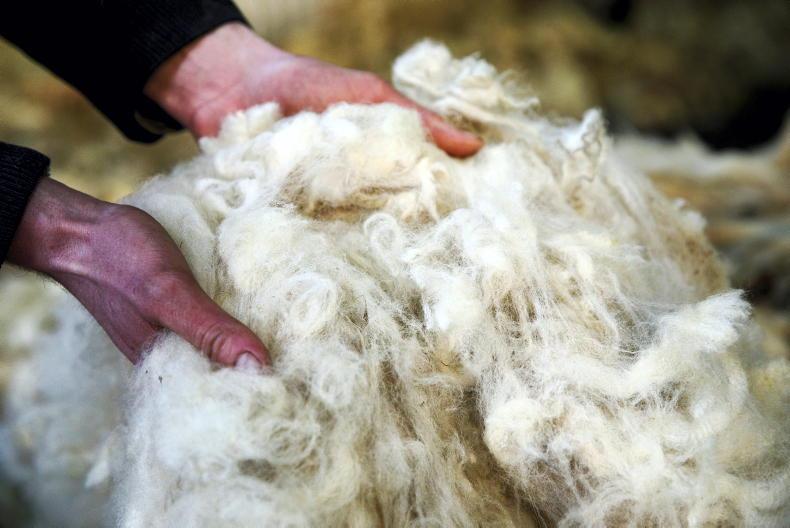
Dooley Wool Ltd, Roscrea, Co Tipperary. \ Donal O'Leary
Future outlook
Global supplies of wool are trending downwards with this particularly true of high-value of Merino wool with continued conversion in Australia from farming sheep for wool to farming sheep for meat production. Demand from China dictates global markets with estimates varying but pointing to 70% of global wool production ending up in China for processing. Stocks of wool in the country are said to be at a low level with this underpinning recent demand.
Some Irish wool merchants explain they are cautious as to how any further outbreaks of bluetongue virus could affect the trade but to-date it has not had any implications on the purchase of wool from Europe and this will hopefully remain.
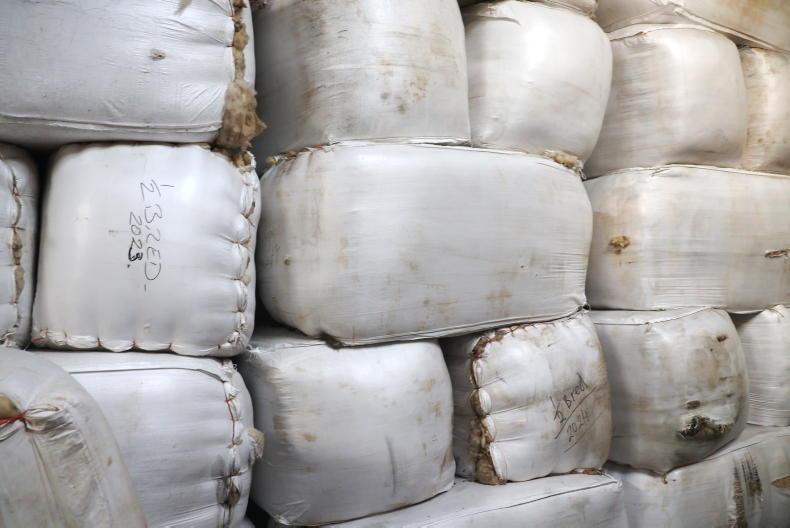
The bales of wool are shipped to Bradford in the UK for further processing.
Australian prices
The latest weekly wool price reports in Australia show prices easing by about AU $0.25/kg (14c/kg). Australian Wool Innovation report that the reduction in price was underpinned by currency movements stating “Currency movements were a key influence on market results this week, with the Australian dollar strengthening against the US dollar. The firmer AUD was supported by rising expectations that the Reserve Bank of Australia may lift interest rates at its upcoming meeting, following stronger-than-expected inflation and labour market data. At the same time, the US dollar eased as markets digested recent Federal Reserve policy decisions.”
While price weakened demand firmed and it is expected that there will be a reversal in this week’s easing in prices. Wool with a micron value of 19 to 16.5 microns is reported as trading on average from AU $20.48 to AU $22.89 AUD or the equivalent of €12.17/kg to €13.61/kg at current exchange rates. Wool at 32 to 26 micron is reported as trading from AU $4.80 to AU $8.50 AUD or €2.85/kg to €5.50/kg.
Global wool prices continue on an upward momentum with recent auctions in New Zealand and Australia recording price increases of upwards of 10%. Last week’s British Wool auction mirrored the upward trajectory seen in the southern hemisphere with the price of greasy wool increasing by 7.6%, or 10%, to average £1.35/kg (€1.56/kg).
The sale report states that prices paid for the major British Wool grades matched those of equivalent New Zealand types with export customers active throughout the sale. The sale opened with prices 5% dearer than the previous sale held in mid-January but with domestic wool buyers and export customers increasing activity prices strengthened to 10% higher than the previous sale to average 7.6% firmer.
The lively bidding led to a full clearance of the 1,125t of wool on offer. British Wool reports that core grades of carpet wool were particularly well sought after with some types trading as high as 12% dearer towards the end of the auction. They add that this has been the case for some time combing types traded in line with carpet wools.
The average greasy price of £1.35/kg is not the price received by producers. The price received is based on the average sale price across the 2025 wool clip for the different classes of wool and the deduction of a handling charge. This was approximately 60p/kg (69c/kg) for the 2024 wool clip year where the average price was £1/kg (€1.14/kg).
British Wool said at the end of 2025 that based on sales to year-end producers who marketed their wool through the co-operative were likely to see their final returns increase by about 20p/kg (23c/kg). This figure could be higher if sales continue to strengthen. There is variation between the value of different wool types with fine wool types, Mules, Cheviots for example securing a significantly higher price than Swaledale, Welsh or Scottish Blackface wool.
Reduced volume
Approximately 58% of the anticipated wool supply available to British Wool for the 2025 year has now been traded. Intake volumes are down 4% year-on-year and expectations remain for the total supply of wool this season to be several hundred tonnes lower than last year. Andrew Hogley, CEO British Wool, previously encouraged any members who still had wool on farm to send it in to capitalise on the improved market dynamics. As can be seen in Figure 1, British Wool reports that prices are at close to pre-Covid 19 pandemic levels (excluding inflation) which triggered a collapse in global demand. All eyes will be on the next British Wool sale in two weeks’ time, on 10 February.
Irish prices
The volume of wool trading in Ireland at present has increased slightly with some farmers clearing sheds ahead of lambing but still remains relatively low. There has also been some upward movement in the market with prices increasing by 10c/kg to 20c/kg in recent months.
Prices paid for lowland wool range from 40c/kg to 50c/kg with the higher prices said to be paid for large volumes of wool packed and stored in optimum conditions. A significant differential remains between lowland and hill-type wool with good-quality white hill wool trading for upwards of 20c/kg and grey or black Scotch wool selling back to 10c/kg to 15c/kg. Producers with significant volumes on hand are encouraged to price the market for the best returns. The upturn in the market is welcome but there will need to be substantial further movement before returns go anywhere near covering shearing costs.
Dooley Wool Ltd, Roscrea, Co Tipperary. \ Donal O'Leary
Future outlook
Global supplies of wool are trending downwards with this particularly true of high-value of Merino wool with continued conversion in Australia from farming sheep for wool to farming sheep for meat production. Demand from China dictates global markets with estimates varying but pointing to 70% of global wool production ending up in China for processing. Stocks of wool in the country are said to be at a low level with this underpinning recent demand.
Some Irish wool merchants explain they are cautious as to how any further outbreaks of bluetongue virus could affect the trade but to-date it has not had any implications on the purchase of wool from Europe and this will hopefully remain.
The bales of wool are shipped to Bradford in the UK for further processing.
Australian prices
The latest weekly wool price reports in Australia show prices easing by about AU $0.25/kg (14c/kg). Australian Wool Innovation report that the reduction in price was underpinned by currency movements stating “Currency movements were a key influence on market results this week, with the Australian dollar strengthening against the US dollar. The firmer AUD was supported by rising expectations that the Reserve Bank of Australia may lift interest rates at its upcoming meeting, following stronger-than-expected inflation and labour market data. At the same time, the US dollar eased as markets digested recent Federal Reserve policy decisions.”
While price weakened demand firmed and it is expected that there will be a reversal in this week’s easing in prices. Wool with a micron value of 19 to 16.5 microns is reported as trading on average from AU $20.48 to AU $22.89 AUD or the equivalent of €12.17/kg to €13.61/kg at current exchange rates. Wool at 32 to 26 micron is reported as trading from AU $4.80 to AU $8.50 AUD or €2.85/kg to €5.50/kg.







SHARING OPTIONS