


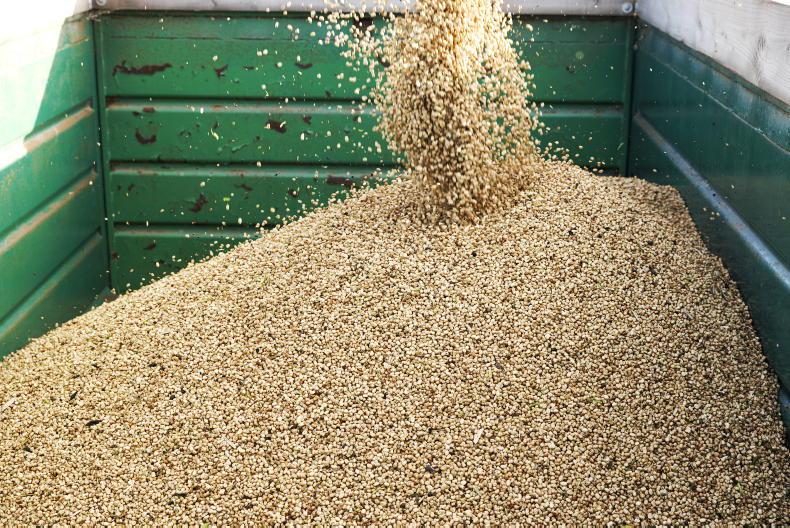
Farmer representatives for the beef, dairy and sheep sectors will have to agree on any changes to the rules to include Irish grain as a requirement for Bord Bia Assurance schemes the food board has said.
Last week, Bord Bia chairperson Larry Murrin, said that it was “double standards” by those opposed to importing beef from Mercosur countries to the EU while they import grain from Mercosur countries to feed Irish animals.
Responding to a query from the Irish Farmers Journal asking when Bord Bia will include Irish grain in its dairy, beef and sheep assurance scheme it said: “Any requirement to use Irish grain in the Bord Bia beef, dairy, and sheep schemes would need to be agreed by the beef, dairy, and sheep sectors and their farmer representatives.
“While Bord Bia would like to give greater recognition to Irish grains, this is not a decision Bord Bia can make on its own. Neither can we mandate the use of Irish grain as this is against EU state aid rules.”
The statement continued on to say: “Bord Bia has been working closely with the Cereals Association of Ireland, DAFM and other industry stakeholders, to agree on the pilot assurance scheme for Irish grain. The pilot aims to recognise the sustainability performance of Irish grain and support access to premium food and drink markets.”
“Should the pilot tillage scheme become part of the primary producer standard and progress to include grain growers supplying animal feed, then there could be a mechanism to include Quality Assured grain from Irish growers as a requirement. However, this would need to be agreed by the beef, lamb, and dairy Technical Advisory Committees.”
The Irish Farmers Journal also asked when AgNav will be updated to include the impact of the carbon footprint of animal feed on the carbon footprint of livestock animal farms? Research by Teagasc was reference which stated that the use of a 64% Irish ration can reduce the carbon footprint of milk production by 7.3%, the same as protected urea.
Bord Bia said: “The carbon footprint of concentrates fed to dairy cows is currently assessed by AgNav. Farmers can adjust to reflect the use of sustainable sourced ingredients not associated with deforestation or land-use change (non-DFC grain). It does not specifically reference Irish grain.
“Bord Bia continues to work with Teagasc and ICBF on developing the functionality of AgNav that best reflects Irish farming and utilizes up to date research.”
Does the scheme measure a carbon footprint? – comment
However, it should be noted that it is not clear how AgNav assesses the carbon footprint of concentrates correctly if it does not specifically reference Irish grain or the country any of the ingredients come from. Saying if ingredients come from deforested land is not assessing the assessing the carbon footprint of concentrates.
Teagasc and Tirlán research has shown that Irish grain is among the lowest carbon footprints in the World. This means a ration made from mainly Irish cereals would have a much lower carbon footprint than something made mainly from maize shipped from South America.
Maize from Brazil for example, has a carbon footprint of about 1,339kg CO2eq/t, while soybeans have a carbon footprint of about 4,484kg CO2eq/t.
Irish barley has a carbon footprint of 256kg CO2eq/t. Ticking a box on the Bord Bia assessment to say the grain isn’t from deforested land does not cut the mustard. One of the main reasons for this is because farmers don’t know where the ingredients in their feed has come from, unless it says it is Irish. A lot of work goes into calculating a carbon footprint as can be seen from the AgNav so it’s not as simple as ticking a box to account for the carbon footprint of animal feed and we shouldn’t devalue Irish grain in this manner.
If it is not being measured right then it is not fair to say it is assessed. Also, only the dairy sustainability assurance scheme was mentioned. Bord Bia did not say it was assessed at all in the beef and sheep schemes.





SHARING OPTIONS