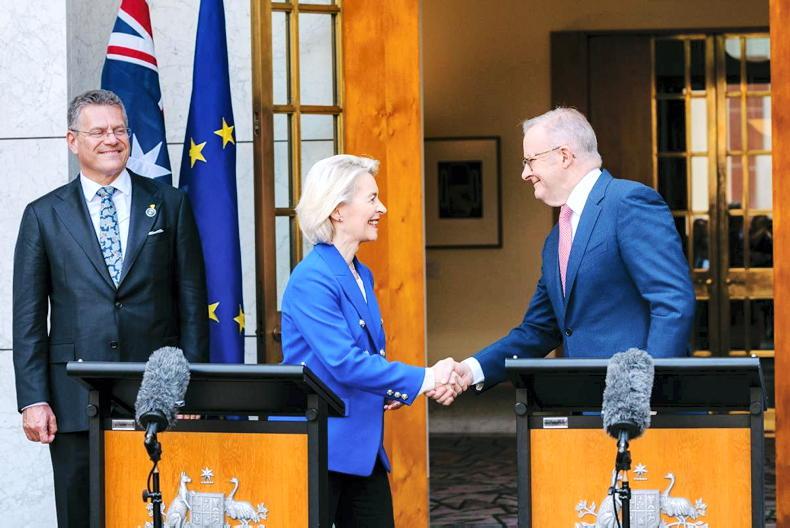
After almost eight years of negotiation, the EU-Australia trade deal was finally agreed last week.
It removes virtually all tariffs on trade, with agricultural products being the key exception.
With them, there remains quota-controlled access to the EU market, with a 30,600-tonne (t) quota for beef, of which 16,380t are tariff-free, while the remainder has a 7.5% tariff.
One third of this will be available when the deal comes into effect, the remainder phased in over 10 years.
For sheepmeat, there is a 25,000t quota tariff-free, phased in over seven years. Both come with a “grass-fed” requirement and there is also a 5,000t butter quota.
Australian industry 'devastated'
The deal has not been well received by Australian meat exporters, who say in a statement that they “are profoundly let down by the outcome” and that “a deal so far below what other suppliers have secured is genuinely bewildering”.
The chair of the Australia-EU Red Meat Market Access Taskforce (RMMAT) Andrew McDonald told the Irish Farmers Journal ahead of the final negotiation that their bottom line was for a 50,000t beef quota and a 67,000t sheepmeat quota.
This was based on the Mercosur countries securing a 99,000t beef quota and Canada getting 50,000t in its negotiation over a decade ago.
For sheepmeat, the benchmark was New Zealand, which now has access to the EU for 163,769t, with 128,000t of this an historical legacy from UK membership of the EU.
Irish and EU farmers not happy either
Copa-Cogeca has described the deal as agriculture “again being used as a bargaining chip in the EU’s pursuit of broader trade and political objectives”.
Here, Irish Farmers Association president Francie Gorman describes the deal as “not having Irish and European farmers’ livelihoods and production standards as a priority”.
Lose-lose or win-win?
In sporting competition, when both sides complain about the referee, it is often suggested that they must have been fair and even -handed if they have annoyed both sides.
In this case, there is validity in the reaction of both the Australian meat industry and EU farmers, who again see competition in their space increased, while the benefit of the trade deal will accrue to the wider economy.
There are two elements in particular that are likely to have impacted Australian expectations.
The first is the ability of Canada to secure a 50,000t quota, despite having a smaller beef export industry, and the other is the particularly successful negotiation it had with the UK trade deal, where they will eventually secure unlimited tariff-free access for beef and sheepmeat.
On sheep meat, Australia is the world’s largest exporter ahead of New Zealand, which has more than six times more quota for the EU.
From the perspective of EU farmers and the meat industry, they see this deal following on immediately from the Mercosur deal and further increasing competition in the market place.
Comment - any deal with Australia was going to increase access
While the deal falls short of Australian expectations, the reality is that it didn’t have the negotiating strength of the Mercosur group of countries, which can offer much greater potential for EU exports.
As for Canada, it is also a larger economy than Australia, though nowhere close to Mercosur, and it also had the benefit of negotiating over a decade ago in an era when there was a different perspective on global trade.
Australian expectations may also have been shaped by the ease with which they concluded a favourable deal with the UK, but there was a political motivation in that negotiation.
As for sheepmeat and New Zealand, there is the legacy quota of 128,000t and a greater priority given to sheepmeat over beef, where there is just a 10,000t quota for New Zealand.
Irish and EU farmers see this as another deal where they have to “take one for the team”, in that the deal is good for the wider economy but at the expense of increasing competition in the beef and sheepmeat market.
Therefore, there is no level of quota that would be welcome, but given the Australian reaction, there may be some consolation in Ireland and across the EU that it wasn’t worse.
After almost eight years of negotiation, the EU-Australia trade deal was finally agreed last week.
It removes virtually all tariffs on trade, with agricultural products being the key exception.
With them, there remains quota-controlled access to the EU market, with a 30,600-tonne (t) quota for beef, of which 16,380t are tariff-free, while the remainder has a 7.5% tariff.
One third of this will be available when the deal comes into effect, the remainder phased in over 10 years.
For sheepmeat, there is a 25,000t quota tariff-free, phased in over seven years. Both come with a “grass-fed” requirement and there is also a 5,000t butter quota.
Australian industry 'devastated'
The deal has not been well received by Australian meat exporters, who say in a statement that they “are profoundly let down by the outcome” and that “a deal so far below what other suppliers have secured is genuinely bewildering”.
The chair of the Australia-EU Red Meat Market Access Taskforce (RMMAT) Andrew McDonald told the Irish Farmers Journal ahead of the final negotiation that their bottom line was for a 50,000t beef quota and a 67,000t sheepmeat quota.
This was based on the Mercosur countries securing a 99,000t beef quota and Canada getting 50,000t in its negotiation over a decade ago.
For sheepmeat, the benchmark was New Zealand, which now has access to the EU for 163,769t, with 128,000t of this an historical legacy from UK membership of the EU.
Irish and EU farmers not happy either
Copa-Cogeca has described the deal as agriculture “again being used as a bargaining chip in the EU’s pursuit of broader trade and political objectives”.
Here, Irish Farmers Association president Francie Gorman describes the deal as “not having Irish and European farmers’ livelihoods and production standards as a priority”.
Lose-lose or win-win?
In sporting competition, when both sides complain about the referee, it is often suggested that they must have been fair and even -handed if they have annoyed both sides.
In this case, there is validity in the reaction of both the Australian meat industry and EU farmers, who again see competition in their space increased, while the benefit of the trade deal will accrue to the wider economy.
There are two elements in particular that are likely to have impacted Australian expectations.
The first is the ability of Canada to secure a 50,000t quota, despite having a smaller beef export industry, and the other is the particularly successful negotiation it had with the UK trade deal, where they will eventually secure unlimited tariff-free access for beef and sheepmeat.
On sheep meat, Australia is the world’s largest exporter ahead of New Zealand, which has more than six times more quota for the EU.
From the perspective of EU farmers and the meat industry, they see this deal following on immediately from the Mercosur deal and further increasing competition in the market place.
Comment - any deal with Australia was going to increase access
While the deal falls short of Australian expectations, the reality is that it didn’t have the negotiating strength of the Mercosur group of countries, which can offer much greater potential for EU exports.
As for Canada, it is also a larger economy than Australia, though nowhere close to Mercosur, and it also had the benefit of negotiating over a decade ago in an era when there was a different perspective on global trade.
Australian expectations may also have been shaped by the ease with which they concluded a favourable deal with the UK, but there was a political motivation in that negotiation.
As for sheepmeat and New Zealand, there is the legacy quota of 128,000t and a greater priority given to sheepmeat over beef, where there is just a 10,000t quota for New Zealand.
Irish and EU farmers see this as another deal where they have to “take one for the team”, in that the deal is good for the wider economy but at the expense of increasing competition in the beef and sheepmeat market.
Therefore, there is no level of quota that would be welcome, but given the Australian reaction, there may be some consolation in Ireland and across the EU that it wasn’t worse.





SHARING OPTIONS