After a wet winter and a wet start to February, most parts of the country are dealing with wetter than normal soils. There are ponds of water in fields that haven’t held water for years, which indicates that the water table is very high.
This has had knock-on impacts on farmers’ ability to spread slurry, apply fertiliser and to get stock out grazing. The general plan on most dairy farms is to spread 30% of the farm with slurry in mid-to-late January and to spread the remaining 70% with 20 units/acre of protected urea in early February.
The part of the farm that is grazed in February (target 30% of the farm) is then spread with slurry in early March and the whole farm is spread with a second round of urea in March also. Essentially, between slurry and urea, by the end of March the whole farm should have received the equivalent of over 60 units/acre of nitrogen.
The March application of nitrogen will vary from field to field depending on when the paddock got slurry.
Paddocks that were grazed in February and subsequently got slurry in early March will generally get 23 units/acre of chemical nitrogen in March, rather than the 40 units/acre across the rest of the farm that did not get slurry in March.
The above plan is the Teagasc blueprint for managing slurry and nitrogen in early spring on farms with a high demand for grass on lighter and free draining soils.
The problem in 2026 is that even light and free-draining soils are waterlogged meaning very little slurry has been spread, virtually no nitrogen been has applied and very little grazing has been done.
Revised plan
Because of the bad weather, the fertiliser plan will need to be adjusted in 2026 to take account of the lost opportunities to get slurry and nitrogen spread. Given how wet land is, particularly in the east and south, it is probably safe to say that farmers won’t be able to spread fertiliser until late February at the earliest.
What impact will this have on the rates to be applied? Ultimately, I think it means that rates should be adjusted upwards as soon as the opportunity to get nitrogen spread presents itself.
Rather than going with 23 units/acre for the first application, I think this should be increased to 30 units N/acre for the first application.
This increase is to take account of the fact that no nitrogen will have been applied for February, so whatever grass was grown in February will have been done so through nitrogen from soil reserves.
The additional nitrogen will serve to replenish these soil reserves and support plant growth through March.
An additional application towards the end of March is also warranted, but this time at a reduced rate compared to the Plan A scenario outlined above. Rather than going with 40 units/acre, I think going with a second application at 30 units/acre makes more sense.
This is because it will only have been three or four weeks since the last application of nitrogen and the overall amount of nitrogen applied on the farm up to 1 April should not exceed the 60 units/acre target. This is particularly important on farms where nitrogen is a limiting factor.
Guide to spreading fertiliser
1. Weather
Farmers need to be conscious of the current and future weather conditions when contemplating whether or not to spread fertiliser. The key things to watch are rainfall and soil temperatures but arguably, rainfall in the days after application is more important than soil temperature. The guidelines are that there should be no heavy rain forecast within five days of spreading nitrogen. For me, some rain is not a problem but if there is anything more than 5mm of rain forecast within a few days of application, then I would hold off.
Nitrogen products containing urea are stable in the soil and are less likely to leach. This is why urea-based fertilisers are the products of choice in spring.
The other thing to consider is ground conditions. If the tractor is leaving a mark on the paddock then it’s too wet to spread.
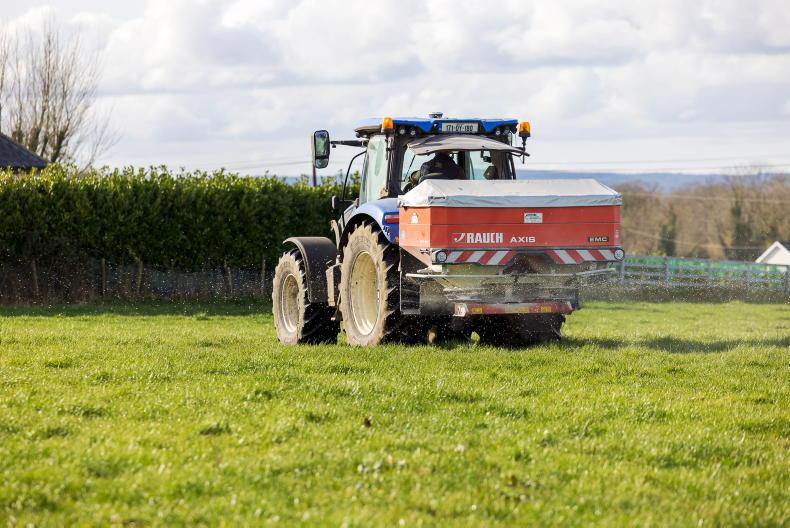
The general plan on most dairy farms is to spread 30% of the farm with slurry in mid-to-late January. \ Odhran Ducie
2. Assess the need
Not all farms need early grass and for many farmers the wet spring is of little consequence as they wouldn’t normally be letting cows out for another month or six weeks anyway. In such cases they should hold off on nitrogen until they are within three weeks of expected turnout. This is of particular relevance to lower stocked farms that have a low demand for grass anyway and don’t need nitrogen in early spring to increase growth.
3. Understand the returns
There is a relatively low agronomic response to early nitrogen but a very strong economic response to early nitrogen. The response to nitrogen is typically in the order of 10kg DM/ha for every 1kg of N applied per hectare. This means that if 20kg N/ha is applied, an additional 200kg DM/ha will be grown over and above if no nitrogen was applied. If this grass is consumed by dairy cows it will leave a big economic return in the form of extra milk solids and reduced costs with less silage and meal being fed.
Compared to the mid-season, the response to nitrogen in spring is low as in the mid-season the typical response is 30kg DM/ha of grass for every 1kg N/ha applied. However, the economic return of more grass in the mid-season is much lower than more grass in spring.
This is because extra grass in the mid-season is generally not displacing other feeds, whereas extra grass in spring is displacing other, higher cost feeds such as silage and meal.
4. Pick the right product
Generally speaking, urea-based fertilisers are the best form of nitrogen for early spring as this type of nitrogen is more stable in the soil, converting to ammonia and binding to soil particles. CAN-based nitrogen is more prone to leaching and so is not advised for early spring.
With the ban on unprotected urea, most farmers will now be spreading protected urea in granular form from this spring. As a general rule, compound fertilisers such as 18:6:12, 10:10:20, etc should not be spread until later in the spring such as late March or April. This is because phosphorus fertiliser is more prone to run-off.
5. Set up the spreader correctly
Correct set up of the fertiliser spreader is really important in order to spread at the correct rate and with an even spread pattern. This is as important when spreading low rates as it is when spreading high rates, but issues are more apparent at the higher rates. The first thing is to ensure that the spreader is set up correctly.
This involves making sure that the top-link is at the correct length meaning that the spreader is level. The other consideration is to ensure that the lift arms are level. If either of these are off, then the machine will be spreading in an uneven pattern.
6. Know the rate
In terms of rates, it’s important to note that most fertiliser spreader settings give the rates in kg/ha for different products. Depending on the machine specification, the manufacturer will have a list of brand names and fertiliser types with specific settings for that product. These settings are based on product testing under field-like conditions.
However, it’s important to note that these suggested settings are only a guide and to get the most accurate settings, farmers should calibrate the machine based on the fertiliser that they are about to spread. The key things are product density and hardness and this will vary from batch to batch. The product rate is generally displayed in kg/ha but this differs from kg N/ha as one represents the amount of product to be applied per hectare while the other refers to the amount of nutrient to be applied per hectare.
Therefore, if the aim is to apply 25kg N/ha, which is the same as 20 units/acre, the farmer needs to work out what that is in kg/ha of actual product and that depends on the percentage of nitrogen in the product.
If it’s 46% urea, that means there is 0.46kg of N in every 1kg of urea fertiliser. Therefore, divide the rate in kg N/ha by 46% to get the rate in kilos of product per hectare. So if 25kgN/ha is to be spread, this means 54kg/ha is the setting to be chosen on the spreader (25 divided by 0.46 is 54).
After a wet winter and a wet start to February, most parts of the country are dealing with wetter than normal soils. There are ponds of water in fields that haven’t held water for years, which indicates that the water table is very high.
This has had knock-on impacts on farmers’ ability to spread slurry, apply fertiliser and to get stock out grazing. The general plan on most dairy farms is to spread 30% of the farm with slurry in mid-to-late January and to spread the remaining 70% with 20 units/acre of protected urea in early February.
The part of the farm that is grazed in February (target 30% of the farm) is then spread with slurry in early March and the whole farm is spread with a second round of urea in March also. Essentially, between slurry and urea, by the end of March the whole farm should have received the equivalent of over 60 units/acre of nitrogen.
The March application of nitrogen will vary from field to field depending on when the paddock got slurry.
Paddocks that were grazed in February and subsequently got slurry in early March will generally get 23 units/acre of chemical nitrogen in March, rather than the 40 units/acre across the rest of the farm that did not get slurry in March.
The above plan is the Teagasc blueprint for managing slurry and nitrogen in early spring on farms with a high demand for grass on lighter and free draining soils.
The problem in 2026 is that even light and free-draining soils are waterlogged meaning very little slurry has been spread, virtually no nitrogen been has applied and very little grazing has been done.
Revised plan
Because of the bad weather, the fertiliser plan will need to be adjusted in 2026 to take account of the lost opportunities to get slurry and nitrogen spread. Given how wet land is, particularly in the east and south, it is probably safe to say that farmers won’t be able to spread fertiliser until late February at the earliest.
What impact will this have on the rates to be applied? Ultimately, I think it means that rates should be adjusted upwards as soon as the opportunity to get nitrogen spread presents itself.
Rather than going with 23 units/acre for the first application, I think this should be increased to 30 units N/acre for the first application.
This increase is to take account of the fact that no nitrogen will have been applied for February, so whatever grass was grown in February will have been done so through nitrogen from soil reserves.
The additional nitrogen will serve to replenish these soil reserves and support plant growth through March.
An additional application towards the end of March is also warranted, but this time at a reduced rate compared to the Plan A scenario outlined above. Rather than going with 40 units/acre, I think going with a second application at 30 units/acre makes more sense.
This is because it will only have been three or four weeks since the last application of nitrogen and the overall amount of nitrogen applied on the farm up to 1 April should not exceed the 60 units/acre target. This is particularly important on farms where nitrogen is a limiting factor.
Guide to spreading fertiliser
1. Weather
Farmers need to be conscious of the current and future weather conditions when contemplating whether or not to spread fertiliser. The key things to watch are rainfall and soil temperatures but arguably, rainfall in the days after application is more important than soil temperature. The guidelines are that there should be no heavy rain forecast within five days of spreading nitrogen. For me, some rain is not a problem but if there is anything more than 5mm of rain forecast within a few days of application, then I would hold off.
Nitrogen products containing urea are stable in the soil and are less likely to leach. This is why urea-based fertilisers are the products of choice in spring.
The other thing to consider is ground conditions. If the tractor is leaving a mark on the paddock then it’s too wet to spread.
The general plan on most dairy farms is to spread 30% of the farm with slurry in mid-to-late January. \ Odhran Ducie
2. Assess the need
Not all farms need early grass and for many farmers the wet spring is of little consequence as they wouldn’t normally be letting cows out for another month or six weeks anyway. In such cases they should hold off on nitrogen until they are within three weeks of expected turnout. This is of particular relevance to lower stocked farms that have a low demand for grass anyway and don’t need nitrogen in early spring to increase growth.
3. Understand the returns
There is a relatively low agronomic response to early nitrogen but a very strong economic response to early nitrogen. The response to nitrogen is typically in the order of 10kg DM/ha for every 1kg of N applied per hectare. This means that if 20kg N/ha is applied, an additional 200kg DM/ha will be grown over and above if no nitrogen was applied. If this grass is consumed by dairy cows it will leave a big economic return in the form of extra milk solids and reduced costs with less silage and meal being fed.
Compared to the mid-season, the response to nitrogen in spring is low as in the mid-season the typical response is 30kg DM/ha of grass for every 1kg N/ha applied. However, the economic return of more grass in the mid-season is much lower than more grass in spring.
This is because extra grass in the mid-season is generally not displacing other feeds, whereas extra grass in spring is displacing other, higher cost feeds such as silage and meal.
4. Pick the right product
Generally speaking, urea-based fertilisers are the best form of nitrogen for early spring as this type of nitrogen is more stable in the soil, converting to ammonia and binding to soil particles. CAN-based nitrogen is more prone to leaching and so is not advised for early spring.
With the ban on unprotected urea, most farmers will now be spreading protected urea in granular form from this spring. As a general rule, compound fertilisers such as 18:6:12, 10:10:20, etc should not be spread until later in the spring such as late March or April. This is because phosphorus fertiliser is more prone to run-off.
5. Set up the spreader correctly
Correct set up of the fertiliser spreader is really important in order to spread at the correct rate and with an even spread pattern. This is as important when spreading low rates as it is when spreading high rates, but issues are more apparent at the higher rates. The first thing is to ensure that the spreader is set up correctly.
This involves making sure that the top-link is at the correct length meaning that the spreader is level. The other consideration is to ensure that the lift arms are level. If either of these are off, then the machine will be spreading in an uneven pattern.
6. Know the rate
In terms of rates, it’s important to note that most fertiliser spreader settings give the rates in kg/ha for different products. Depending on the machine specification, the manufacturer will have a list of brand names and fertiliser types with specific settings for that product. These settings are based on product testing under field-like conditions.
However, it’s important to note that these suggested settings are only a guide and to get the most accurate settings, farmers should calibrate the machine based on the fertiliser that they are about to spread. The key things are product density and hardness and this will vary from batch to batch. The product rate is generally displayed in kg/ha but this differs from kg N/ha as one represents the amount of product to be applied per hectare while the other refers to the amount of nutrient to be applied per hectare.
Therefore, if the aim is to apply 25kg N/ha, which is the same as 20 units/acre, the farmer needs to work out what that is in kg/ha of actual product and that depends on the percentage of nitrogen in the product.
If it’s 46% urea, that means there is 0.46kg of N in every 1kg of urea fertiliser. Therefore, divide the rate in kg N/ha by 46% to get the rate in kilos of product per hectare. So if 25kgN/ha is to be spread, this means 54kg/ha is the setting to be chosen on the spreader (25 divided by 0.46 is 54).







SHARING OPTIONS