Last week, Joskin invited the Irish Farmers Journal over to visit its headquarters in the town of Soumagne in Belgium along with a flying visit to see its largest production plant in Trzcianka, in northwest Poland.
Still wholly owned by the Joskin family, the business was founded by Victor Joskin who started out as an agricultural contractor, before building his first machine in 1983. Fast forward 43 years and Joskin has built over 135,000 machines, operate out of six factories, and employ over 875 staff. Meanwhile, there are 600 Joskin dealers present in over 60 countries.
Background
In 1968, Victor Joskin carried out work for local farmers, tasks such as spreading slurry and muck, along with planting and harvesting maize. In 1972, Victor moved the business into servicing and repairing machinery, and one year later he started to import machinery into Belgium, something the business still does today.
Having felt that the machines on the market at the time for spreading slurry could be improved upon, Victor looked into building his own slurry equipment. By 1984, Joskin had built his first slurry tanker, a 777 gallon (3,500l). In 1984, he also built a grass aerator, which remains an important product for Joskin today.
The company
Joskin specialises in farm transport vehicles – notably slurry, muck, livestock, silage and grain, etc, which is then complemented by grassland equipment, such as tine harrows and aerators. In terms of volume, slurry tankers account for 45% of production, while trailers and muck spreaders account for 45%. The remaining 10% is made up of smaller products, such as its grass harrows. Last year, the company’s turnover was 147m. Unlike, most tractor manufacturers, Joskin forecast turnover fro the current year to be up, based on a strong 2026 order book. Joskin build in the region of 2,200 tankers and 1,600 trailers annually. The company galvanises 70-80% of what it produces, the majority of which is done in-house at its state of the art facility in Poland. In total, Joskin has six manufacturing facilities.
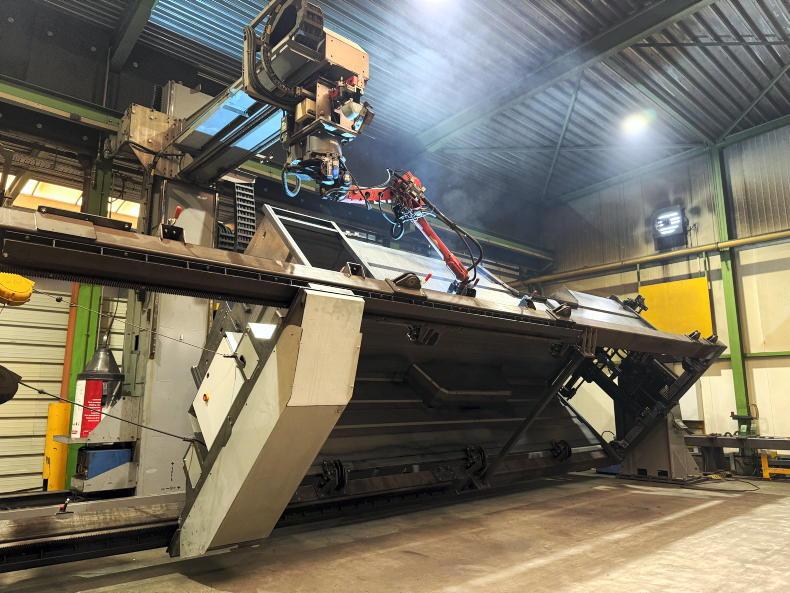
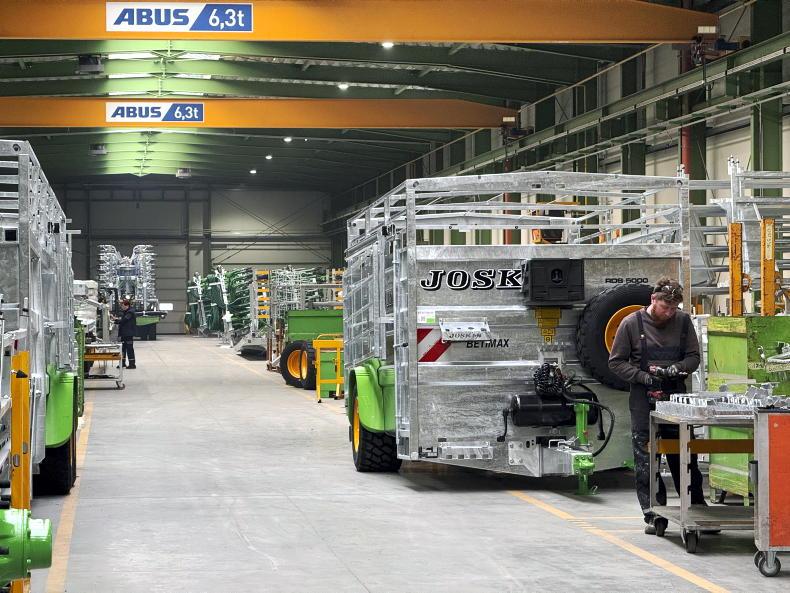
All large components are robotically welded.
Slurry tankers are built at both the 17.5ha Belgian HQ in Soumagne and in Trzcianka, Poland. The Polish factory was opened in 1999 and is now the firms largest at 30ha, despite awaiting planning permission for further expansion. It was expanded in 2010 with an 8,000m/sq galvanising plant.
Poland was seen as an attractive location for two reasons, firstly was the availability of labour and secondly, its location meant better access to the Eastern European market. Its primary, products are tankers and Silo Space ejector silage trailers. Next to the Joskin HQ in Soumagne, is the 1.36ha Spaw Tech plant where sub assemblies are built and tack welding is done ahead of final construction.
Tipping trailers are built at the Bourges site in France which was opened in 2002 and today spans 5.9ha. In 2012, a 12.3ha site in northern France was added, when it acquired the LeBoulch trailer brand.
Although sites are spread out, the level of integration between each of the facilities is significant, each linked up by a fleet of over 30 trucks. For example, the majority of steel is shipped into Belgium, where it is then cut and formed in Soumagne, before making a 900km journey to Poland for galvanising. Here it is either used for tanker fabrication or transported elsewhere, depending on what it is.
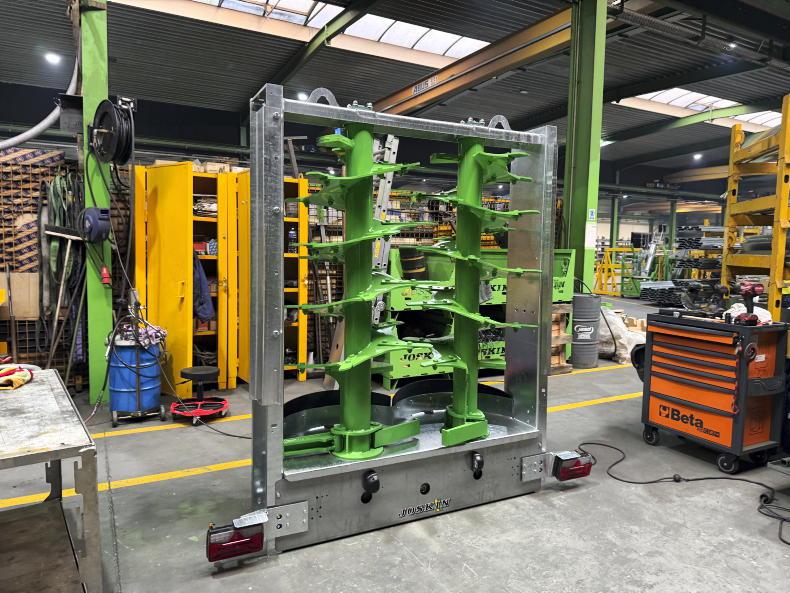
Over 85% of components are built in house.
New factory
Joskin is in the completion stages of building its 15,800m2 factory in Luxembourg which is set to build dung spreaders and larger trailers. The 6.2ha Luxembourg site was chosen based on its location in addition to a skilled local workforce. It has been designed to facilitate the assembly of large monocoque tipping trailers and a range of Joskin muck spreaders.
Although, not so common on Irish and UK markets, the Leboulch brand (acquired in 2012) is Based at La Vieille-Lyre in France’s Normandy region. In recent years, Joskin has invested in a new building to include new welding workshops, an automatic shot-blasting machine for large parts, and a painting area, increasing the sites production capacity by 40% and bringing it to a total of 21,000m².
Joskin’s aim is to further grow the brands presence in European export markets. Alongside its own branded kit, the site manufactures painted Joskin bale trailers and the Cargo-Lift hook-lift range.
Factory visit
We visited two of the Joskin factories, including its headquarters at Soumagne, Belgium along with its largest production facility, situated in Poland. An interesting point that the company noted, is its ability to shift production of certain ranges to different factories depending on demand and availability.
Once an order is placed, an ID number and spec list is created and assigned to the specific chassis. Every component associated with that particular machine will also bear that same ID number for full traceability and accountability.
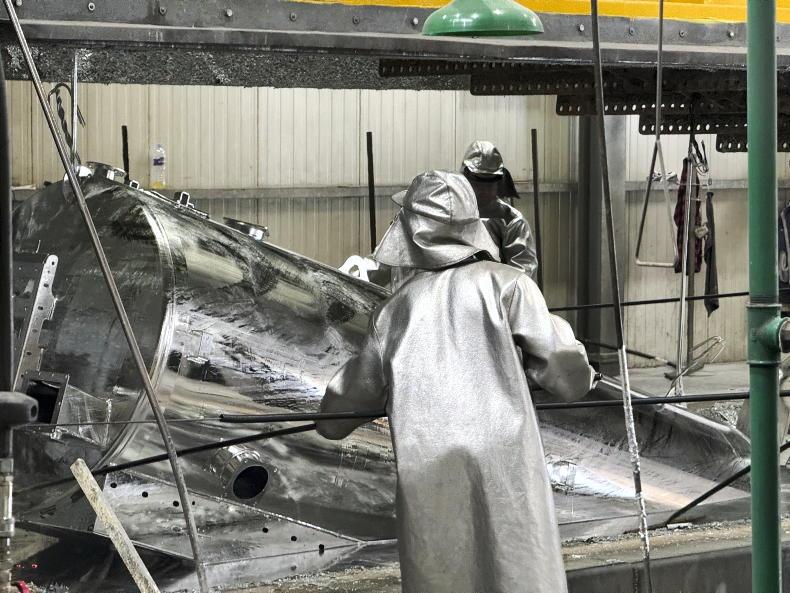
The galvanising facility at the Poland factory was built in 2010 at a cost of €60 million.
The Joskin group use a centralised computer system across all its production sites, which allows precise management of the whole production process in real time.
Standardisation, is a buzz word used by Joskin quite a bit. Building slurry tankers which are now highly customisable machines, Joskin has standardised many design aspects across its product ranges and model to streamline production and to remain efficient and competitive.
Speaking of competitiveness, not every range is fully customisable. For example, Joskin explained that to stay competitive on pricing, especially against Irish and UK manufacturers, and to create efficiencies of scale within the factory, it offers its Advantage series. This range works off a standard specification it feels is broadly required by the market. Outside the Advantage series, lead times can vary up to 16 weeks, whereas Advantage series machines may be in stock. That said, customisation is there for those who want it. For example, Joskin offers more than 900 options across its slurry tanker range alone, with a staggering 120 different tyre options and about €2m worth of tyres in stock at any one time.
Walking around the factories, the investment into modern production techniques is evident. This includes equipment such as fibre-optic laser cutters, robotic lathes/welders, computer aided CNC machines, automatic storage systems etc. Robotics and automation has played a pivotal role in production for the past 10 years and a role that continues to grow for consistency and speed. In recent years, the firm has added a 1,000-tonne press and more recently, two fully automated positive and negative folding presses to its Soumagne plant, claimed to be unique in the world.
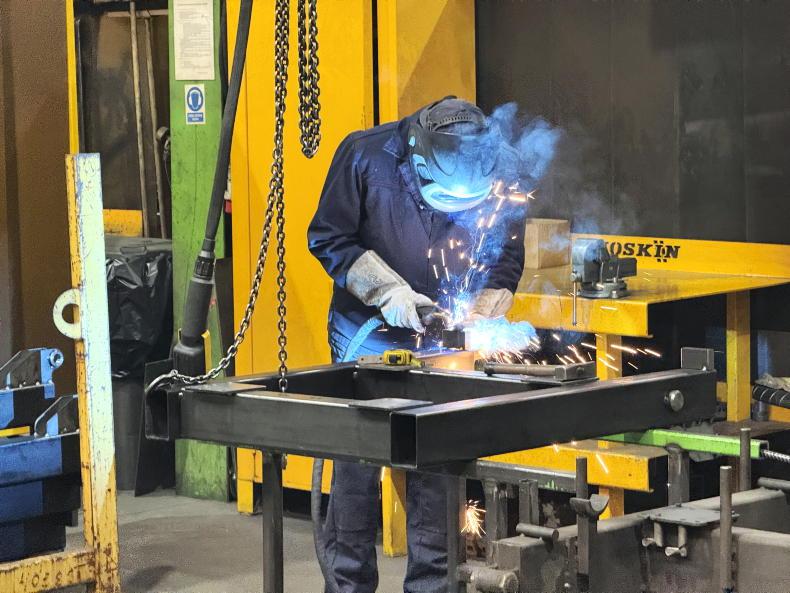
Components are manually tack welded before being robotically welded.
With the exception of Hardox, Joskin use the one grade of steel, HLE420 for almost all production. The majority of which arrives in sheet form before being laser cut and formed. Components are manually tack welded, held in place with jigs that the company has built itself.
Tanker barrels are fabricated at the Spawtech facility. Depending on the tanker, 4-6mm sheet steel is rolled, reinforced and tack welded. Baffles are positioned every two metres, with a six-metre-long tank using two baffles. It takes three hours to tack weld a standard tanker, with internal and external seam welding done robotically. Then all auxiliaries such as fill points etc are cut out of the barrel and fabricated. The company said that what once took 24 hours of manual welding can be completed in just seven hours using one robot. Joskin uses around 20,000t of steel annually, sourced worldwide from countries such as India and the UAE.
Components
In addition to its own software, machines and jigs, Joskin manufactures 85% of components it uses, in-house. It even builds its own hydraulic rams, with the exception of trailer tipping rams. Joskin says that in order to keep control over quality and stock levels, it invests in production each year. Part of this investment in recent years involved the purchase a 3D scanner and printer which it claims gives huge flexibility, allowing outsourced components to be scanned onto design software down to one micron accuracy as well as printing prototype parts for production.
Joskin’s main plant has 8,000 solar panels, feeding three large storage batteries. When there isn’t a demand for power from the plant, such as in the evenings, the power is sold back to the grid.
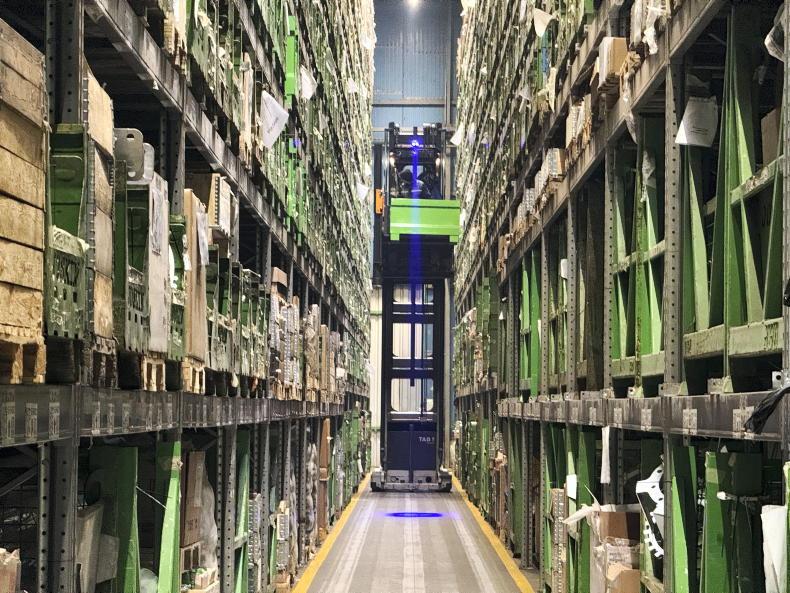
Joskin has enough parts storage for one years worth of production
Galvanising
Joskin products are known worldwide for their galvanised finish. All large tankers made in Belgium, are galvanised in Belgium. Meanwhile, all tankers, muck spreaders and trailers built in Poland, as well as all parts and componentry are galvanised at its Polish plant. Prior to building its own galvanising bath, all galvanising was outsourced. Despite the multi million Euro investment, Joskin seen a saving long term, and straight away cut out over 900,000km/s of transport too and from the previous galvanisers.
The in-house galvanising bath never cools, purely due to the time and energy required for it to reheat to 450°C. The facility is capable of almost double the capacity needed by Joskin, therefore it galvanises for other companies too.
Firstly, the steel is cleaned as part of a 13 stage treatment. This includes washing, degreasing, rinsing, pickling and fluxing. It is then dried and annealed to reduce thermal shock and severe temperature drops when dipped in the zinc bath.
Parts are then slowly submerged in the molten zinc at an angle, time depends on material type, size and thickness. The
zinc protects the steel by penetrating it, resulting in a 70 micron protective coating. Zinc alloys ingots are frequently added to ensure a glossy, quality finish. By-products such as hard zinc, zinc ash and other impurities are removed frequently.
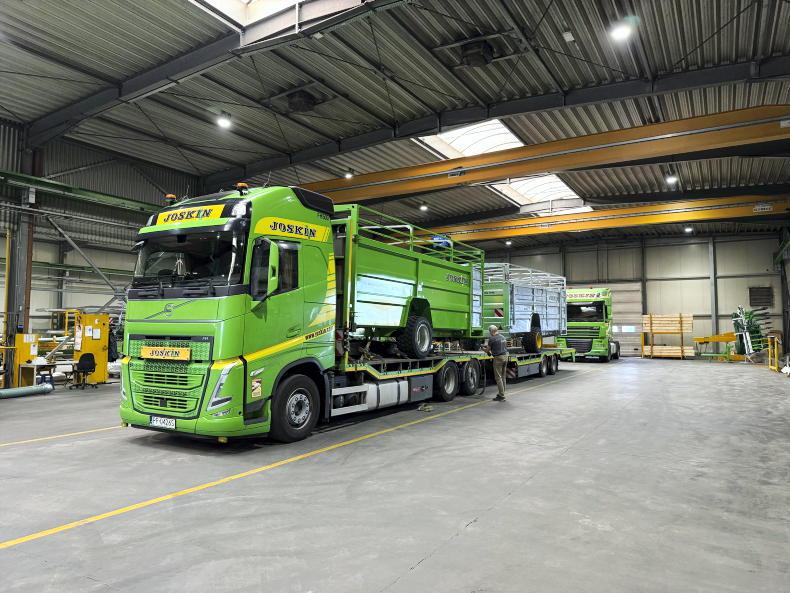
Joskin has over 30 trucks on the road hauling machines and components between each of its factories.
The bath itself weighs 50t empty (new)and has a capacity of 700t. It has a 10 year lifespan before needing replaced at a cost of €400,000 as the molten zinc and burners penetrate the 50mm thick steel bath, reducing its strength thickness over time. Parts are then cooled, deburred and stored indoors until neutralised.
With the exception of tanker barrels, painted components are shot-blasted and electrically charged. It says this is for better adhesion when spraying with an initial layer of epoxy primer and final layer coat. Painted tankers are originally galvanised, then sanded in Poland and then painted.
Components such as axles and pumps are fitted to the galvanised body and final assembly takes place. Tankers are then tested in an outdoor facility using harvested rain water.
Slurry
Slurry is Joskin’s bread and butter product. Its most popular size tankers are tandem axle, 4,000-to-4,400-gallon units. The firm patented its first macerator design in 1990 and today offers six variations of slurry pumps. Vacuum pumps account for 60%, lobe pumps 10%, spiral pumps 10% and its hybrid Vacu-Storm pump accounts for the remaining 10%. The Vacu-Storm pump is a hybrid system developed by Joskin seven years ago. It combines the advantages of a vacuum pump on the suction side and a Storm centrifugal pump on the discharge side.
Joskin says vacuum pumps are limited to a working width of 12m. The 13,000l Jurop pump is integrated in the drawbar and is used for suction. The Storm centrifugal pump (10,000l/min) is designed to feed the rear implement and allows spreading over larger widths and with a high and constant flow rate. Today, between 70 to 80% of the tankers sold are Advantage models.
While the perception amongst many is that Joskin machines carry a premium price, management emphasised that it is, in fact, more competitively priced than many think. For example, a 2,500-gallon Advantage series tanker with a 7.5m trailing shoe, with a complete integrated electro-hydraulic independent control box is priced in the region of €42,000 plus VAT.
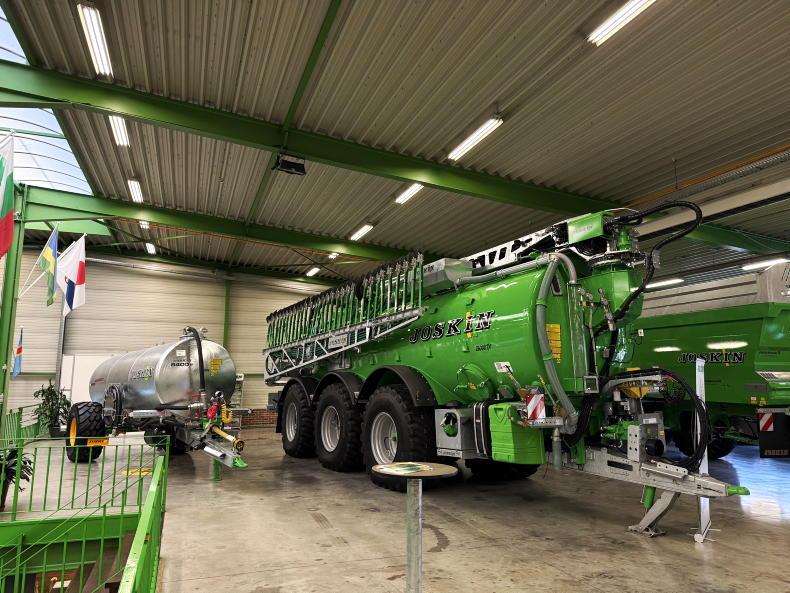
Joskin make a massive range of slurry tankers of all sizes.
Spare parts
Warehousing of production parts and spares is impressive. For example, the Polish facility has eight 12m high automated storage carousels to prepare trolleys with all parts needed to assemble each specific machine. The computer aided management system knows the exact location of every component via bar code. A similar approach is used in Soumagne for production inventory, with automated storage for bulkier lengths of raw steel up to 6m long. There are 396 shelves capable of holding up to 2,400t. The spare parts centre at Soumagne is equally impressive too, broken down into small, medium and large part divisions. At any given, Joskin has enough spares on site to equal a year’s worth of production.
A family business
Joskin feels that the fact it remained a totally owned family business, rather than answering to a board of shareholders, allows it to react to the customer quicker and make investment decisions based on what’s best for the company long term.
Victor Joskin, who is now in his 70s, continues to be present day-to-day, but is more involved in the future of the business, overseeing investments.
His three children, Didier, Vinciane and Murielle, hold key positions within the business.
Retail business
The Joskin family’s retail machinery retail business is still in operation today. They are a Fendt and Massey Ferguson dealer, a JCB sub-dealer. The family also import and distribute eight brands across Belgium. This includes Strautmann, Rauch, Quicke, Monosem, Hardi, Bednar, Evrard and Breviagri.
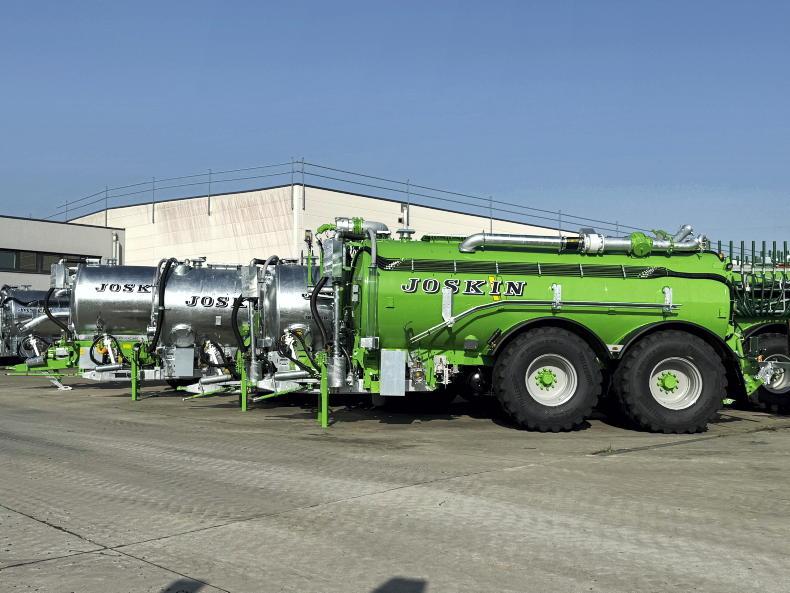
There are over 900 machines awaiting delivery at any one time.
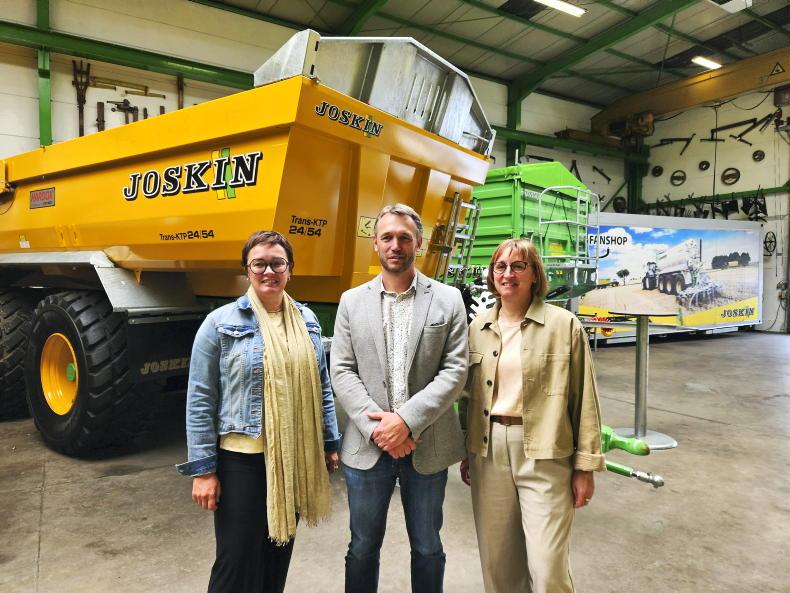
Vinciane, Didier and Murille Joskin.
Last week, Joskin invited the Irish Farmers Journal over to visit its headquarters in the town of Soumagne in Belgium along with a flying visit to see its largest production plant in Trzcianka, in northwest Poland.
Still wholly owned by the Joskin family, the business was founded by Victor Joskin who started out as an agricultural contractor, before building his first machine in 1983. Fast forward 43 years and Joskin has built over 135,000 machines, operate out of six factories, and employ over 875 staff. Meanwhile, there are 600 Joskin dealers present in over 60 countries.
Background
In 1968, Victor Joskin carried out work for local farmers, tasks such as spreading slurry and muck, along with planting and harvesting maize. In 1972, Victor moved the business into servicing and repairing machinery, and one year later he started to import machinery into Belgium, something the business still does today.
Having felt that the machines on the market at the time for spreading slurry could be improved upon, Victor looked into building his own slurry equipment. By 1984, Joskin had built his first slurry tanker, a 777 gallon (3,500l). In 1984, he also built a grass aerator, which remains an important product for Joskin today.
The company
Joskin specialises in farm transport vehicles – notably slurry, muck, livestock, silage and grain, etc, which is then complemented by grassland equipment, such as tine harrows and aerators. In terms of volume, slurry tankers account for 45% of production, while trailers and muck spreaders account for 45%. The remaining 10% is made up of smaller products, such as its grass harrows. Last year, the company’s turnover was 147m. Unlike, most tractor manufacturers, Joskin forecast turnover fro the current year to be up, based on a strong 2026 order book. Joskin build in the region of 2,200 tankers and 1,600 trailers annually. The company galvanises 70-80% of what it produces, the majority of which is done in-house at its state of the art facility in Poland. In total, Joskin has six manufacturing facilities.
All large components are robotically welded.
Slurry tankers are built at both the 17.5ha Belgian HQ in Soumagne and in Trzcianka, Poland. The Polish factory was opened in 1999 and is now the firms largest at 30ha, despite awaiting planning permission for further expansion. It was expanded in 2010 with an 8,000m/sq galvanising plant.
Poland was seen as an attractive location for two reasons, firstly was the availability of labour and secondly, its location meant better access to the Eastern European market. Its primary, products are tankers and Silo Space ejector silage trailers. Next to the Joskin HQ in Soumagne, is the 1.36ha Spaw Tech plant where sub assemblies are built and tack welding is done ahead of final construction.
Tipping trailers are built at the Bourges site in France which was opened in 2002 and today spans 5.9ha. In 2012, a 12.3ha site in northern France was added, when it acquired the LeBoulch trailer brand.
Although sites are spread out, the level of integration between each of the facilities is significant, each linked up by a fleet of over 30 trucks. For example, the majority of steel is shipped into Belgium, where it is then cut and formed in Soumagne, before making a 900km journey to Poland for galvanising. Here it is either used for tanker fabrication or transported elsewhere, depending on what it is.
Over 85% of components are built in house.
New factory
Joskin is in the completion stages of building its 15,800m2 factory in Luxembourg which is set to build dung spreaders and larger trailers. The 6.2ha Luxembourg site was chosen based on its location in addition to a skilled local workforce. It has been designed to facilitate the assembly of large monocoque tipping trailers and a range of Joskin muck spreaders.
Although, not so common on Irish and UK markets, the Leboulch brand (acquired in 2012) is Based at La Vieille-Lyre in France’s Normandy region. In recent years, Joskin has invested in a new building to include new welding workshops, an automatic shot-blasting machine for large parts, and a painting area, increasing the sites production capacity by 40% and bringing it to a total of 21,000m².
Joskin’s aim is to further grow the brands presence in European export markets. Alongside its own branded kit, the site manufactures painted Joskin bale trailers and the Cargo-Lift hook-lift range.
Factory visit
We visited two of the Joskin factories, including its headquarters at Soumagne, Belgium along with its largest production facility, situated in Poland. An interesting point that the company noted, is its ability to shift production of certain ranges to different factories depending on demand and availability.
Once an order is placed, an ID number and spec list is created and assigned to the specific chassis. Every component associated with that particular machine will also bear that same ID number for full traceability and accountability.
The galvanising facility at the Poland factory was built in 2010 at a cost of €60 million.
The Joskin group use a centralised computer system across all its production sites, which allows precise management of the whole production process in real time.
Standardisation, is a buzz word used by Joskin quite a bit. Building slurry tankers which are now highly customisable machines, Joskin has standardised many design aspects across its product ranges and model to streamline production and to remain efficient and competitive.
Speaking of competitiveness, not every range is fully customisable. For example, Joskin explained that to stay competitive on pricing, especially against Irish and UK manufacturers, and to create efficiencies of scale within the factory, it offers its Advantage series. This range works off a standard specification it feels is broadly required by the market. Outside the Advantage series, lead times can vary up to 16 weeks, whereas Advantage series machines may be in stock. That said, customisation is there for those who want it. For example, Joskin offers more than 900 options across its slurry tanker range alone, with a staggering 120 different tyre options and about €2m worth of tyres in stock at any one time.
Walking around the factories, the investment into modern production techniques is evident. This includes equipment such as fibre-optic laser cutters, robotic lathes/welders, computer aided CNC machines, automatic storage systems etc. Robotics and automation has played a pivotal role in production for the past 10 years and a role that continues to grow for consistency and speed. In recent years, the firm has added a 1,000-tonne press and more recently, two fully automated positive and negative folding presses to its Soumagne plant, claimed to be unique in the world.
Components are manually tack welded before being robotically welded.
With the exception of Hardox, Joskin use the one grade of steel, HLE420 for almost all production. The majority of which arrives in sheet form before being laser cut and formed. Components are manually tack welded, held in place with jigs that the company has built itself.
Tanker barrels are fabricated at the Spawtech facility. Depending on the tanker, 4-6mm sheet steel is rolled, reinforced and tack welded. Baffles are positioned every two metres, with a six-metre-long tank using two baffles. It takes three hours to tack weld a standard tanker, with internal and external seam welding done robotically. Then all auxiliaries such as fill points etc are cut out of the barrel and fabricated. The company said that what once took 24 hours of manual welding can be completed in just seven hours using one robot. Joskin uses around 20,000t of steel annually, sourced worldwide from countries such as India and the UAE.
Components
In addition to its own software, machines and jigs, Joskin manufactures 85% of components it uses, in-house. It even builds its own hydraulic rams, with the exception of trailer tipping rams. Joskin says that in order to keep control over quality and stock levels, it invests in production each year. Part of this investment in recent years involved the purchase a 3D scanner and printer which it claims gives huge flexibility, allowing outsourced components to be scanned onto design software down to one micron accuracy as well as printing prototype parts for production.
Joskin’s main plant has 8,000 solar panels, feeding three large storage batteries. When there isn’t a demand for power from the plant, such as in the evenings, the power is sold back to the grid.
Joskin has enough parts storage for one years worth of production
Galvanising
Joskin products are known worldwide for their galvanised finish. All large tankers made in Belgium, are galvanised in Belgium. Meanwhile, all tankers, muck spreaders and trailers built in Poland, as well as all parts and componentry are galvanised at its Polish plant. Prior to building its own galvanising bath, all galvanising was outsourced. Despite the multi million Euro investment, Joskin seen a saving long term, and straight away cut out over 900,000km/s of transport too and from the previous galvanisers.
The in-house galvanising bath never cools, purely due to the time and energy required for it to reheat to 450°C. The facility is capable of almost double the capacity needed by Joskin, therefore it galvanises for other companies too.
Firstly, the steel is cleaned as part of a 13 stage treatment. This includes washing, degreasing, rinsing, pickling and fluxing. It is then dried and annealed to reduce thermal shock and severe temperature drops when dipped in the zinc bath.
Parts are then slowly submerged in the molten zinc at an angle, time depends on material type, size and thickness. The
zinc protects the steel by penetrating it, resulting in a 70 micron protective coating. Zinc alloys ingots are frequently added to ensure a glossy, quality finish. By-products such as hard zinc, zinc ash and other impurities are removed frequently.
Joskin has over 30 trucks on the road hauling machines and components between each of its factories.
The bath itself weighs 50t empty (new)and has a capacity of 700t. It has a 10 year lifespan before needing replaced at a cost of €400,000 as the molten zinc and burners penetrate the 50mm thick steel bath, reducing its strength thickness over time. Parts are then cooled, deburred and stored indoors until neutralised.
With the exception of tanker barrels, painted components are shot-blasted and electrically charged. It says this is for better adhesion when spraying with an initial layer of epoxy primer and final layer coat. Painted tankers are originally galvanised, then sanded in Poland and then painted.
Components such as axles and pumps are fitted to the galvanised body and final assembly takes place. Tankers are then tested in an outdoor facility using harvested rain water.
Slurry
Slurry is Joskin’s bread and butter product. Its most popular size tankers are tandem axle, 4,000-to-4,400-gallon units. The firm patented its first macerator design in 1990 and today offers six variations of slurry pumps. Vacuum pumps account for 60%, lobe pumps 10%, spiral pumps 10% and its hybrid Vacu-Storm pump accounts for the remaining 10%. The Vacu-Storm pump is a hybrid system developed by Joskin seven years ago. It combines the advantages of a vacuum pump on the suction side and a Storm centrifugal pump on the discharge side.
Joskin says vacuum pumps are limited to a working width of 12m. The 13,000l Jurop pump is integrated in the drawbar and is used for suction. The Storm centrifugal pump (10,000l/min) is designed to feed the rear implement and allows spreading over larger widths and with a high and constant flow rate. Today, between 70 to 80% of the tankers sold are Advantage models.
While the perception amongst many is that Joskin machines carry a premium price, management emphasised that it is, in fact, more competitively priced than many think. For example, a 2,500-gallon Advantage series tanker with a 7.5m trailing shoe, with a complete integrated electro-hydraulic independent control box is priced in the region of €42,000 plus VAT.
Joskin make a massive range of slurry tankers of all sizes.
Spare parts
Warehousing of production parts and spares is impressive. For example, the Polish facility has eight 12m high automated storage carousels to prepare trolleys with all parts needed to assemble each specific machine. The computer aided management system knows the exact location of every component via bar code. A similar approach is used in Soumagne for production inventory, with automated storage for bulkier lengths of raw steel up to 6m long. There are 396 shelves capable of holding up to 2,400t. The spare parts centre at Soumagne is equally impressive too, broken down into small, medium and large part divisions. At any given, Joskin has enough spares on site to equal a year’s worth of production.
A family business
Joskin feels that the fact it remained a totally owned family business, rather than answering to a board of shareholders, allows it to react to the customer quicker and make investment decisions based on what’s best for the company long term.
Victor Joskin, who is now in his 70s, continues to be present day-to-day, but is more involved in the future of the business, overseeing investments.
His three children, Didier, Vinciane and Murielle, hold key positions within the business.
Retail business
The Joskin family’s retail machinery retail business is still in operation today. They are a Fendt and Massey Ferguson dealer, a JCB sub-dealer. The family also import and distribute eight brands across Belgium. This includes Strautmann, Rauch, Quicke, Monosem, Hardi, Bednar, Evrard and Breviagri.
There are over 900 machines awaiting delivery at any one time.
Vinciane, Didier and Murille Joskin.






SHARING OPTIONS