



The failure of politicians at Stormont to agree on financial allocations to government departments has the potential to delay a new farm grant scheme and ultimately, direct payments to farmers, Agriculture Minister Andrew Muir has warned.
Appearing in front of the Stormont Agriculture committee last Thursday, Minister Muir said that DAERA is facing “significant pressures” on current budgets and is still waiting on definite allocation from the NI Executive for the next financial year.
That uncertainty has led to a delay in the roll-out of a new Sustainable Farming Investment Scheme (SFIS), which is to offer support for new technology and equipment, similar to previous Tier 1 grants. With a potential budget of up to £40m paid out across a number of tranches, it was originally expected that the scheme would open before the end of 2025, although the latest indication was that it should open this spring.
“I need to get a bit more certainty in relation to the budget situation. I have engaged with the finance minister [John O’Dowd] around this and there isn’t a full budget cover,” Minister Muir told MLAs.
He added that he will need support from across political parties to find the funding as the scheme is “absolutely critical” in helping farmers deal with issues such as ammonia emissions and excess nutrients getting into water.
Payments
Looking ahead to the new financial year, proposed allocations to government departments were published by Minister O’Dowd in January and included an earmarked annual allocation of £332.5m to cover farm payments.
However, according to Minister Muir, a confirmed budget will need to be known by early July if farm payments are to be issued this September. “If budget agreement is not reached until later in the year, payments will be delayed,” he said.
The uncertainty around finances also has the potential to slow major DAERA infrastructure projects, including new facilities at CAFRE campuses at Greenmount and Loughry.
Government-run farms at both CAFRE Greenmount and AFBI Hillsborough need to be a “role model” for the rest of the farming industry to follow, the DAERA permanent secretary, Katrina Godfrey, has said.
Responding to questions from MLAs last Thursday around recent allegations of poor practice at AFBI Hillsborough, the top civil servant in DAERA said it was reasonable to expect higher standards to be in place.
“I still take the view that if your farm is run in a public sector organisation, you don’t just meet minimum. You don’t fall over the line. You ought to be better than that,” she said.
The allegations concerning AFBI centre around evidence provided to GB News by a whistleblower relating to animal welfare and management of slurry on the farm.
At last Thursday’s committee meeting, Minister Muir confirmed that on receipt of the allegations, inspections at Hillsborough were undertaken by both DAERA Veterinary Service and the NI Environment Agency (NIEA) on 28 October 2025.
Inspection
The inspection by Veterinary Service “found no issues of concern”, while the NIEA confirmed that allegations of slurry being spread outside of the closed season were “unfounded”, said the minister.
However, NIEA did identify sewage fungus in a waterway below the farm which was assessed as a low severity incident. “Remedial action was requested and carried out. NIEA determined that formal enforcement action was not required,” Minister Muir added.
AFBI also invited NI Food Chain Certification to the site to undertake a farm assurance inspection. This was completed on 6 November and the farm’s accreditation was maintained.
Minister Muir told MLAs that the majority of photos provided by the whistleblower appear to be from 2023 and 2024, and since then, line management structures at the farm have changed. The images have been reviewed by DAERA, with no additional action deemed necessary.
He also said that a subgroup of the AFBI Board has been convened to review standards at the Hillsborough farm and it is expected they will deliver a report by April 2026.
There seems to be little prospect of the department rolling forward a Young Farmers’ Payment into 2026.
The scheme, which existed since 2015, provided a top-up to payment entitlements while also potentially allowing successful applicants to establish new entitlements at the NI average. However, analysis by DAERA suggests the scheme did not impact the average age of farmers in NI.
“Our previous interventions didn’t change the dial in regards to this. We have to make sure if we are going to make new interventions, it’s actually going to be effective in regards to that,” said Minister Muir.
A Farming for the Generations pilot scheme, run by Rural Support, is concluding at the end of this month, ahead of a new scheme being launched this November.
This programme is mainly focused on providing advice and guidance to farm families around succession within their businesses.
At last Thursday’s meeting, Minister Muir told MLAs he has been engaging with officials around this new scheme and how the department might include potential financial incentives for those taking part.
He also pointed out that in the EU some radical proposals have come forward around the issue of generational renewal, including stopping farm payments to those aged over 65.
“We are not proposing to go that way,” he said.
Answering a question from West Tyrone MLA Daniel McCrossan, Minister Muir suggested that the department could offer incentives to build the likes of covered slurry stores under a new Sustainable Farming Investment Scheme (SFIS).
He indicated that one of the issues coming from a new Task and Finish group set up to chart a way forward around a future Nutrients Action Programme (NAP) was how to better manage nutrients against a backdrop of extreme weather events driven by climate change.
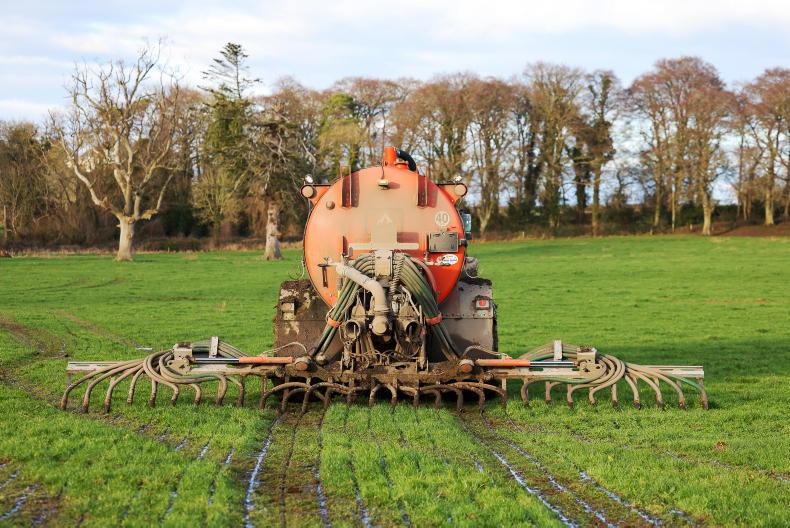
Additional slurry storage would provide more flexibility for farmers and where these stores are covered, it has the added benefit of reducing ammonia emissions from manures.
On the wider issue of ammonia, the Minister said a solution needs to be found which allows farmers to get planning for replacement farm buildings which do not add to ammonia pollution or actually lead to a reduction in emissions from livestock.
He was also pressed by MLAs on the slow responses coming from the NI Environment Agency (NIEA) in its role to provide advice to planners around ammonia emissions. “We need to find a way of turning around these applications quicker. We need to improve,” he said.
In June 2025 DAERA published a consultation on its first Climate Action Plan for the period from 2023 to 2027.
That plan tasked all government departments with delivering an average 33% reduction in greenhouse gas emissions when compared to 1990, as part of the first step in achieving net zero emissions by 2050. For agriculture, its contribution to lower emissions was to be achieved by implementing various policies, including the Beef Carbon Reduction scheme.
At last week’s Stormont Agriculture committee, Minister Muir told MLAs a summary of responses to the consultation will be published shortly and he hoped the formal plan would be in place before MLAs go on their summer break.
He also confirmed that work has begun on the second Climate Action Plan covering the period 2028 to 2032, which comes with a target to cut emissions by an average of 48% when compared to the 1990 baseline.
That plan will have to be “considerably more ambitious”, acknowledged Minister Muir, with a Just Transition Fund for Agriculture from the Stormont Executive “really crucial” if farmers are to make the changes necessary to comply with climate law.
Officials in DAERA have been working on a crisis framework which will set out the approach taken by government in response to major shocks that are impacting agriculture.
MLAs are to be briefed on proposals in April, confirmed Minister Muir last Thursday.
A new independent Environmental Protection Agency (EPA) which would take on much of the enforcement work currently done by the NI Environment Agency (NIEA), is not being taken forward by Minister Muir.
“Unfortunately, I’ve not received support from the [Stormont] executive for this important reform which would bring long-term benefits for everyone,” he said.
“This is disappointing and a lost opportunity to transform environmental governance here.”
A task and finish group set up in the wake of a disastrous May-2025 consultation on proposed changes to the Nutrients Action Programme (NAP), “will hopefully come back this spring” with recommendations on a way forward, confirmed Minister Muir last Thursday.
Those recommendations will then be subject to a further public consultation ahead of final agreement being sought from the Stormont Executive.
The group comprises farmers, processors, environmentalists and government.



SHARING OPTIONS