German dairy farmer Christoph Luepschen doesn’t wait for change – he gets out ahead of it.
His innovative mindset was evident early on, when he invested in his first milking robot in 2001 – a decision that made his family’s holding in the hilly Bergisches Land region of North Rhine-Westphalia the second robot-equipped farm in the country at the time.
Then, in 2009, amid a volatile milk price market, the husband to Birgit and father to Christian (30), Johanna (28), and Stefanie (26), boldly invested in a €4m biogas plant that uses food waste, manure, slurry, and residues from food production to put their farm on a more secure financial footing.
His ambition didn’t stop there. In 2011, the Luepschen family became one of the first in Europe – and the first in Germany – to enter the genomic breeding market when they founded Colonia Cows (prefix: COL), further expanding the added value of their dairy farm.
Today, 240 Holstein dairy cows are milked with four robots at the seventh-generation farm, Schoepcherhof, near the town of Lohmar.
An additional 450 young cattle (bullocks and heifers), 20 breeding bulls, and calves are housed across three locations on the 294ha farm.
The farm is comprised of 193ha grassland, 60ha maize, 7ha arable, and 34ha forestry.
The family’s biogas plant produces 800 kilowatt-hours of electrical power and 900 kilowatt-hours of thermal power, supplying energy to 30 local businesses, a church, and a restaurant through a district heating network.
It also meets all the farm’s electricity needs and feeds surplus into the public grid.
Following a successful collaboration with Dutch company Genetics Consolidated, the Luepschen’s family has profitably traded breeding animals and embryos for the international market – initially in the US and later across Europe.
They became full owners of the business, Genesland, in 2022.
Speaking to the Irish Farmers Journal, during a visit to his holding with the European Network of Agricultural Journalists, Christoph reflected on the factors contributing to their entrepreneurial success and his family’s plans for the future.
“I took the farm over from my father-in-law 30 years ago. At that time, there were 60 cows, and it was a normal farm for this region. It was well farmed but it was traditional.
“In the first years we grew each year by five or 10 cows, and we tried to earn enough money to exist, but we were always looking for new opportunities.
“We started with the Merlin robot system 25 years ago because the manufacturer, Lemmer Fullwood, is based here in our town, and we came to a position to work together.
“In the beginning milking with robots was very difficult because they were not ready for normal farms.
“But we stayed with this type of robot, and today our system is very good, it’s easy, not a problem for our employees,” said Christoph, whose children run different divisions of the enterprise, alongside 15 outside labourers.
His cost of production is about 35c/L of milk. Average milk yield per cow per year is 11,456kg at 4.12% fat and 3.47% protein.
They currently supply DMK, Germany’s largest dairy cooperative, though Christoph intends to make a change this year.
“DMK is merging with Arla. That is not the way I want to continue because Arla wants farmers to share information on fertility and feed, which, to me, is a senseless request. So this year we will switch to a smaller processor,”
he said.
Most feed for the cows and young stock – corn silage and grass silage in winter – is grown on the farm, with some protein-rich ration sourced via by-product from a local plant-based milk company. The cows are housed in the barn, where an autonomous Aranom feeding robot is also in operation.
“They go one or two hours per day on the grass in summer, but we are in a very hilly region, and we get 1,200mm of rain per year, which is a lot, so having them mostly inside works much better for the robot system,” he said.
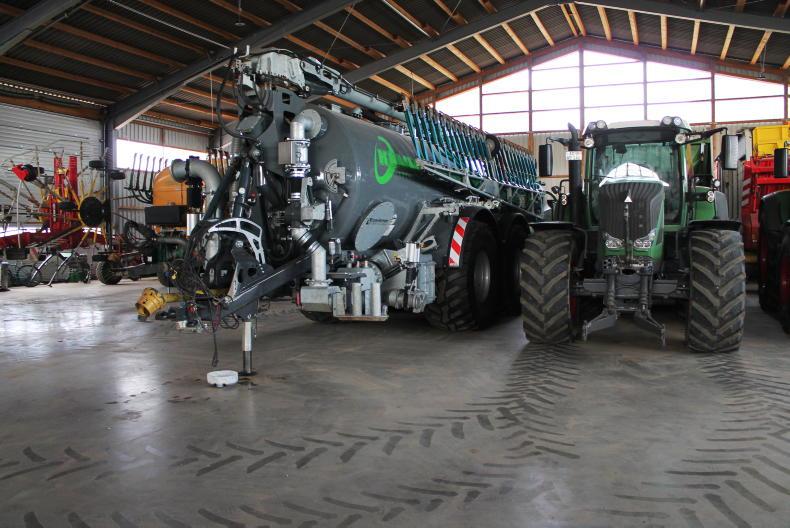
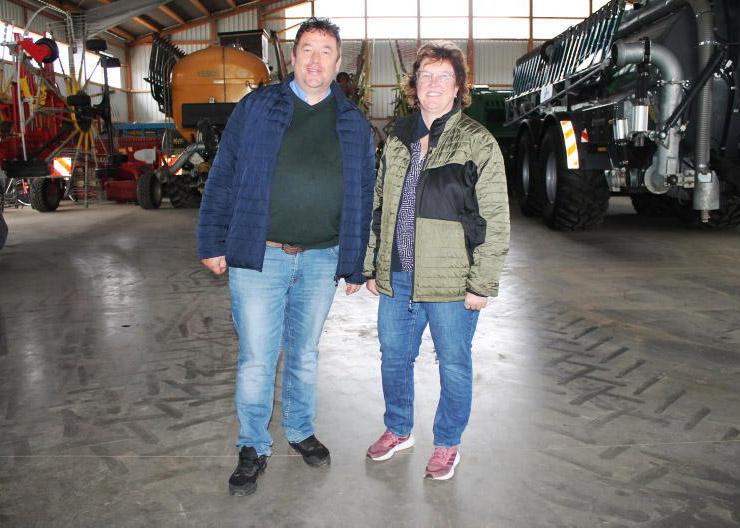
Inside the machinery shed at Christoph Luepschen’s farm in Lohmar, Germany. \ Claire McCormack
Biogas: ‘we can lay our power lines from our plant to customers’ meters’
On the biogas side, Christoph says while it was difficult to get the go-ahead for their plant design, his determination ultimately paid off.
“In Germany, there are two different types of biogas. One is sourced from renewable raw material—around 95% of biogas plants in Germany work like such—and the other is from food waste.
“We wanted to work only with food waste and waste from our farm.
“But in 2008 the big difference was the price for the electricity – for renewable biogas it was 23c/kWh, and for food waste it was 9.5c/kWh.
“We thought it was completely crazy because, for the future, we believed food waste was the more sensible option.
“We went ahead but also considered what decisions the government might make in the future and how to prepare for that.
“We are very fortunate to be located near a town, so we bought some ground to extend our land to reach it.
“Since 2024, a change in legislation makes it possible to no longer feed electricity surpluses into the public grid. Instead, we can lay our own power lines from our plant directly to our customers’ meters. This form of electricity supply is something completely new in Germany.
“It puts us in a good situation. We could get perhaps 20c/kWh, which would be a big fortune, 10c/kWh more, so this is our next goal for 2026,” he said, adding, “customers would still be safeguarded in case the biogas plant fails; then the electricity comes from the grid”.
Around 70 tonnes of solid material is supplied daily to the digester. The digestate is also used as high-quality liquid ammonia nitrogen on their land and neighbouring farms.
“For 16 years now, no mineral fertiliser has been applied here. The digestate works very well as a fertiliser, it is perfect.
“The nitrogen is highly and quickly available. We inject it directly to where the plants need fertilisation,” he said.
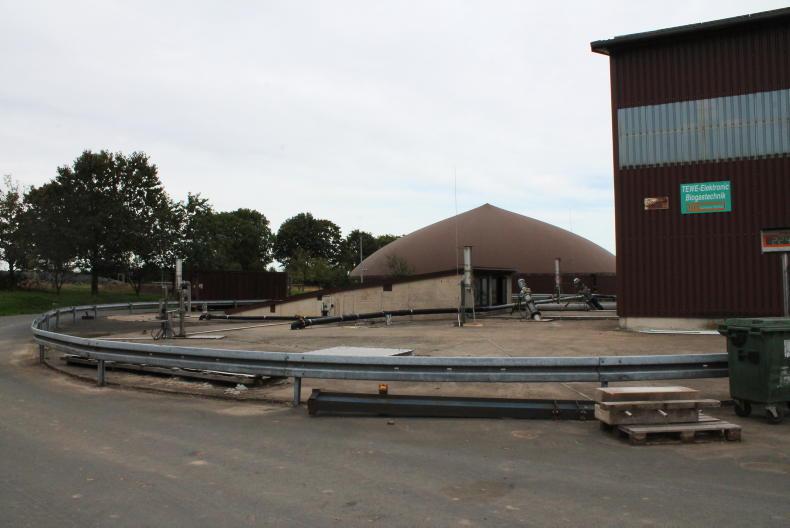
Biogas plant at the Luepschen farm in Lohmar, Germany. \ Claire McCormack
Results on breeding value available within a few days of testing
On the genomics side, which Christoph runs with his daughter Johanna, he says they use new methods to determine the breeding value of animals.
“We make it possible to predict the genetic potential of bull calves long before daughter performance data is available. While it used to take four years to determine breeding value through test bull deployment, it can now be done within 14 days.
“A genomic analysis can be carried out just one day after a calf’s birth. Results on breeding value – such as milk yield, fat and protein content, fitness, and longevity – are available within just a few days, making this procedure so valuable,” he said.
Looking ahead, Christoph says, “We must look at what the market needs, not what we think is best”.
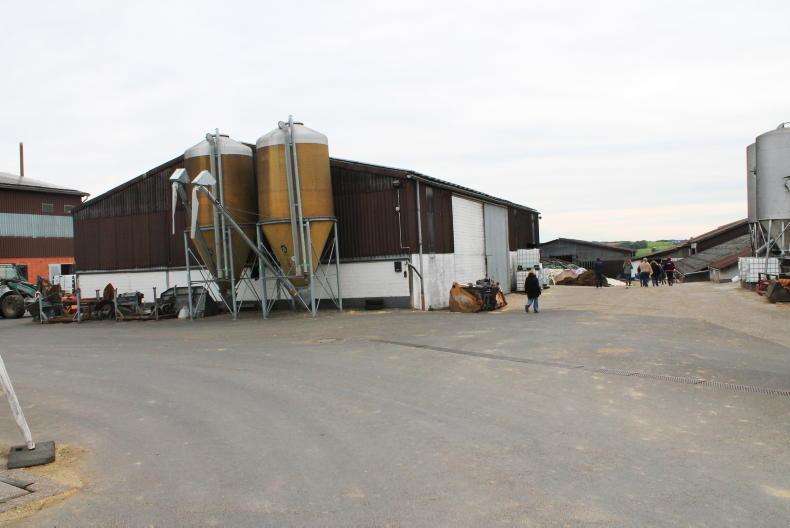
The farmyard of the Luepschen family in Lohmar, Germany. \ Claire McCormack
“Every European country has a different request. In Germany, it’s very interesting to breed polled animals without horns. In southern Europe it’s more and more important to breed slick animals with a different type of skin to be healthy in hot climates. Italy wants to breed for cheese production. So there is no one specific focus.
“We make a profit out of our breeding programme but it is not our first goal; it comes automatically. Our main goal is to produce sires for the EU industry.
“Our most valuable bull breed in the world today is Percival; his mother is housed here, and his grandmother. The semen is going around the world, and it is very successful as a sire.”
Despite many innovative achievements, Christoph appears to take most joy in knowing his children want to drive the farm forward.
“We are a family farm. I’ve worked on the farm for 30 years with my wife, and our children now all work in different positions on the farm.
“We are very proud of that because it means we didn’t do a lot wrong in the past – otherwise, they would not want to work with us here. They will find their own way in the world, but they still all want to continue to farm.”
Food production decisions in middle Europe will have consequences for the whole world, says pioneering German dairy farmer and biogas and breeding entrepreneur Christoph Luepschen.
Speaking to the Irish Farmers Journal during a visit to his farm with the European Network of Agricultural Journalists, the well-known producer shared his thoughts on the outlook for the sector.
“Last year was a good year for dairy farmers in Germany; therefore, we must say it was a good situation – not complain that it could have been better.
“I think in the future milk production can be successful in Middle Europe.
Focus
“Five years ago, governments all around middle Europe thought in different ways. We heard ‘cows are climate killers,’ ‘we are not good for animals,’ and ‘our production is going to South America with Mercosur’.
“But I think it’s more important now that the focus is on ensuring the people in Europe will always have enough to eat—no matter what decisions will be taken. The problem is that if we don’t produce it ourselves, with our standards, it will be produced in other parts of the world where we don’t have the influence on the standards – and we will buy it from there.
“So food production decisions in middle Europe will have consequences for the whole world, and the consequences will come back to us – it’s very important that governments and political people think about this.”
CAP
He hopes that, in the long term, European farmers become less reliant on CAP support as well.
“We received no funding from CAP to develop our farm. We got some public support to get hot water pipes for supplying the local village, but that is the only official support we received.
“Overall, we are very independent. That is one big problem in European agriculture; the sector is far too dependent on political decisions.
“When you are independent, it’s much easier to make your own decisions on how you want to move forward.”
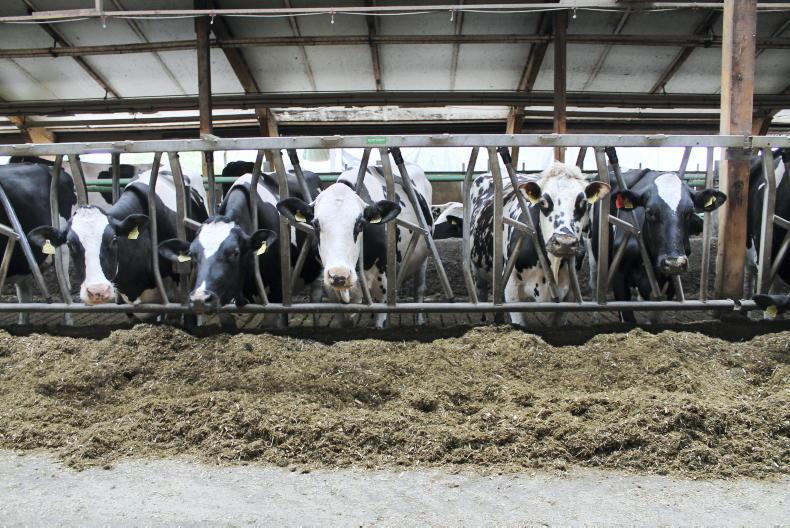
Dairy cows at the Luepschen farm in Lohmar, Germany. \ Claire McCormack
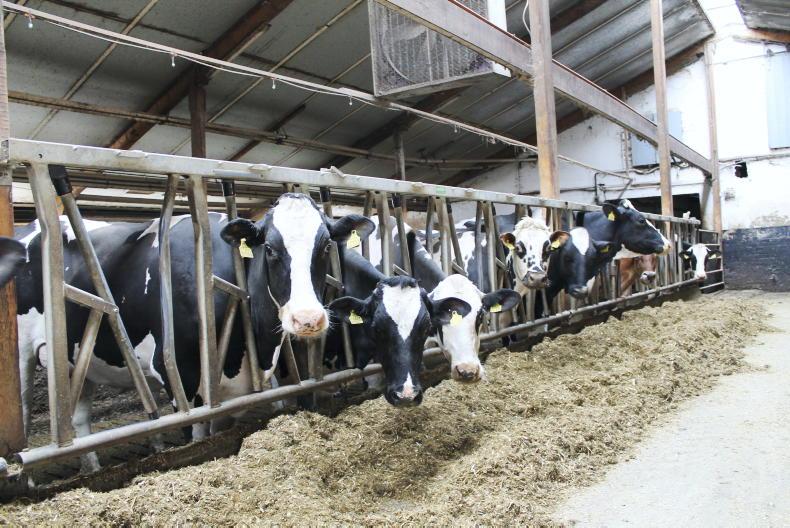
Dairy cows at the Luepschen farm in Lohmar, Germany. \ Claire McCormack
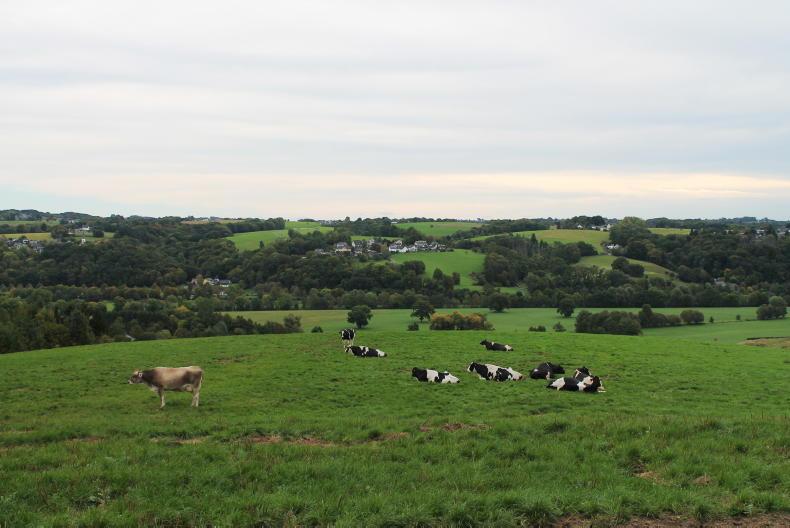
Dairy cows grazing on the rolling hills surrounding the Luepschen farm. \ Claire McCormack
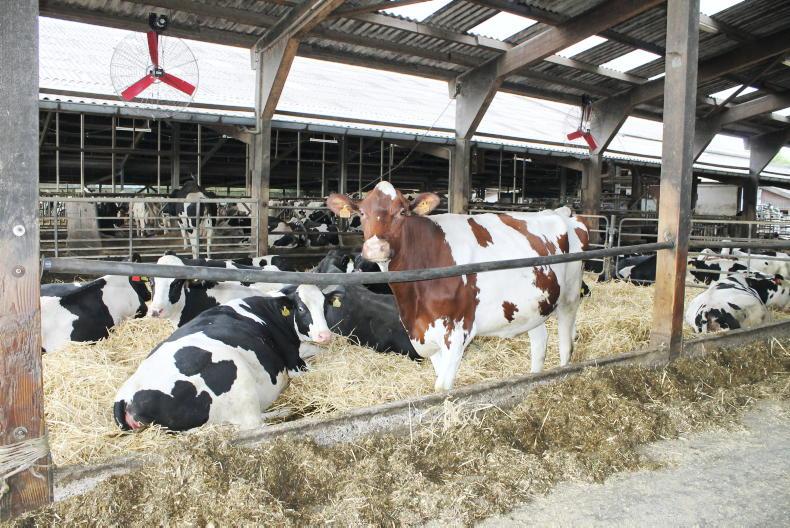
Cows in the shed on the Luepschen farm. \ Claire McCormack
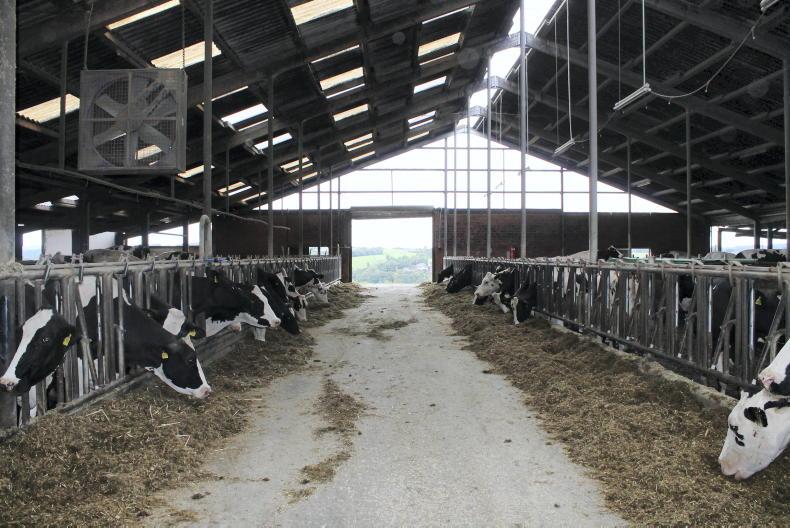
Cows in the shed on the Luepschen farm. \ Claire McCormack
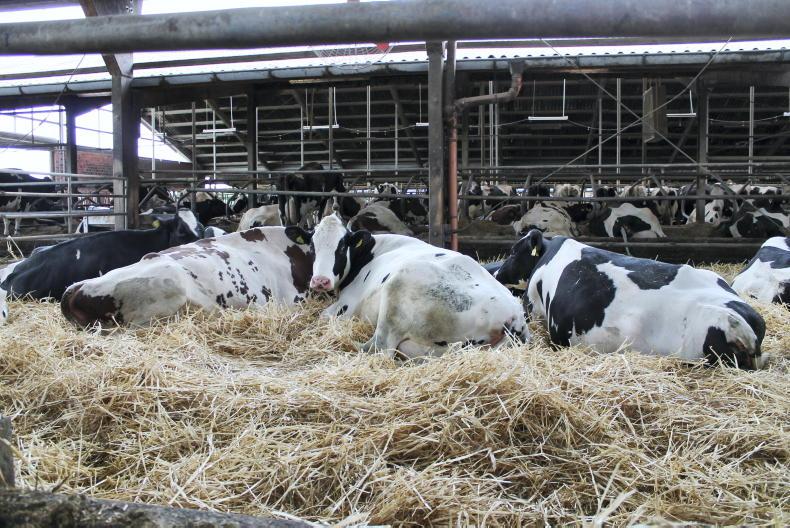
Cows in the shed on the Luepschen farm. \ Claire McCormack
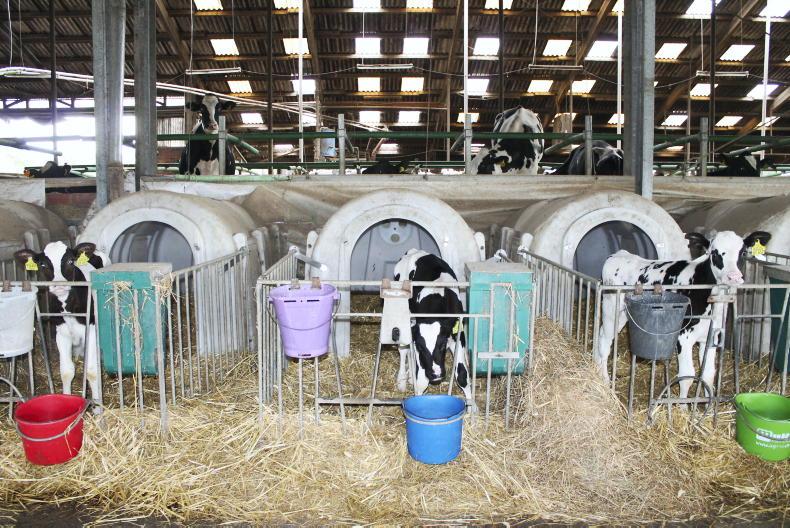
Calf housing unit at the Luepschen farm. \ Claire McCormack
German dairy farmer Christoph Luepschen doesn’t wait for change – he gets out ahead of it.
His innovative mindset was evident early on, when he invested in his first milking robot in 2001 – a decision that made his family’s holding in the hilly Bergisches Land region of North Rhine-Westphalia the second robot-equipped farm in the country at the time.
Then, in 2009, amid a volatile milk price market, the husband to Birgit and father to Christian (30), Johanna (28), and Stefanie (26), boldly invested in a €4m biogas plant that uses food waste, manure, slurry, and residues from food production to put their farm on a more secure financial footing.
His ambition didn’t stop there. In 2011, the Luepschen family became one of the first in Europe – and the first in Germany – to enter the genomic breeding market when they founded Colonia Cows (prefix: COL), further expanding the added value of their dairy farm.
Today, 240 Holstein dairy cows are milked with four robots at the seventh-generation farm, Schoepcherhof, near the town of Lohmar.
An additional 450 young cattle (bullocks and heifers), 20 breeding bulls, and calves are housed across three locations on the 294ha farm.
The farm is comprised of 193ha grassland, 60ha maize, 7ha arable, and 34ha forestry.
The family’s biogas plant produces 800 kilowatt-hours of electrical power and 900 kilowatt-hours of thermal power, supplying energy to 30 local businesses, a church, and a restaurant through a district heating network.
It also meets all the farm’s electricity needs and feeds surplus into the public grid.
Following a successful collaboration with Dutch company Genetics Consolidated, the Luepschen’s family has profitably traded breeding animals and embryos for the international market – initially in the US and later across Europe.
They became full owners of the business, Genesland, in 2022.
Speaking to the Irish Farmers Journal, during a visit to his holding with the European Network of Agricultural Journalists, Christoph reflected on the factors contributing to their entrepreneurial success and his family’s plans for the future.
“I took the farm over from my father-in-law 30 years ago. At that time, there were 60 cows, and it was a normal farm for this region. It was well farmed but it was traditional.
“In the first years we grew each year by five or 10 cows, and we tried to earn enough money to exist, but we were always looking for new opportunities.
“We started with the Merlin robot system 25 years ago because the manufacturer, Lemmer Fullwood, is based here in our town, and we came to a position to work together.
“In the beginning milking with robots was very difficult because they were not ready for normal farms.
“But we stayed with this type of robot, and today our system is very good, it’s easy, not a problem for our employees,” said Christoph, whose children run different divisions of the enterprise, alongside 15 outside labourers.
His cost of production is about 35c/L of milk. Average milk yield per cow per year is 11,456kg at 4.12% fat and 3.47% protein.
They currently supply DMK, Germany’s largest dairy cooperative, though Christoph intends to make a change this year.
“DMK is merging with Arla. That is not the way I want to continue because Arla wants farmers to share information on fertility and feed, which, to me, is a senseless request. So this year we will switch to a smaller processor,”
he said.
Most feed for the cows and young stock – corn silage and grass silage in winter – is grown on the farm, with some protein-rich ration sourced via by-product from a local plant-based milk company. The cows are housed in the barn, where an autonomous Aranom feeding robot is also in operation.
“They go one or two hours per day on the grass in summer, but we are in a very hilly region, and we get 1,200mm of rain per year, which is a lot, so having them mostly inside works much better for the robot system,” he said.
Inside the machinery shed at Christoph Luepschen’s farm in Lohmar, Germany. \ Claire McCormack
Biogas: ‘we can lay our power lines from our plant to customers’ meters’
On the biogas side, Christoph says while it was difficult to get the go-ahead for their plant design, his determination ultimately paid off.
“In Germany, there are two different types of biogas. One is sourced from renewable raw material—around 95% of biogas plants in Germany work like such—and the other is from food waste.
“We wanted to work only with food waste and waste from our farm.
“But in 2008 the big difference was the price for the electricity – for renewable biogas it was 23c/kWh, and for food waste it was 9.5c/kWh.
“We thought it was completely crazy because, for the future, we believed food waste was the more sensible option.
“We went ahead but also considered what decisions the government might make in the future and how to prepare for that.
“We are very fortunate to be located near a town, so we bought some ground to extend our land to reach it.
“Since 2024, a change in legislation makes it possible to no longer feed electricity surpluses into the public grid. Instead, we can lay our own power lines from our plant directly to our customers’ meters. This form of electricity supply is something completely new in Germany.
“It puts us in a good situation. We could get perhaps 20c/kWh, which would be a big fortune, 10c/kWh more, so this is our next goal for 2026,” he said, adding, “customers would still be safeguarded in case the biogas plant fails; then the electricity comes from the grid”.
Around 70 tonnes of solid material is supplied daily to the digester. The digestate is also used as high-quality liquid ammonia nitrogen on their land and neighbouring farms.
“For 16 years now, no mineral fertiliser has been applied here. The digestate works very well as a fertiliser, it is perfect.
“The nitrogen is highly and quickly available. We inject it directly to where the plants need fertilisation,” he said.
Biogas plant at the Luepschen farm in Lohmar, Germany. \ Claire McCormack
Results on breeding value available within a few days of testing
On the genomics side, which Christoph runs with his daughter Johanna, he says they use new methods to determine the breeding value of animals.
“We make it possible to predict the genetic potential of bull calves long before daughter performance data is available. While it used to take four years to determine breeding value through test bull deployment, it can now be done within 14 days.
“A genomic analysis can be carried out just one day after a calf’s birth. Results on breeding value – such as milk yield, fat and protein content, fitness, and longevity – are available within just a few days, making this procedure so valuable,” he said.
Looking ahead, Christoph says, “We must look at what the market needs, not what we think is best”.
The farmyard of the Luepschen family in Lohmar, Germany. \ Claire McCormack
“Every European country has a different request. In Germany, it’s very interesting to breed polled animals without horns. In southern Europe it’s more and more important to breed slick animals with a different type of skin to be healthy in hot climates. Italy wants to breed for cheese production. So there is no one specific focus.
“We make a profit out of our breeding programme but it is not our first goal; it comes automatically. Our main goal is to produce sires for the EU industry.
“Our most valuable bull breed in the world today is Percival; his mother is housed here, and his grandmother. The semen is going around the world, and it is very successful as a sire.”
Despite many innovative achievements, Christoph appears to take most joy in knowing his children want to drive the farm forward.
“We are a family farm. I’ve worked on the farm for 30 years with my wife, and our children now all work in different positions on the farm.
“We are very proud of that because it means we didn’t do a lot wrong in the past – otherwise, they would not want to work with us here. They will find their own way in the world, but they still all want to continue to farm.”
Food production decisions in middle Europe will have consequences for the whole world, says pioneering German dairy farmer and biogas and breeding entrepreneur Christoph Luepschen.
Speaking to the Irish Farmers Journal during a visit to his farm with the European Network of Agricultural Journalists, the well-known producer shared his thoughts on the outlook for the sector.
“Last year was a good year for dairy farmers in Germany; therefore, we must say it was a good situation – not complain that it could have been better.
“I think in the future milk production can be successful in Middle Europe.
Focus
“Five years ago, governments all around middle Europe thought in different ways. We heard ‘cows are climate killers,’ ‘we are not good for animals,’ and ‘our production is going to South America with Mercosur’.
“But I think it’s more important now that the focus is on ensuring the people in Europe will always have enough to eat—no matter what decisions will be taken. The problem is that if we don’t produce it ourselves, with our standards, it will be produced in other parts of the world where we don’t have the influence on the standards – and we will buy it from there.
“So food production decisions in middle Europe will have consequences for the whole world, and the consequences will come back to us – it’s very important that governments and political people think about this.”
CAP
He hopes that, in the long term, European farmers become less reliant on CAP support as well.
“We received no funding from CAP to develop our farm. We got some public support to get hot water pipes for supplying the local village, but that is the only official support we received.
“Overall, we are very independent. That is one big problem in European agriculture; the sector is far too dependent on political decisions.
“When you are independent, it’s much easier to make your own decisions on how you want to move forward.”
Dairy cows at the Luepschen farm in Lohmar, Germany. \ Claire McCormack
Dairy cows at the Luepschen farm in Lohmar, Germany. \ Claire McCormack
Dairy cows grazing on the rolling hills surrounding the Luepschen farm. \ Claire McCormack
Cows in the shed on the Luepschen farm. \ Claire McCormack
Cows in the shed on the Luepschen farm. \ Claire McCormack
Cows in the shed on the Luepschen farm. \ Claire McCormack
Calf housing unit at the Luepschen farm. \ Claire McCormack





SHARING OPTIONS