With development of anaerobic digestion (AD) beginning to take off in Ireland, the Irish Farmers Journal travelled to England to visit operational plants, and see what lessons could be learned. The trip was organised by Marches Biogas, which specialises in building a type of AD plant using semi plug-flow tank design.
Bagley Biogas
When we landed in Birmingham, we met Irish man Ger Walsh, who brought us to the plants. The longest visit of the day was to Bagley Biogas in Shropshire, where we met plant operators Oliver Kennerley and Rob Benson.
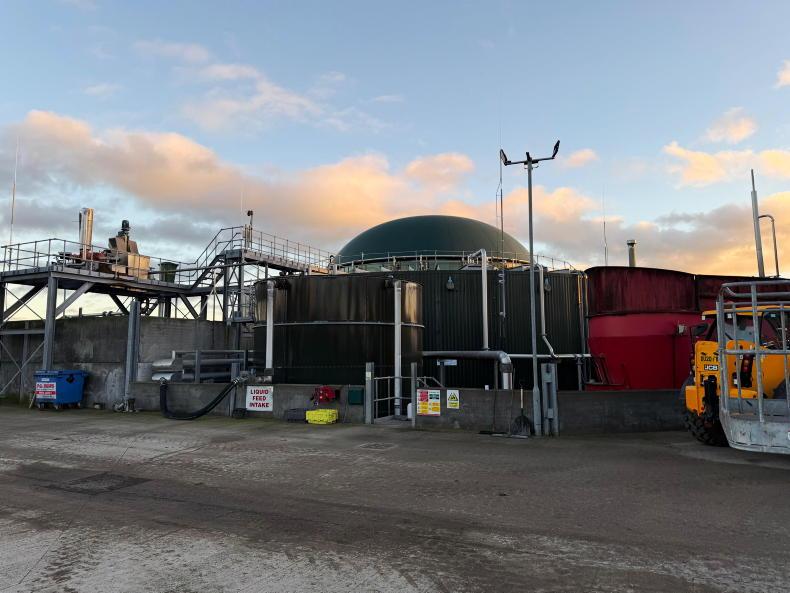
Bagley Biogas was established in 2014, originally designed as a 3,200m³ semi plug-flow digester producing 500kWh of electricity through combusting biogas in a combined heat and power (CHP) plant.
The plant is fed a mixture of chicken manure, maize silage, rye, and whey. Since the initial build, the plant has expanded substantially, adding a second 350kWh CHP unit.
The AD enterprise is a joint venture between two farming families, the Bensons and the Kennerleys, who operated pig and tillage farms prior to moving into AD. According to Oliver, diversification was essential for long-term viability.
Both CHPs are supported under long-term electricity support schemes, and the Renewable Heat Incentive (RHI) allows the business to receive payment for heat used on site, including within a digestate-drying operation.
These supports are central to the plant’s economics. For example, under the RHI, they get paid for 60% of heat used to heat the AD plant itself. The electricity support schemes run into the mid-2030s, while the RHI continues until 2030.

Oliver Kennerley and Rob Benson.

The plant is now drying and pelleting digestate.
Feedstock
The AD plant uses around 500 acres of maize and 165 acres of hybrid rye to meet this feedstock requirement, supplemented by chicken manure and whey permeate. They have spent years adjusting feedstock mixes and operating parameters, making small changes and observing their effects, he explained.
This incremental approach has allowed the plant to now operate at roughly twice its original design capacity. Both CHPs are running at essentially full output, and Oliver said that if they had additional generating capacity, they could produce an extra 50 m³ of biogas per hour.
Life after subsidies
Oliver explained that they are fully aware that the subsidy landscape will change, and much of the current development on site is aimed at preparing for a post-support environment. A major area of focus is the processing of digestate. The plant is now drying and pelleting digestate, not only the separated fibre, but the entire digestate stream. The dryer, originally designed for grass, has been adapted for digestate.
Liquid digestate, typically around 10% dry matter, is blended with dried material before entering the dryer, allowing it to be processed into a consistent dry pellet. The team is exploring markets including garden centres.
Alongside this, a heat-recovery and ammonia-capture system is under construction. Vapour from the dryer will be scrubbed and treated to produce a concentrated ammonia fertiliser. They estimate that between 180 and 200 tonnes of concentrated fertiliser could be recovered annually, potentially reducing reliance on imported fertiliser.

The pelletiser.

The plant is now drying and pelleting digestate
From farmers to engineers
When the plant was first constructed, Oliver said both him and John had no experience in AD.
Oliver described the early operational period as a steep learning curve. According to him, running an AD plant required a fundamental shift in working identity: “I wouldn’t really call myself a farmer anymore. We grow feedstock, yes, but that’s only part of the year. Every other day is spent running the AD plant. It’s very much a case of the more you put into it, the more you get out.”
Digestate continues to be land-spread in certain circumstances, particularly separated fibre on heavier soils. However, the business strategy is clearly moving towards higher-value digestate products to reduce reliance on land application. The current drying system has a throughput capacity of around 31m³ of digestate per day. Bagley Biogas is located far from any gas grid infrastructure, so gas-to-grid injection is not currently a viable option. Transport fuel may be considered in future, but for now the focus remains on digestate upgrading.

A mix of agricultural feedstocks are used.

The ammonia capture system.
Foxholes farm AD
Another visit was Foxholes Farm in Shropshire, operated by Guy Davies. The business runs several enterprises, including a broiler house where they are capable of housing 700,000 birds at any one time, 3,400 acres of arable land and an on-farm AD plant.
The AD manager, Marcus Goodall, provided an overview of the plant’s operation.
The AD facility exports 1.7 MWh of electricity. Its main feedstocks are maize silage, hybrid rye, grass silage, milk whey, slurry, and chicken manure. Chicken manure is incorporated because it is readily available on the farm, while the maize is produced on roughly 300 acres across owned, rented and contracted land. Whey is delivered daily from a local dairy processor.
Feeding
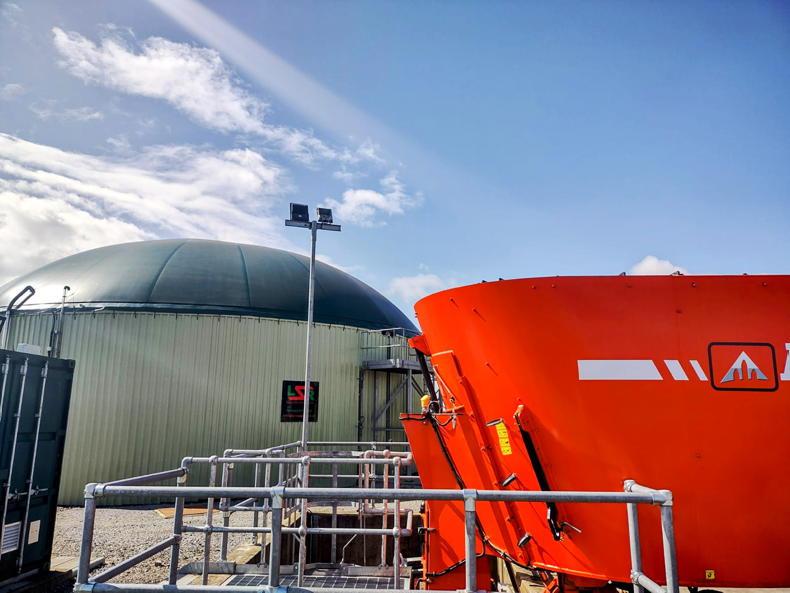
Solid feedstocks are prepared in a Trioliet Solomix feeder–mixer, which has a working capacity of approximately 35 tonnes.
The mixer uses three vertical augers to chop and mix the material before discharging it into a Vogelsang Quickmix unit, where it is combined with liquid digestate and further reduced in particle size to below 20mm.
This produces a slurry suitable for pumping to the digester. Feeding is automated and takes place on an hourly cycle.
Mixing within the digester is carried out without internal moving parts. Instead, the material is circulated using an external hydraulic pump, while a biogas bubble-mixing system provides additional agitation.
The most recently built tank incorporates external heating, with the digestate pumped through a heat exchanger and returned to the vessel at between 38°C and 40°C.

The AD manager at Foxholes Farm, Marcus Goodall.

Foxholes farm AD
Expansion
The AD plant was originally built as a 500kWh installation and later expanded to 1.7MWh by increasing feedstock throughput and adding a second digester. Heat from the site’s 500kWh and two 600kWh CHP engines is used on the farm, supplying a 50-60t/hr grain dryer, a woodchip drying operation, and heat for the poultry enterprise. The heat used from the plant is supported by the RHI.
Digestate
Digestate from the AD process is stored in a 15,000 m³ lagoon. Both solid and liquid fractions are applied to the farm’s own land.
Soil testing is carried out every three to four years to inform nutrient management. The farm uses an umbilical system with a dribble bar for application. A permanent network of underground 6-inch PVC pipework, totalling around six kilometres, connects the lagoon to application points across the farm. A pump at the lagoon pumps digestate through this system, allowing efficient spreading.

Whey permeate is used as a feedstock.

The digestate is separated.
Semi plug-flow
A semi plug-flow digester system operates quite differently from a conventional continuous stirred tank reactor (CSTR) used in anaerobic digestion. In this design, the digester consists of two tanks, in a ring-within-a-ring layout.
The outer ring, or tank, acts as primary digesters. Inside it, the inner ring is enclosed by a flexible membrane, which doubles as the plant’s biogas storage. Feedstock moves slowly through each ring, helping to ensure it stays in the tank for the target time, extracting as much gas as possible.
According to Ger Walsh of Marches, the semi plug-flow configuration can deliver up to a 30% increase in gas yields, although it is more expensive to build.
The author Stephen Robb is currently involved in a family/community proposal for an anaerobic digestion facility in Co Donegal.

The grain store.

A new tank was recently built.

Solid feedstocks are prepared in a Trioliet Solomix feeder–mixer.
With development of anaerobic digestion (AD) beginning to take off in Ireland, the Irish Farmers Journal travelled to England to visit operational plants, and see what lessons could be learned. The trip was organised by Marches Biogas, which specialises in building a type of AD plant using semi plug-flow tank design.
Bagley Biogas
When we landed in Birmingham, we met Irish man Ger Walsh, who brought us to the plants. The longest visit of the day was to Bagley Biogas in Shropshire, where we met plant operators Oliver Kennerley and Rob Benson.
Bagley Biogas was established in 2014, originally designed as a 3,200m³ semi plug-flow digester producing 500kWh of electricity through combusting biogas in a combined heat and power (CHP) plant.
The plant is fed a mixture of chicken manure, maize silage, rye, and whey. Since the initial build, the plant has expanded substantially, adding a second 350kWh CHP unit.
The AD enterprise is a joint venture between two farming families, the Bensons and the Kennerleys, who operated pig and tillage farms prior to moving into AD. According to Oliver, diversification was essential for long-term viability.
Both CHPs are supported under long-term electricity support schemes, and the Renewable Heat Incentive (RHI) allows the business to receive payment for heat used on site, including within a digestate-drying operation.
These supports are central to the plant’s economics. For example, under the RHI, they get paid for 60% of heat used to heat the AD plant itself. The electricity support schemes run into the mid-2030s, while the RHI continues until 2030.
Oliver Kennerley and Rob Benson.
The plant is now drying and pelleting digestate.
Feedstock
The AD plant uses around 500 acres of maize and 165 acres of hybrid rye to meet this feedstock requirement, supplemented by chicken manure and whey permeate. They have spent years adjusting feedstock mixes and operating parameters, making small changes and observing their effects, he explained.
This incremental approach has allowed the plant to now operate at roughly twice its original design capacity. Both CHPs are running at essentially full output, and Oliver said that if they had additional generating capacity, they could produce an extra 50 m³ of biogas per hour.
Life after subsidies
Oliver explained that they are fully aware that the subsidy landscape will change, and much of the current development on site is aimed at preparing for a post-support environment. A major area of focus is the processing of digestate. The plant is now drying and pelleting digestate, not only the separated fibre, but the entire digestate stream. The dryer, originally designed for grass, has been adapted for digestate.
Liquid digestate, typically around 10% dry matter, is blended with dried material before entering the dryer, allowing it to be processed into a consistent dry pellet. The team is exploring markets including garden centres.
Alongside this, a heat-recovery and ammonia-capture system is under construction. Vapour from the dryer will be scrubbed and treated to produce a concentrated ammonia fertiliser. They estimate that between 180 and 200 tonnes of concentrated fertiliser could be recovered annually, potentially reducing reliance on imported fertiliser.
The pelletiser.
The plant is now drying and pelleting digestate
From farmers to engineers
When the plant was first constructed, Oliver said both him and John had no experience in AD.
Oliver described the early operational period as a steep learning curve. According to him, running an AD plant required a fundamental shift in working identity: “I wouldn’t really call myself a farmer anymore. We grow feedstock, yes, but that’s only part of the year. Every other day is spent running the AD plant. It’s very much a case of the more you put into it, the more you get out.”
Digestate continues to be land-spread in certain circumstances, particularly separated fibre on heavier soils. However, the business strategy is clearly moving towards higher-value digestate products to reduce reliance on land application. The current drying system has a throughput capacity of around 31m³ of digestate per day. Bagley Biogas is located far from any gas grid infrastructure, so gas-to-grid injection is not currently a viable option. Transport fuel may be considered in future, but for now the focus remains on digestate upgrading.
A mix of agricultural feedstocks are used.
The ammonia capture system.
Foxholes farm AD
Another visit was Foxholes Farm in Shropshire, operated by Guy Davies. The business runs several enterprises, including a broiler house where they are capable of housing 700,000 birds at any one time, 3,400 acres of arable land and an on-farm AD plant.
The AD manager, Marcus Goodall, provided an overview of the plant’s operation.
The AD facility exports 1.7 MWh of electricity. Its main feedstocks are maize silage, hybrid rye, grass silage, milk whey, slurry, and chicken manure. Chicken manure is incorporated because it is readily available on the farm, while the maize is produced on roughly 300 acres across owned, rented and contracted land. Whey is delivered daily from a local dairy processor.
Feeding
Solid feedstocks are prepared in a Trioliet Solomix feeder–mixer, which has a working capacity of approximately 35 tonnes.
The mixer uses three vertical augers to chop and mix the material before discharging it into a Vogelsang Quickmix unit, where it is combined with liquid digestate and further reduced in particle size to below 20mm.
This produces a slurry suitable for pumping to the digester. Feeding is automated and takes place on an hourly cycle.
Mixing within the digester is carried out without internal moving parts. Instead, the material is circulated using an external hydraulic pump, while a biogas bubble-mixing system provides additional agitation.
The most recently built tank incorporates external heating, with the digestate pumped through a heat exchanger and returned to the vessel at between 38°C and 40°C.
The AD manager at Foxholes Farm, Marcus Goodall.
Foxholes farm AD
Expansion
The AD plant was originally built as a 500kWh installation and later expanded to 1.7MWh by increasing feedstock throughput and adding a second digester. Heat from the site’s 500kWh and two 600kWh CHP engines is used on the farm, supplying a 50-60t/hr grain dryer, a woodchip drying operation, and heat for the poultry enterprise. The heat used from the plant is supported by the RHI.
Digestate
Digestate from the AD process is stored in a 15,000 m³ lagoon. Both solid and liquid fractions are applied to the farm’s own land.
Soil testing is carried out every three to four years to inform nutrient management. The farm uses an umbilical system with a dribble bar for application. A permanent network of underground 6-inch PVC pipework, totalling around six kilometres, connects the lagoon to application points across the farm. A pump at the lagoon pumps digestate through this system, allowing efficient spreading.
Whey permeate is used as a feedstock.
The digestate is separated.
Semi plug-flow
A semi plug-flow digester system operates quite differently from a conventional continuous stirred tank reactor (CSTR) used in anaerobic digestion. In this design, the digester consists of two tanks, in a ring-within-a-ring layout.
The outer ring, or tank, acts as primary digesters. Inside it, the inner ring is enclosed by a flexible membrane, which doubles as the plant’s biogas storage. Feedstock moves slowly through each ring, helping to ensure it stays in the tank for the target time, extracting as much gas as possible.
According to Ger Walsh of Marches, the semi plug-flow configuration can deliver up to a 30% increase in gas yields, although it is more expensive to build.
The author Stephen Robb is currently involved in a family/community proposal for an anaerobic digestion facility in Co Donegal.
The grain store.
A new tank was recently built.
Solid feedstocks are prepared in a Trioliet Solomix feeder–mixer.






SHARING OPTIONS