


Spring has sprung. We're busy in the fields, and this is going to be a shortish long read, but four quick observations - one for each of the four seasons we are having most March days.
1- Battling a beetle and its larval worm
The law of unintended consequences is one of the more immutable truths of farming. It's like whack a mole most days, you fix one problem and another immediately emerges.
We've had to adjust our min-till system this year, for the most unexpected of reasons. We've been practicing min-till (non-inversion ground preparation) on our farm for five years now. It suits part-time farmers, as it's quicker than ploughing.
It's a measure in the Agri-Climate Rural Environment Scheme (ACRES), in which I am a participant. It's seen as more sustainable than ploughing, as it burns less diesel and releases fewer emissions from the soil.
It also is seen as promoting organic activity in the soil.
We are also sowing cover crops on most of our fields, for mostly the same reasons. We have been carrying out a third sustainable practice - not using insecticides on our crops - for a decade now.
Spraying aphicides kills the pest, but also affects the aphid predators, such as ladybirds. We have opted to encourage the predator and let nature control aphid numbers.
But Houston, we have a problem.
We are lucky enough to have a neighbor who grows potatoes and cabbage. And we rotate those crops through our land.
It is a good rotational practice and, to be frank, renting land for such crops has been paying better than growing cereals over the last three years.
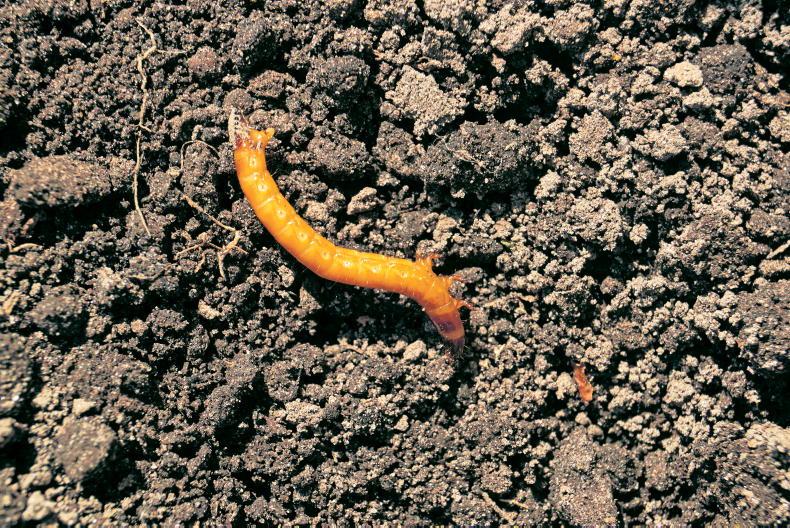
But last year, one field saw fairly significant losses due to wireworm. This is the larval stage of the click-beetle and the little wireworm loves spuds as much as the Two Johnnies do.
It has emerged that all these sustainable practices I've been doing have helped to create our wireworm problem.
The lack of inversion ploughing reduces the amount of soil being turned over that brings light, air and predators after the wireworm and the clickbeetle.
I don't know whether Eric Cantona was correct about the seagulls following the trawler, but they certainly form an airborne flotilla behind any plough I've ever seen at work.
The wireworm feeds on the cover crops we grow and while they are remarkably resilient to any insecticide left on the market, the clickbeetle would be susceptible to insecticides if we were using them.
I haven't reached that point yet, but we are ploughing fields earmarked for potatoes next year, as we try to combat the law of unintended consequences.
2 - The armchair farmer was a creation of Frankenstein Fischler
Our front page story this week had Amy Forde reporting how senior officials in the European Commission are wringing their hands over how to prioritise the active farmer over the armchair landowner.
Every farmer, to quote Francie Gorman once again, "calving the cow, lambing the ewe and growing the crop" will agree with the sentiment.
It has to be said, though, that the armchair farmer is a monster that the Commission itself created.
It was they who allowed entitlements to be rented with or without land, leased with land or sold. That was putting power into the hands of people who generated entitlements.
It also effectively guaranteed that new entrant farmers (as opposed to farmers who entered through inheritance of land and entitlements) and developing farmers, particularly those working from a smaller starting point, would be forced to pay for entitlements as well as land in order to gain a place at farming's casino table.
The Commission is trying to fix a problem that never would have existed had they adopted a genuine use-it or lose-it system for entitlements in 2004. That would have generated a constant flow of entitlements into the national reserve to be allocated to emerging farmers.
This is not 20/20 hindsight on my part. I was a young farmer during the reference years and argued then that entitlements should not lead to entitlement for those farmers who generated them.
The coupled schemes they had participated in to generate the entitlements in the first place could not be traded - everyone started from scratch every year.
3 - The solution to armchair farmers is obvious
At the risk of labouring the point, there's no big mystery as to how the CAP can prioritise active farmers - simply recouple the payments.
I know I said this only two weeks ago in this very column, but it needs to be repeated until the message gets through to those in power.
It has to be remembered that the current decoupled payment system has actually lasted much longer than the coupled payment system that preceded it.
The MacSharry CAP reform that introduced coupled payments only took effect in 1992. Only 10 years later, Franz Fischler abandoned that system, under pressure from the WTO, to ensure that EU farm supports could not be accused of being trade distorting.
It isn't hard to argue that recoupling payments is now necessary to prevent the total erosion of Europe's suckler herds and sheep flocks.
Last week brought the latest evidence of a decline in Irish cattle numbers that seems inexorable under the current system - a 4% drop in cattle numbers from June 2024 to June 2025. I rest my case. For now.
4 - Heydon boxing clever
One of the biggest mistakes a politician can make is to over-commit and under-deliver. It's a lesson that Martin Heydon seems to have absorbed in his relatively short time at the helm of the Department of Agriculture.
A couple of tillage farmers this week have said to me that they got more than they expected from the National Tillage Sustainability Support payment that landed in their accounts (and mine) in recent days.
When the €29.1m package was announced, farmers were underwhelmed. After all, it was only half the €60m promised in the pre-election manifestos of both government parties.
When the Minister announced that the payments would be degressive (farmers with higher hectarage being paid less after a certain number of hectares), farmers expected to get less from this payment than the similar flat-rate per hectare payment made for the 2024 harvest.
The farmers I encountered were pleasantly surprised to discover that they actually were receiving a little more than last year and they were on fairly high hectarage.
Minister Heydon has effectively over-delivered, having under-committed when the funding was first announced. Clever.




SHARING OPTIONS