


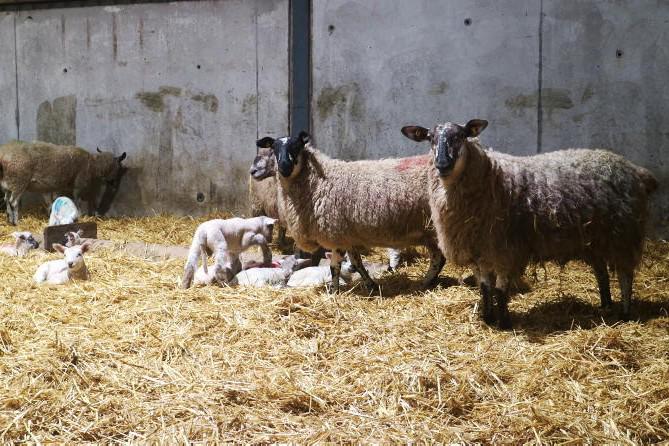
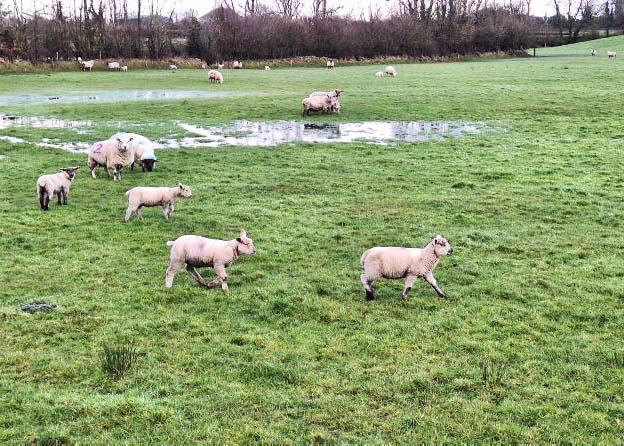
Earlier lambing: weather remains hugely challenging, with many earlier lambing flocks in the southeast receiving huge volumes of rainfall in the last two weeks.
This is presenting challenges in getting ewes and lambs turned outdoors. Where turnout is delayed for a few days, then continuing pre-lambing feeding levels will generally be sufficient.
However, if feeding is delayed beyond this then concentrate supplementation needs to be stepped up to ensure performance is not compromised. Ewes in good body condition and suckling two lambs with access to good-quality forage will require in the region of 1.5kg concentrates daily, and 0.3kg to 0.5kg higher if ewes are lacking flesh.
Where forage quality is poor then it will only act as a roughage source with ewes practically requiring ad-lib feeding, rising to upwards of 2.5kg daily. This increases the urgency of getting ewes turned out where possible. Teagasc advice where feeding a high concentrate diet is a recommended crude fibre content of at least 7%.
Pressure on space will be the other challenge. The space requirement of 1.2m2 to 1.4m2 for a 70kg to 80kg liveweight ewe needs to increase by 0.3m2 for each additional lamb. Feeding space is also critical, with 500mm to 600mm of trough space recommended for large-framed lowland ewes.
Fresh straw will be required more frequently, with higher intake in turn increasing urinating and defecating frequency. Applying lime periodically before replenishing straw in high traffic areas or around water troughs will help to keep disease from establishing.
When turning out ewes and lambs, have tasks such as applying rubber rings completed in advance of turnout.
Turning animals out earlier in the day to dry sheltered paddocks in smaller numbers initially may also help. There is merit in supplementing ewes at a rate of 0.8kg to 1kg for twin-suckling ewes, with the boost in dry matter boosting milk yield which, in turn, will benefit lambs. A low level of 0.3kg to 0.5kg concentrates may be beneficial for single-suckling ewes, depending on ground conditions and grass supplies.
Clean livestock policy: factory procurement agents are again reporting a spike in challenges in drafting sheep in a suitable manner for slaughter. They continue to encourage farmers where at all possible to present sheep dry, as this can be the difference between sheep classified as category C and rejected for slaughter to being classified as category B, with some remedial attention possible on the line.
Where fleeces are in any way wet or damp, then it is even more important to have sheep fasted pre-transport to reduce fleece soiling. Applying an absorbent material, such as sawdust or wood shavings, on the floor of trailers is also highly beneficial.
Organic feeds: reports indicate big variation remains in the quality of organic concentrates on the market.
This is not unique to organic producers with similar issues in conventional feeds. Where at all possible try and investigate the main ingredients – these should be high-energy feeds such as barley, wheat, maize, oats and low-energy ingredients should be well down the inclusion list.
There are also good opportunities to tie in with Irish producers of organic feeds, with many specialising in delivering feeds to a wide geographical location. The organic trading hub is a good resource for organic sourcing and trading such feeds, and you can find them at organictradinghub.ie.



SHARING OPTIONS