A field population of rye brome (Bromus secalinus L) has been confirmed as the first brome species in Ireland resistant to ALS herbicides normally used to control bromes in winter wheat.
While sterile brome remains the most widespread grass weed in cereal crops, the incidence of other brome types (rye, soft or meadow) has increased in recent years.
This suspect population, received for resistance testing in 2025, came from a non-plough-established winter wheat field in Co Wicklow.
It was initially misidentified as soft brome at submission, but examination of the characteristic V-shaped seed cross-sections confirmed it as rye brome.
Plants at the two- to four-leaf stage were sprayed with the ALS herbicide Pacifica Plus at three dose rates: 0.5x, 1x and 1.5x the recommended label rate (1x = 500 g/ha) (Figure 1).
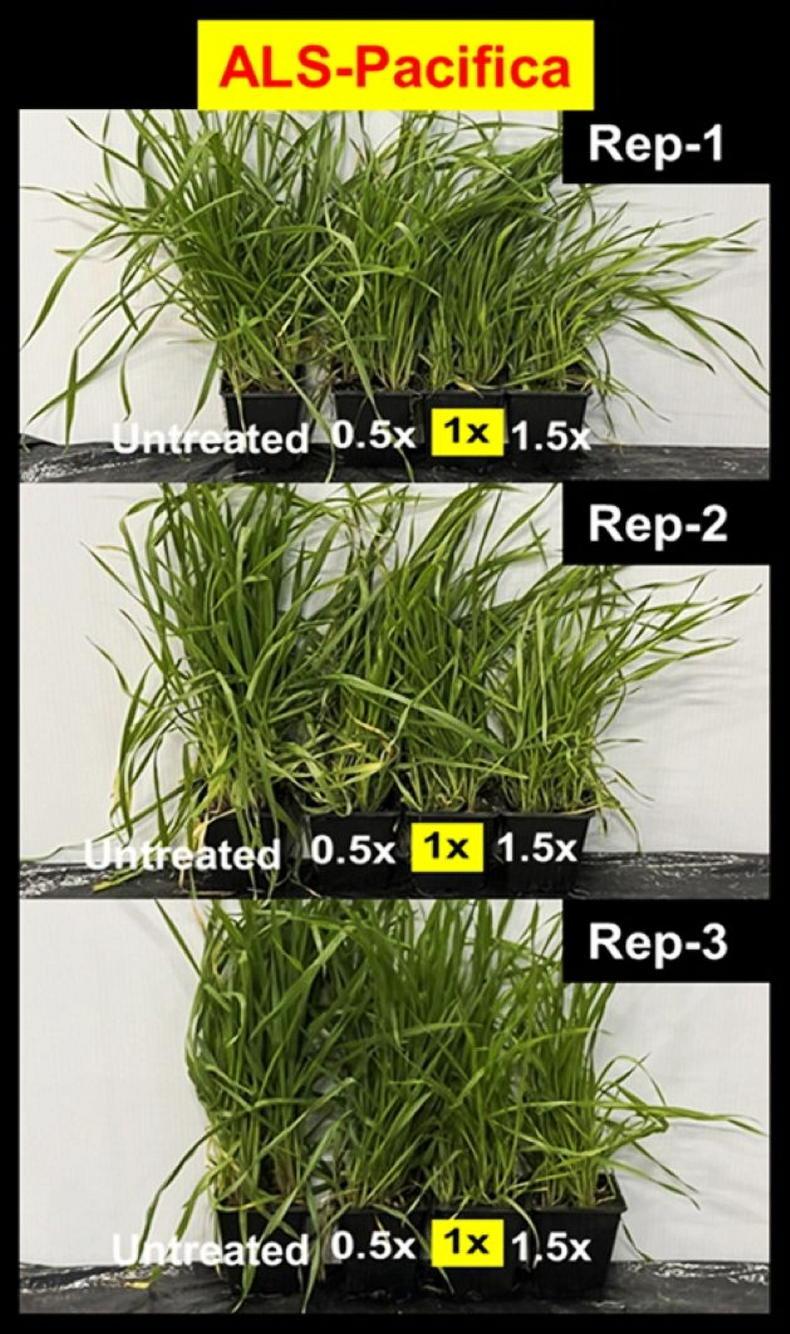
Figure 1: Response of a resistance-suspect rye brome population following application of the ALS herbicide Pacifica Plus at three dose rates: 0.5x, 1x (in yellow) and 1.5x the recommended label rate (where 1x = 500 g/ha). Each dose rate was tested in three replicates (Rep).
Pacifica Plus was virtually ineffective at all rates. Genetic analysis identified a rare Asp-376 mutation, which is associated with ALS resistance and has previously been detected in some ALS-resistant Italian ryegrass populations.
Nevertheless, the rye brome population was fully controlled by the ACCase graminicide herbicides Falcon and Stratos Ultra when applied at the recommended label rates.
Prior to this finding, no fully resistant brome populations had been detected, although reduced herbicide rates have been shown to cause widespread tolerance in brome species.
Weed resistance is becoming an increasing challenge in Irish tillage, with 10 species now confirmed as resistant: six grasses (blackgrass, Italian ryegrass, wild oats, annual meadow grass, rough-stalked meadow grass, and rye brome) and four broad-leaved weeds (common poppy, common chickweed, corn marigold, and common field-speedwell).
Ongoing regulatory changes are expected to put further pressure on post-emergence herbicides, increasing the risk of resistance.
This makes continued resistance monitoring and accurate species identification essential.
At the same time, there is an urgent need to develop robust integrated weed management practices to reduce reliance on herbicides and slow the spread of resistant weeds.
A field population of rye brome (Bromus secalinus L) has been confirmed as the first brome species in Ireland resistant to ALS herbicides normally used to control bromes in winter wheat.
While sterile brome remains the most widespread grass weed in cereal crops, the incidence of other brome types (rye, soft or meadow) has increased in recent years.
This suspect population, received for resistance testing in 2025, came from a non-plough-established winter wheat field in Co Wicklow.
It was initially misidentified as soft brome at submission, but examination of the characteristic V-shaped seed cross-sections confirmed it as rye brome.
Plants at the two- to four-leaf stage were sprayed with the ALS herbicide Pacifica Plus at three dose rates: 0.5x, 1x and 1.5x the recommended label rate (1x = 500 g/ha) (Figure 1).
Figure 1: Response of a resistance-suspect rye brome population following application of the ALS herbicide Pacifica Plus at three dose rates: 0.5x, 1x (in yellow) and 1.5x the recommended label rate (where 1x = 500 g/ha). Each dose rate was tested in three replicates (Rep).
Pacifica Plus was virtually ineffective at all rates. Genetic analysis identified a rare Asp-376 mutation, which is associated with ALS resistance and has previously been detected in some ALS-resistant Italian ryegrass populations.
Nevertheless, the rye brome population was fully controlled by the ACCase graminicide herbicides Falcon and Stratos Ultra when applied at the recommended label rates.
Prior to this finding, no fully resistant brome populations had been detected, although reduced herbicide rates have been shown to cause widespread tolerance in brome species.
Weed resistance is becoming an increasing challenge in Irish tillage, with 10 species now confirmed as resistant: six grasses (blackgrass, Italian ryegrass, wild oats, annual meadow grass, rough-stalked meadow grass, and rye brome) and four broad-leaved weeds (common poppy, common chickweed, corn marigold, and common field-speedwell).
Ongoing regulatory changes are expected to put further pressure on post-emergence herbicides, increasing the risk of resistance.
This makes continued resistance monitoring and accurate species identification essential.
At the same time, there is an urgent need to develop robust integrated weed management practices to reduce reliance on herbicides and slow the spread of resistant weeds.






SHARING OPTIONS