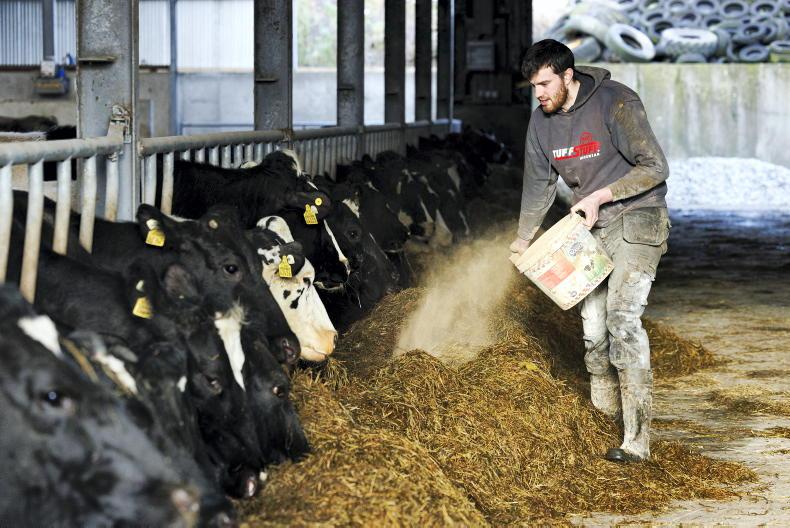
Minerals: At this time of year farmers will be looking at purchasing dry cow minerals for the dry period. The general advice is to feed dry cow minerals to cows for six weeks prior to calving, meaning cows calving in early February will need to be fed dry cow minerals from mid-December. The feed rate for most minerals is 120g per cow per day.
There is a big difference in price between minerals, which is largely down to the specification. The labels are difficult to follow, but there are some key ingredients that farmers should be aware of.
The first is the phosphorus levels, with cheaper minerals having low levels of phosphorus inclusion. The target is to have 4% to 5% phosphorus level in the dry cow mineral. Magnesium is another big one, with the higher inclusion of magnesium the better, in my view.
Many farmers need to supplement with extra magnesium pre-calving to prevent milk fever after calving. There should be 20% or more magnesium in the mineral. Vitamin D is also important to prevent milk fever, and this should be present at a rate of at least 120,000 units per kg. The other key thing is to ensure that where feed face is tight, cows are fed minerals morning and evening to ensure all cows get their allocation.
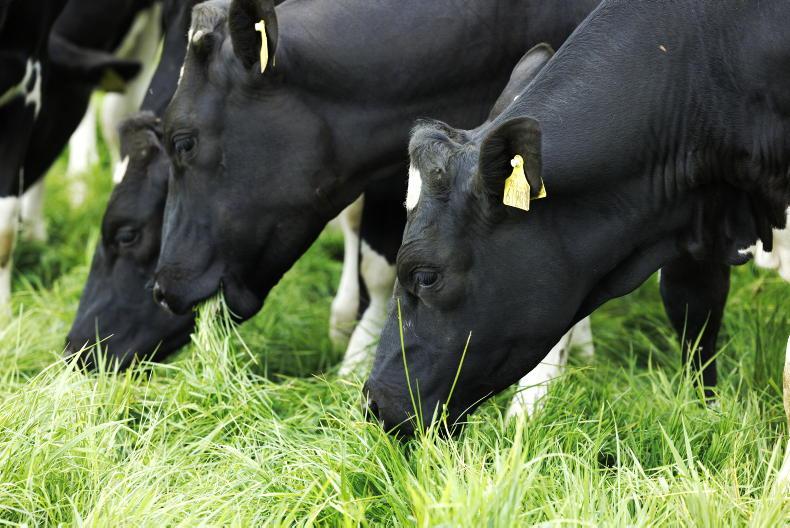
Covers: Almost 30% of farmers that measure grass have too little grass on farms right now. That’s based on Teagasc PastureBase data, and it indicates that grazing went on for too long on many farms and consequently there will not be enough grass next spring. Driving around the country, there are still a good few herds out grazing and despite the recent rain, ground conditions are holding up well.
For me, it doesn’t make sense to be grazing into late November if it means there won’t be enough grass on the farm in late March or early April. Putting in poor quality feed at that time of year is seriously damaging to cow performance.
Anyone grazing now needs to ensure they don’t fall into that trap. All farmers should be doing a closing cover now and updating the spring grass budget. There’s not a lot that can be done to increase grass supply between now and spring, but not continuing to graze will be a good starting point.
Milk price: After another month of severe milk price cuts, the outlook for the rest of the year and for next spring is looking bleak.
While prices are still numerically higher than they were in say the low milk price years of 2009 or 2013, the reality is that costs of production have increased enormously since then. This means that the impact on farm profit will be as severe, if not worse even though milk price is still considered high. The question is, how many of these costs can be stripped back now that milk price is low?
It’s not easy to address that, given labour costs, contractor costs and repairs and maintenance costs are all high and largely outside of farmers control, at least in the short term.
How much feed, fertiliser, vet and parlour consumables to use is more in farmers’ control. Whatever happens, using less bought in of everything and utilising more grass will play a big part in reducing costs.
Minerals: At this time of year farmers will be looking at purchasing dry cow minerals for the dry period. The general advice is to feed dry cow minerals to cows for six weeks prior to calving, meaning cows calving in early February will need to be fed dry cow minerals from mid-December. The feed rate for most minerals is 120g per cow per day.
There is a big difference in price between minerals, which is largely down to the specification. The labels are difficult to follow, but there are some key ingredients that farmers should be aware of.
The first is the phosphorus levels, with cheaper minerals having low levels of phosphorus inclusion. The target is to have 4% to 5% phosphorus level in the dry cow mineral. Magnesium is another big one, with the higher inclusion of magnesium the better, in my view.
Many farmers need to supplement with extra magnesium pre-calving to prevent milk fever after calving. There should be 20% or more magnesium in the mineral. Vitamin D is also important to prevent milk fever, and this should be present at a rate of at least 120,000 units per kg. The other key thing is to ensure that where feed face is tight, cows are fed minerals morning and evening to ensure all cows get their allocation.
Covers: Almost 30% of farmers that measure grass have too little grass on farms right now. That’s based on Teagasc PastureBase data, and it indicates that grazing went on for too long on many farms and consequently there will not be enough grass next spring. Driving around the country, there are still a good few herds out grazing and despite the recent rain, ground conditions are holding up well.
For me, it doesn’t make sense to be grazing into late November if it means there won’t be enough grass on the farm in late March or early April. Putting in poor quality feed at that time of year is seriously damaging to cow performance.
Anyone grazing now needs to ensure they don’t fall into that trap. All farmers should be doing a closing cover now and updating the spring grass budget. There’s not a lot that can be done to increase grass supply between now and spring, but not continuing to graze will be a good starting point.
Milk price: After another month of severe milk price cuts, the outlook for the rest of the year and for next spring is looking bleak.
While prices are still numerically higher than they were in say the low milk price years of 2009 or 2013, the reality is that costs of production have increased enormously since then. This means that the impact on farm profit will be as severe, if not worse even though milk price is still considered high. The question is, how many of these costs can be stripped back now that milk price is low?
It’s not easy to address that, given labour costs, contractor costs and repairs and maintenance costs are all high and largely outside of farmers control, at least in the short term.
How much feed, fertiliser, vet and parlour consumables to use is more in farmers’ control. Whatever happens, using less bought in of everything and utilising more grass will play a big part in reducing costs.







SHARING OPTIONS